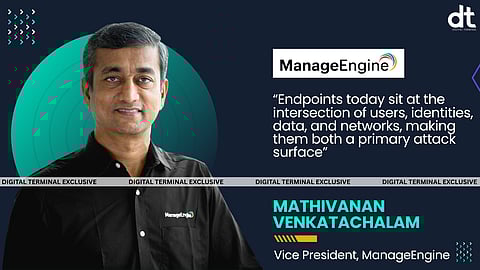

As enterprises operate across hybrid work, cloud, mobile, and connected environments, endpoint security has become central to cyber resilience. Organizations now need proactive, AI-driven protection that integrates identity, access, and network controls while reducing alert fatigue and response delays. In this exclusive conversation, Rajeev Ranjan, Editor, Digital Terminal speaks with Mathivanan Venkatachalam, Vice President, ManageEngine, about Zero Trust, EDR gaps, and autonomous cybersecurity outcomes.
Rajeev: With endpoints now spanning laptops, mobile devices, IoT, and cloud workloads, how should enterprises rethink endpoint security as a strategic layer rather than just an operational function?
Mathivanan: Endpoints today sit at the intersection of users, identities, data, and networks, making them both a primary attack surface and a key transit point during cyberattacks. This positions them as a critical control layer for detecting and stopping lateral movement.
To treat endpoint security as a strategic layer, enterprises must move beyond siloed, point-in-time controls to a continuous, context-aware model that works in tandem with identity and network security as part of a broader defense-in-depth approach.
This approach aligns with zero trust principles, where access decisions are not based on implicit or static trust but on real-time assessment of device posture. Endpoint security, therefore, can no longer be a one-time configuration exercise. Devices drift over time due to missing patches, misconfigurations, or emerging threats. Device posture must be continuously assessed and enforced to ensure only secure, compliant devices can access enterprise resources, limiting lateral movement and containing threats.
Equally important is closing the loop after an incident. When a breach occurs, organisations must address the root cause, whether it is a missing patch, misconfiguration, or excessive privilege, to prevent recurrence. This creates a continuous feedback mechanism that strengthens the overall security posture over time.
Rajeev: Many organizations have invested in EDR, yet breaches still occur. Where do you see the current gaps in EDR effectiveness, and how can AI truly close those gaps beyond just faster alerts?
Mathivanan: Persistent breaches highlight that EDR, while essential, does not constitute a complete security model. While it is a critical real-time detection and response layer, overall effectiveness depends on proactive controls such as vulnerability remediation, misconfiguration management, and privilege governance. Without these, EDR is often left addressing threats that could have been prevented earlier.
For example, a misconfigured setting, such as a disabled security control, may remain undetected. In a proactive model, this would be identified and fixed early. Without it, attackers exploit the gap, leaving EDR to respond after compromise attempts begin. This keeps security teams in a reactive loop, chasing alerts while the underlying attack surface remains exposed.
The challenge is amplified by modern threats that are faster, stealthier, and increasingly AI-driven, often using malware-free, living-off-the-land techniques that evade traditional detection. This significantly increases both the volume and speed of alerts, overwhelming manual triage processes.
AI can help bridge these gaps, but its real value goes beyond faster alerts. It enhances context, improves detection accuracy, and drives action by correlating device behaviour, user context, and system activity, enabling high-confidence, low-risk responses to be executed autonomously within defined guardrails.
Over time, this enables a shift toward autonomous hygiene and response, closing gaps before exploitation and allowing real-time containment and remediation with minimal human intervention. As confidence, explainability, and risk controls mature, this autonomy can expand further.
This creates a continuous feedback loop where every detected threat strengthens preventive controls, reducing alert volumes, shrinking the attack surface, and shifting security from reactive triage to a prevention-first approach.
Rajeev: Security teams often struggle with alert fatigue and limited resources. How does autonomous endpoint security help reduce human dependency while still maintaining control and accountability?
Mathivanan: Alert fatigue and resource constraints stem largely from a detection-heavy approach that relies on constant human intervention. Autonomous endpoint security addresses this by shifting to a prevention-first model by stopping threats before they execute rather than reacting after the fact.
AI-driven systems reduce hundreds of low-level alerts into a smaller set of prioritised, actionable incidents, significantly cutting noise. At the core is automated triage: instead of analysts manually correlating events, the system reconstructs activity, validates it against behavioural patterns, assesses risk, and enriches context in real time. This improves detection quality while allowing teams to focus on genuine threats. In parallel, low-risk, high-confidence actions such as isolating endpoints or blocking suspicious processes can be executed autonomously, reducing human dependency.
Autonomy also extends to vulnerability management, where remediation is prioritised based on risk through AI-driven correlation of threat and exposure signals, avoiding misaligned efforts.
Importantly, reduced human involvement does not mean reduced control. Given the risk of false positives and potential business disruption, organisations must define clear guardrails for automation. CISOs determine which actions can run autonomously and where human approval is required, ensuring accountability remains intact while freeing teams to focus on high-impact, judgment-driven decisions.
For autonomous response to be trusted, every action must be explainable and auditable. Clear audit trails are essential to show why decisions were made, ensuring transparency and alignment with regulatory expectations such as RBI guidelines, SEBI regulations, and the Digital Personal Data Protection (DPDP) Act, all of which emphasise accountability and traceability.
Rajeev: In real-world enterprise environments, how challenging is it to integrate endpoint security with identity, access, and network layers to enable a truly unified security posture?
Mathivanan: Achieving a unified security posture requires organisations to break down silos and bring together visibility across endpoint, identity, access, and network layers, thereby shifting from passive monitoring to real-time containment and remediation.
In practice, this integration is complex. Each security layer generates telemetry in its own “language”, from endpoint IDs and MAC addresses to user principal names (UPNs). Without automated correlation, security teams are forced into manual validation, increasing mean time to respond (MTTR) and extending threat dwell time.
The challenge is further compounded by fragile integrations that can break with vendor updates, as well as the absence of widely adopted data standards. While frameworks such as the Open Cybersecurity Schema Framework are emerging to address this interoperability gap, most enterprises still operate with siloed insights that limit consistent, cross-layer decision-making.
Ultimately, the shift is from layer-specific security to contextual security, where user identity, device posture, and network behaviour are evaluated together to enable a single, high-confidence decision.
Rajeev: As Zero Trust matures, what are the biggest misconceptions enterprises have when implementing device trust, and how can they avoid turning it into just another checkbox exercise?
Mathivanan: As Zero Trust matures, a key misconception is that it can be achieved through a single tool or deployment. In reality, it's an architectural approach that requires coordinated controls across endpoints, identity, and network layers, so that if one layer is compromised, others can contain the impact and minimise the blast radius. Another frequent mistake is equating device management with device trust. A managed device is not inherently secure without continuous validation of posture, configurations, and privileges; a principle that applies equally across identity and network layers.
To avoid reducing device trust to a checkbox exercise, organisations need a layered, maturity-driven approach. Controls should be introduced incrementally and evolve toward continuous, risk-based enforcement. For example, vulnerability and configuration management must move from periodic assessments and patch cycles to continuous monitoring with automated, risk-prioritised remediation. Similarly, micro-segmentation should evolve from static network zones to granular, identity- and workload-aware policies that dynamically limit lateral movement. Across layers, the shift is consistent from periodic controls to real-time, context-aware enforcement integrated with broader security signals.
Ultimately, trust must be dynamic and continuously validated. Access decisions should factor in user behaviour, device posture, and network context in real time. This combination of progressive control maturity and continuous verification ensures Zero Trust delivers tangible security outcomes, rather than becoming a compliance-driven checkbox.
Rajeev: From a leadership perspective, how should CISOs measure the ROI of autonomous security—what metrics or outcomes truly indicate that an organization has moved from reactive to resilient operations?
Mathivanan: From a leadership standpoint, the ROI of autonomous security is best measured through outcome-driven metrics rather than operational indicators like alert volume. The emphasis shifts to how effectively an organisation detects, responds to, and learns from threats.
Key metrics include:
MTTD (Mean Time to Detect): the time taken to identify a threat from the point of initial compromise.
MTTR (Mean Time to Remediate): the time required to contain and mitigate a threat to limit its impact.
MTTC (Mean Time to Closure): the time taken to eliminate the root cause and close the underlying gap across the environment, preventing recurrence.
Consistent reduction across these metrics signals faster detection, more efficient response, and stronger systemic remediation. This shift from tracking alerts to measuring response effectiveness and recurrence is what marks the transition from reactive operations to true resilience.
𝐒𝐭𝐚𝐲 𝐢𝐧𝐟𝐨𝐫𝐦𝐞𝐝 𝐰𝐢𝐭𝐡 𝐨𝐮𝐫 𝐥𝐚𝐭𝐞𝐬𝐭 𝐮𝐩𝐝𝐚𝐭𝐞𝐬 𝐛𝐲 𝐣𝐨𝐢𝐧𝐢𝐧𝐠 𝐭𝐡𝐞 WhatsApp Channel now! 👈📲
𝑭𝒐𝒍𝒍𝒐𝒘 𝑶𝒖𝒓 𝑺𝒐𝒄𝒊𝒂𝒍 𝑴𝒆𝒅𝒊𝒂 𝑷𝒂𝒈𝒆𝐬 👉 Facebook, LinkedIn, Twitter, Instagram
