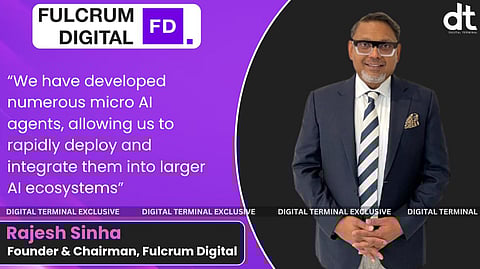

Fulcrum Digital recently hosted an exclusive roundtable meet at its Pune Head Office, where it made a groundbreaking announcement poised to redefine enterprise AI on a global scale. At the event, Rajeev Ranjan, Editor, Digital Terminal, engaged in an exclusive conversation with Rajesh Sinha, Founder & Chairman of Fulcrum Digital. The insightful discussion covered Fulcrum Digital’s bold vision for scaling AI adoption, key industry trends, and the company’s strategic roadmap for revolutionizing intelligent automation and enterprise transformation.
Rajeev: You’ve set a bold target of deploying 10,000 AI agents in a year. Could you elaborate on the strategy and roadmap to achieve this goal?
Rajesh: Our plan is driven by the overwhelming demand from customers seeking AI-driven solutions to enhance both employee and business productivity. In response, we are expanding our portfolio of AI agents across various domains. For instance, we are scaling horizontal AI agents, such as HR, marketing, and finance assistants, which are already well-integrated through conversational AI.
Taking this a step further, we are now introducing vertical AI agents that provide specialized solutions, such as product recommendation systems and AI-powered insurance sales support. Additionally, we have developed numerous micro AI agents, allowing us to rapidly deploy and integrate them into larger AI ecosystems. This modular approach significantly accelerates our ability to deliver AI agents faster than our competitors.
With this foundation in place, we are confident in scaling from 200 to 10,000 agents, leveraging our advanced integration capabilities to streamline and enhance AI-driven business solutions.
Watch The Complete Video
Rajeev: As a leading Indian innovator, how has your growth journey evolved, and do you see this year as a breakthrough moment for your success?
Rajesh: We have been laying the groundwork for quite some time, and as the saying goes, water needs just one degree more to turn into steam. Similarly, after three to four years of building our AI-driven journey, this could be the year we achieve exponential growth. The key to this transformation lies in deploying hundreds or even thousands of AI agents to medium-sized and large enterprises, which could serve as a catalyst for our accelerated expansion.
Rajeev: How do you see the government's AI initiatives, such as the AI India Mission? Are you engaging with policymakers or exploring potential collaborations?
Rajesh: Yes, we are consistently engaged with regulators, government bodies, and scientists. We believe that these initiatives provide a strong foundation and the necessary resources for AI-driven transformation. For AI to be truly effective, it requires high-quality data, and without complete end-to-end digitization, its full potential cannot be realized.
I often emphasize AI evolving into UI—Unified Intelligence. When governments support AI initiatives, they help create a structured data ecosystem that enables this unification, moving beyond just AI discussions. Once intelligence is unified, the next phase is intelligence amplification, where AI continuously enhances decision-making and efficiencies. Government backing, whether through mandates for AI adoption or regulatory frameworks, plays a crucial role in accelerating AI maturity and fostering widespread innovation.
Rajeev: What are your top three predictions for the future of AI and technology? Which key trends should CIOs and CTOs prioritize for long-term success?
Rajesh: Businesses will need to build super AI agents rather than relying on isolated, siloed AI tools. It will no longer be sufficient to have just one or two AI agents handling specific tasks. For example, in an HR department, a simple HR support service won't be enough—it will need to automate payroll processing, accounts receivable, and other key functions.
Additionally, we will see the rise of autonomous AI agents that possess self-reasoning capabilities and the ability to complete tasks independently. These AI systems will require minimal human intervention while delivering significant business value. While human oversight will always be necessary, the level of direct involvement will decrease as AI agents mature and become more capable of handling complex tasks on their own.
Rajeev: What opportunities do you see for SIs, NDs, and other partners to collaborate with your organization for mutual growth?
Rajesh: The good news for businesses is that they have a wide range of options, from open-source to closed-source AI solutions, allowing them to align their choices with their strategic goals. Our recommendation is to consider partnering with us, as we offer a flexible approach that combines both open-source and closed-source technologies. For small companies, large system integrators, and other partners, maintaining an open strategy that embraces both open and closed LLMs can be highly beneficial. By refining their integration and interface strategies across multiple AI platforms, they can position themselves for greater success in the market.
Rajeev: What key message would you like to share with your customers?
Rajesh: Be the IIA disruptor otherwise, you will get disrupted.
𝐒𝐭𝐚𝐲 𝐢𝐧𝐟𝐨𝐫𝐦𝐞𝐝 𝐰𝐢𝐭𝐡 𝐨𝐮𝐫 𝐥𝐚𝐭𝐞𝐬𝐭 𝐮𝐩𝐝𝐚𝐭𝐞𝐬 𝐛𝐲 𝐣𝐨𝐢𝐧𝐢𝐧𝐠 𝐭𝐡𝐞 WhatsApp Channel now! 👈📲
𝑭𝒐𝒍𝒍𝒐𝒘 𝑶𝒖𝒓 𝑺𝒐𝒄𝒊𝒂𝒍 𝑴𝒆𝒅𝒊𝒂 𝑷𝒂𝒈𝒆𝐬 👉 Facebook, LinkedIn, Twitter, Instagram
