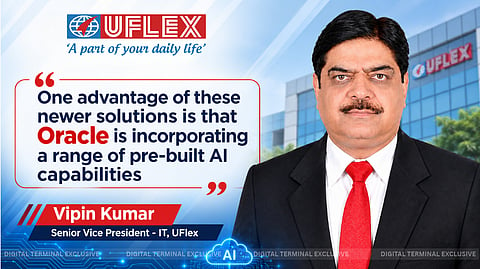

As manufacturing operations become increasingly complex, UFlex is transforming workforce management through an integrated Oracle Fusion Cloud HCM platform. In this conversation with Rajeev Ranjan, Editor, Digital Terminal, Vipin Kumar, Senior Vice President - IT, UFlex, shares insights into the company’s Oracle Fusion Cloud HCM implementation, automated HR processes, AI-led employee services, and the key considerations for successful digital transformation in manufacturing.
Rajeev: What drove UFlex to adopt an integrated Oracle Fusion Cloud HCM environment across its manufacturing operations?
Vipin Kumar: Historically, we were taught that the customer is king. In modern times, however, the employee has become equally important because a satisfied employee is a valuable asset who can help build an organisation.
Traditionally, HR operations in India relied on multiple technology platforms for attendance, performance management, payroll, and other functions. These systems were not integrated, so a process that started in one application often ended in another. This created challenges for HR teams, plant personnel, and employees, resulting in a less-than-optimal employee experience.
We wanted to build a future-ready organisation with a modern, integrated HR system that connects employees and HR seamlessly. Employees should understand what is happening within HR, while HR should have complete visibility into employee-related processes. After evaluating multiple solutions, we selected Oracle HCM.
We divided the transformation into two phases. The first covered core HR, performance management, absence management, and learning management. Once these areas stabilised, we moved to shift planning, time and labour management, and payroll. Both phases have now been implemented, bringing our entire HR function onto a single integrated platform.
Rajeev: How did you approach the implementation across UFlex’s multiple locations and divisions?
Vipin: UFlex is a multi-location and multi-division organisation, with different processes across locations. Therefore, implementation and stabilisation required time.
We started the first phase a few years ago, moving our HR operations away from legacy systems. After the initial implementation was completed and stabilised, we identified the need to integrate shift planning, time and labour management, and payroll, which were running on third-party systems. We undertook the second phase over the last one to one-and-a-half years and have now gone live with it.
However, going live is only the beginning, not the end. In large manufacturing organisations, mindset and change management are important considerations. We continuously engage with employees, conduct training, understand their concerns, identify gaps, and assess what more they need from the system. This ongoing engagement has helped us implement the HR solution seamlessly across divisions.
Rajeev: How has the integrated platform improved workforce visibility, shift planning, and labour cost management?
Vipin: Shift planning is one of the most cumbersome and labour-intensive tasks in manufacturing. Since our implementation covered multiple locations and divisions, we first standardised shifts and then introduced greater discipline by automating the entire shift-planning process.
For example, monthly shift schedules can now be replicated from the previous month and modified according to requirements. Earlier, plant teams had to prepare schedules manually for every employee, which was time-consuming and prone to mismatches and errors. Automation has significantly reduced this burden on plant heads.
Changes are now managed through workflows and approvals, eliminating the need for manual communication between plants and HR whenever an employee’s shift changes.
The system has also improved overtime management. Employee attendance, working hours, and overtime are recorded and calculated within the system. This provides accurate information without manual intervention or discrepancies, allowing us to monitor overtime costs and identify opportunities for optimisation.
Rajeev: What improvements have you observed in payroll accuracy and reconciliation after the transformation?
Vipin: We have designed the process so that information flows from the initial attendance punch through attendance records, leave management, weekly offs, and applicable policies directly into payroll.
Even exceptions, such as a missed biometric punch, follow a defined process within the system with the necessary approvals. Since payroll and the backend Oracle system are integrated, the relevant information flows into payroll without manual intervention.
This ensures that payroll calculations are based on consistent and accurate data. Employees, HR, and plant teams have access to a single source of truth, reducing discrepancies and the scope for errors. The salary slip also provides detailed information about leave records, leave without pay, deductions, and other relevant details. Employees can clearly understand how their salary has been calculated and why any deductions have been made.
The system also sends notifications when attendance records are missing or approvals are pending. Employees receive alerts about missing attendance, while managers are reminded to complete pending approvals. This creates a structured escalation and engagement mechanism across employees, managers, and HR, helping minimise errors.
Rajeev: How is Oracle’s built-in AI functionality supporting UFlex’s HR transformation?
Vipin: One advantage of these newer solutions is that Oracle is incorporating a range of pre-built AI capabilities. Some of these functionalities are already trained for specific HR-related applications, making implementation and the delivery of a better user experience easier.
Building an AI solution from scratch can be a challenging task. Using packaged AI capabilities that are already available simplifies the process and makes implementation more seamless. AI adoption is a journey. We are at a particular stage today, but the pace of development is rapid. We may be much further ahead of the curve two years from now.
Rajeev: What key lessons can Indian manufacturers learn from UFlex’s HCM transformation?
Vipin: The first lesson is to involve all stakeholders from the beginning. HR involves people across the organisation, including plant teams, HR personnel, and end users. Their participation creates a sense of ownership and encourages them to become champions of the new system. An integrated HR solution should be treated as a people system, not merely an IT or HR project.
Second, organisations should standardise processes across locations wherever possible. Large, geographically dispersed businesses often develop local variations over time. These can become challenging when implementing a centralised system, so processes should be streamlined while accommodating genuine local requirements.
Third, a strong governance structure is essential. It should include HR, IT, HR representatives across locations, and key members of the management team. This ensures transparency around implementation plans, milestones, go-live dates, and expected changes.
Fourth, organisations must focus on change management through continuous engagement and training. Employees need to understand what is changing and why. Ground-level discussions and one-to-one engagement can help address concerns and reduce uncertainty before implementation.
Another important lesson is to clean master data before starting the implementation. Carrying poor-quality data into a new system can prevent an organisation from realising its full benefits.
Finally, a clear communication strategy is essential. Everyone, from senior management to employees, should understand what is being implemented, why it is being done, and when it will happen.
𝐒𝐭𝐚𝐲 𝐢𝐧𝐟𝐨𝐫𝐦𝐞𝐝 𝐰𝐢𝐭𝐡 𝐨𝐮𝐫 𝐥𝐚𝐭𝐞𝐬𝐭 𝐮𝐩𝐝𝐚𝐭𝐞𝐬 𝐛𝐲 𝐣𝐨𝐢𝐧𝐢𝐧𝐠 𝐭𝐡𝐞 WhatsApp Channel now! 👈📲
𝑭𝒐𝒍𝒍𝒐𝒘 𝑶𝒖𝒓 𝑺𝒐𝒄𝒊𝒂𝒍 𝑴𝒆𝒅𝒊𝒂 𝑷𝒂𝒈𝒆𝐬 👉 Facebook, LinkedIn, Twitter, Instagram