
Karam Safety Pvt. Ltd., a leading Indian multinational in personal protective equipment and fall protection solutions, is undergoing a large scale digital transformation powered by Oracle technologies. The organization has transitioned from legacy ERP systems to Oracle Fusion Cloud ERP to build a more agile, scalable, and unified digital core supporting its global operations across 150 plus countries.
In this exclusive interaction with Rajeev Ranjan, Editor, Digital Terminal, Amit Bhatia, Global CIO and CISO, Karam Safety Pvt. Ltd., shares insights on the company’s transformation journey, cloud adoption strategy, integration approach, and key lessons from implementing Oracle Fusion Cloud ERP.
Rajeev: Can you briefly introduce Karam Safety and your role in the organization?
Amit Bhatia: Karam Safety is an Indian multinational and one of the leading manufacturers of personal protective equipment and fall protection solutions. We operate in industries like oil, coal, and manufacturing where worker safety is critical. Our products include helmets, gloves, gumboots, and other safety equipment used by workers across hazardous environments.
We are the number one manufacturer in this category and export our products to more than 150 countries. We also operate six international offices along with 17 offices in India, and recently we expanded into Australia and New Zealand.
In my role as Global CIO and CISO, I manage the complete IT landscape as well as the security posture across automation systems and OT deployments across our manufacturing units.
Rajeev: What were the key reasons behind moving from Oracle R12 to Oracle Fusion Cloud ERP?
Amit Bhatia: We were using Oracle R12 for more than a decade and over time it became heavily customized. Because of that, the system became bulky and less agile. Change management became limited and upgrades were not easy to execute quickly. Given our global nature and continuous organic and inorganic growth, we needed a much more robust and scalable ERP backbone that could support faster changes and business expansion.
That is why we moved to Oracle Fusion Cloud ERP. It provided us a secure SaaS platform, better scalability, and a unified system. We have now deployed 19 modules across factories, marketing offices, and headquarters. We went live in April and have already completed a successful financial closing after implementation.
Rajeev: What were the biggest challenges during the change management and adoption phase?
Amit Bhatia: The entire journey was planned over a one year period starting with detailed requirement gathering and gap assessment. The main challenge was identifying the gap between how users were currently working and how Oracle Fusion was designed to function. We addressed this gap in two ways. First, through structured training programs, and second, by creating limited wrappers or controlled customization without disturbing the core system.
Since Oracle Fusion is a SaaS platform, we receive quarterly updates. Therefore, we ensured that customization does not impact patch upgrades. We also built a strong Learning and Development structure. We implemented a train the trainer model where core users were trained first and then they trained others. Users were assessed for readiness before go live. Another major change was behavioral. Users moved from desktop-based systems to a web-based application. Initially there was resistance, but once we demonstrated time savings through training, adoption improved significantly.
Rajeev: How did you manage integration of multiple business systems without disrupting operations?
Amit Bhatia: We followed a structured approach starting with requirement gathering and gap identification, followed by solution design. Earlier, we had more than 80 integrations across systems including CRM, manufacturing systems, and B2C portals. We rationalized and reduced these to under 25 integrations.
We designed a proper integration architecture using microservices to make the system more stable and sustainable. Importantly, we did not disrupt existing operations. The legacy system continued running until the final cutover. Once the go live was executed in April, the transition was smooth, and we are currently stabilizing minor issues through continuous support and training.
Rajeev: How has system connectivity improved collaboration across departments?
Amit Bhatia: A strong example is our iSupplier portal, which was not present in the earlier system.
We have around 5000 suppliers who now interact through this portal. They can generate invoices, track payment status, and view payment advices directly.
Earlier, multiple departments like procurement, manufacturing, quality, and finance were involved in supplier communication, which created a lot of manual coordination. Now, everything is centralized in a single system. This has significantly improved productivity across teams and reduced dependency on manual follow ups. It has also improved transparency for suppliers and created a more efficient ecosystem.
Rajeev: How would you describe Oracle’s role in this transformation journey?
Amit Bhatia: I have been working with Oracle products for almost 22 years out of my 27 years of experience, so I have a long association with their ecosystem. One of the key strengths of Oracle is its customer engagement model. They ensure continuous support during the implementation phase, not just during pre sales or post sales.
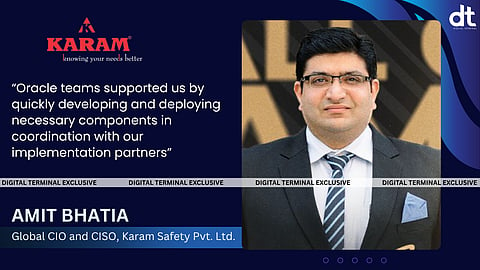
During the project, there were multiple critical decisions and compliance requirements. Oracle teams supported us by quickly developing and deploying necessary components in coordination with our implementation partners. This close collaboration helped us successfully implement 19 modules in a large scale rollout, which is one of the significant implementations for a manufacturing organization in India.
Rajeev: What key lessons did you learn from this digital transformation journey?
Amit Bhatia: One of the biggest learnings is the importance of expectation setting. Every stakeholder must clearly understand why the transformation is being done and what the roadmap looks like. Second, requirement gathering must be signed off by all department heads to ensure alignment and avoid gaps later. Third, agile execution is critical. Users should be involved early through demos and prototypes instead of waiting for a final finished product. Fourth, training and readiness assessment are extremely important before go live. If users are not ready, the system will not succeed, regardless of how good the technology is.
Finally, data migration is a critical success factor. We cleaned our legacy data, removed inactive suppliers and customers, and ensured only relevant and accurate data was migrated. Without strong master data management, ERP implementation cannot succeed.
Rajeev: How has Oracle Fusion Cloud ERP benefited Karam Safety so far?
Amit Bhatia: We are still in the early stages of full utilization, but the improvements are already visible.
Earlier, we had more than 600 reports. We have now standardized this to around 100 reports, ensuring consistency across the organization.
Now everyone works on a single version of truth. Whether it is purchase, manufacturing, or customer data, the same information is visible across departments. Processes like customer onboarding and supplier registration have become fully digitized. The iSupplier portal has further improved automation.
In addition, the built in analytics and reporting capabilities provide strong decision support. Overall, it has improved data integrity, operational efficiency, and decision making across the organization.
𝐒𝐭𝐚𝐲 𝐢𝐧𝐟𝐨𝐫𝐦𝐞𝐝 𝐰𝐢𝐭𝐡 𝐨𝐮𝐫 𝐥𝐚𝐭𝐞𝐬𝐭 𝐮𝐩𝐝𝐚𝐭𝐞𝐬 𝐛𝐲 𝐣𝐨𝐢𝐧𝐢𝐧𝐠 𝐭𝐡𝐞 WhatsApp Channel now! 👈📲
𝑭𝒐𝒍𝒍𝒐𝒘 𝑶𝒖𝒓 𝑺𝒐𝒄𝒊𝒂𝒍 𝑴𝒆𝒅𝒊𝒂 𝑷𝒂𝒈𝒆𝐬 👉 Facebook, LinkedIn, Twitter, Instagram
