
As India accelerates its shift toward experiential and technology-driven education, the integration of robotics into school curricula has emerged as a transformative step. The National Education Policy (NEP) 2020, combined with initiatives such as Atal Tinkering Labs, has provided a strong foundation for fostering creativity, problem-solving, and innovation among students across the country.
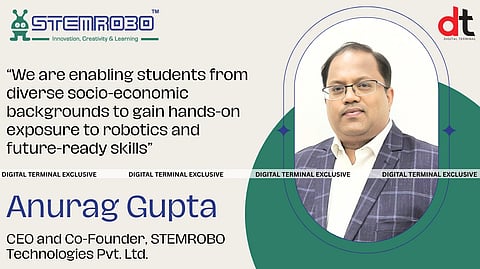
In this exclusive conversation, Rajeev Ranjan, Editor, Digital Terminal, speaks with Anurag Gupta, CEO and Co-Founder of STEMROBO Technologies Pvt. Ltd., about the growing role of educational robotics in shaping India’s next generation of innovators, the expanding reach beyond metropolitan schools, and the global potential of India’s edtech ecosystem.
Rajeev: How do you see the NEP 2020 accelerating the adoption of educational robotics in Indian schools?
Anurag: The NEP 2020 has created a clear direction for schools to focus on hands-on and technology-enabled learning. Robotics fits well into this framework since it connects science, math, and coding with real-world problem-solving. A strong example is Kerala, which introduced robotics in the Class X ICT curriculum. This initiative has reached over 430,000 students, distributed 29,000 robotics kits, and trained close to 10,000 teachers. These steps show how the policy is making robotics part of mainstream school learning, moving students from rote-based methods to activity-based education.
With NEP encouraging critical thinking, creativity, and digital skills, robotics is emerging as a key tool for preparing students for future careers. The policy is not just enabling adoption but also ensuring structured implementation across schools in India.
Rajeev: What factors are driving the growth of robotics education beyond premium schools into tier-2 and tier-3 cities?
Anurag: Robotics education is now spreading to schools outside large metro cities. There are three major reasons for this shift. First, internet penetration has improved in smaller towns, making access to online learning and support easier. Second, the cost of robotics kits has reduced, making them more affordable for a wider range of schools and parents. Third, there is growing demand from parents who want their children to develop practical skills that will help them in the future. According to industry estimates, India’s tech-toy market is expected to reach USD 1.6 billion by 2030, growing at nearly 15 percent each year.
This market expansion shows how demand is increasing beyond a limited segment of elite schools. Together, these factors are ensuring that robotics education is becoming more widespread across tier-2 and tier-3 cities.
Rajeev: How are initiatives like Atal Tinkering Labs shaping the innovation mindset among school students?
Anurag: Atal Tinkering Labs have become a significant part of the school innovation ecosystem in India. They provide access to emerging technologies like robotics, artificial intelligence, and 3D tools, giving students a chance to experiment and learn in practical ways. The number of labs has nearly doubled from about 5,000 in 2020 to almost 10,000 in 2023, and the plan is to expand to 50,000. Importantly, over 60 percent of these labs are set up in government and rural schools, ensuring that access is not limited to urban or premium institutions.
Students are encouraged to work on projects, think independently, and solve problems that matter to their communities. This exposure helps them develop creative thinking and entrepreneurial skills at a young age. By giving children access to tools and platforms, ATLs are fostering a culture of innovation across schools in India.
Rajeev: In your view, how does educational robotics bridge the gap between classroom learning and future employability skills?
Anurag: Robotics education is a practical way of connecting classroom subjects with workplace skills. When students build and program robots, they apply math, science, and coding while also learning teamwork, problem-solving, and design thinking. These are the same skills needed in many modern industries. The demand for such skills is reflected in the market growth numbers. India’s educational robotics sector is projected to grow from USD 38.3 million in 2024 to nearly USD 189 million by 2030, growing at about 32 percent annually. This trend shows rising recognition that robotics is not just about technology, but about building computational thinking and adaptability.
As industries move toward automation and AI, students who learn robotics are better prepared for the workforce. Educational robotics is helping bridge the gap between academic learning and the skills required for future employment.
Rajeev: What role is STEMROBO playing in making robotics learning more accessible and affordable for schools and students?
Anurag: We are working to make robotics education accessible to every student, regardless of their school type or location. So far, we have supported more than 1,200 Atal Tinkering Labs across India by providing end-to-end solutions such as lab setups, do-it-yourself robotics kits, and structured teacher training programs. Our focus has been on creating scalable models that schools of different sizes and budgets can adopt with ease. This approach ensures that robotics is not limited to premium institutions but also reaches government and affordable private schools.
By lowering costs and offering ready-to-use solutions, we are helping schools overcome adoption challenges. At the same time, we place strong emphasis on teacher training, as skilled educators are critical for guiding students effectively. Through these efforts, we are enabling students from diverse socio-economic backgrounds to gain hands-on exposure to robotics and future-ready skills.
Rajeev: How do you see India’s educational robotics market evolving into a global opportunity over the next five years?
Anurag: India’s educational robotics market is growing rapidly and is projected to reach about USD 189 million by 2030, making it one of the fastest expanding segments in the Asia Pacific region. Globally, the market is expected to touch nearly USD 6 billion in the same period. Beyond these figures, the real opportunity lies in how India positions itself in this ecosystem. The country has a large student population, a growing base of teachers being trained in technology, and cost-efficient models for lab setups and robotics kits.
Over the next five years, we can expect India to move from being a consumer of educational robotics to also becoming a developer and exporter of solutions tailored for diverse markets. Partnerships with schools, government initiatives, and private sector innovation will be key. If India builds strong intellectual property and scalable products, it can emerge as a global hub for affordable, high-quality educational robotics.
𝐒𝐭𝐚𝐲 𝐢𝐧𝐟𝐨𝐫𝐦𝐞𝐝 𝐰𝐢𝐭𝐡 𝐨𝐮𝐫 𝐥𝐚𝐭𝐞𝐬𝐭 𝐮𝐩𝐝𝐚𝐭𝐞𝐬 𝐛𝐲 𝐣𝐨𝐢𝐧𝐢𝐧𝐠 𝐭𝐡𝐞 WhatsApp Channel now! 👈📲
𝑭𝒐𝒍𝒍𝒐𝒘 𝑶𝒖𝒓 𝑺𝒐𝒄𝒊𝒂𝒍 𝑴𝒆𝒅𝒊𝒂 𝑷𝒂𝒈𝒆𝐬 👉 Facebook, LinkedIn, Twitter, Instagram
