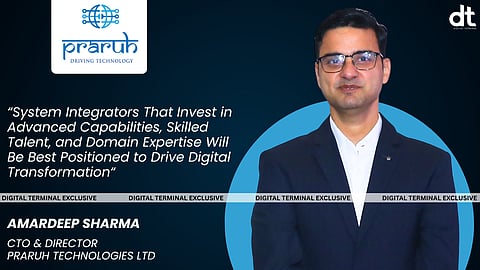

As organizations across sectors like railways, aviation, defense, and public infrastructure accelerate digital transformation, the need for secure, scalable, and future-ready ICT ecosystems is becoming increasingly critical. In this exclusive interaction, Rajeev Ranjan, Editor, Digital Terminal, speaks with Amardeep Sharma, CTO & Director at Praruh Technologies Ltd about the evolving role of system integrators, modernization of mission-critical infrastructure, emerging communication technologies, and the future of large-scale digital deployments in India.
Rajeev: Praruh is playing a key role in modernizing mission-critical infrastructure across sectors like railways, aviation, and defense. What are the biggest challenges organizations face when transforming legacy systems into scalable, future-ready environments?
Amardeep: Modernizing mission-critical infrastructure across sectors like railways, aviation, and defense is inherently complex, primarily due to the deep-rooted presence of legacy systems. One of the biggest challenges is integration, many legacy platforms were not designed with interoperability or open standards in mind, making seamless connectivity with modern technologies difficult.
Another critical concern is ensuring business continuity. These sectors operate in high-stakes environments where even minimal downtime can have serious operational and safety implications. As a result, transformation initiatives must be carefully phased and rigorously tested.
Additionally, data migration and integrity remain key risks, especially when dealing with large volumes of sensitive or real-time data. Cybersecurity is another growing concern, as modernization often expands the attack surface. Organizations also face talent gaps and procurement complexities, particularly in government-led projects, where regulatory processes can slow execution. Praruh Technologies address these challenges through a structured, phased transformation approach, combining domain expertise with strong governance frameworks to ensure minimal disruption and long-term scalability.
Rajeev: With your deep experience in unified communications and network design, how are communication technologies evolving in large public sector and enterprise deployments today?
Amardeep: Communication technologies are moving toward unified, IP-based, and software-defined environments. Voice, video, and data systems are increasingly integrated into Unified Communications (UC) platforms, improving collaboration and operational efficiency.
There is also a strong shift toward cloud and hybrid architectures, offering scalability and flexibility. Emerging trends like AI-driven network analytics, automation, and secure communication frameworks (including zero-trust models) are becoming standard, especially in public sector deployments. Communication systems are now strategic enablers rather than just support tools.
Rajeev: Having worked extensively on RFPs and large government projects, what differentiates a successful system integrator in winning and executing complex ICT projects?
Amardeep: A successful system integrator (SI) differentiates itself through both strong bidding capability and execution excellence. Winning projects requires a deep understanding of RFPs, precise compliance, and the ability to deliver cost-effective, technically sound solutions backed by strong OEM partnerships.
Execution success depends on project management strength, multi-vendor coordination, and adherence to SLAs. Domain expertise, especially in sectors like railways or defense, helps in delivering customized solutions. Consistent communication, transparency, and reliable post-deployment support further strengthen credibility.
Praruh Technologies differentiate themselves by combining technical depth with sector-specific expertise, ensuring not just successful delivery but also sustained operational value for clients.
Rajeev: Proof of Concepts (POCs) are critical in large deployments. Based on your experience, what are the key factors that ensure a smooth transition from POC to full-scale implementation?
Amardeep: The transition from POC to full-scale deployment is a critical phase that determines the success of any large ICT project. A key factor is defining clear, measurable success criteria during the POC stage, aligned closely with real-world operational requirements rather than controlled test scenarios.
Scalability is another crucial consideration. Solutions must be validated not just for performance in isolation, but for their ability to function effectively across large, complex, and dynamic environments.
Comprehensive documentation and standardisation during the POC phase help ensure consistency during rollout. Equally important is stakeholder alignment, ensuring that all decision-makers are on the same page before scaling begins.
From a practical standpoint, resource planning, supply chain readiness, and risk mitigation strategies play a vital role in avoiding delays. A phased rollout approach, supported by continuous monitoring and feedback loops, helps minimize disruption and ensures a smoother transition to full-scale operations.
Rajeev: As enterprises and government bodies increasingly focus on security, scalability, and integration, how do you see the role of system integrators like Praruh evolving over the next 3–5 years?
Amardeep: Over the next 3–5 years, system integrators will evolve into strategic partners rather than just solution providers. Their role will expand to include consulting, lifecycle management, and continuous optimization.
With increasing focus on cybersecurity and compliance, SIs will play a key role in designing secure, scalable architectures. The adoption of AI-driven operations (AIOps) and automation will further enhance efficiency and reduce downtime.
Clients will increasingly expect end-to-end ownership, from design to long-term support. System integrators that invest in advanced capabilities, skilled talent, and domain expertise will be best positioned to drive digital transformation and deliver long-term value.
We are already moving in this direction, positioning ourselves as long-term partners in digital transformation, enabling organizations to navigate complexity while building resilient, future-ready systems.
𝐒𝐭𝐚𝐲 𝐢𝐧𝐟𝐨𝐫𝐦𝐞𝐝 𝐰𝐢𝐭𝐡 𝐨𝐮𝐫 𝐥𝐚𝐭𝐞𝐬𝐭 𝐮𝐩𝐝𝐚𝐭𝐞𝐬 𝐛𝐲 𝐣𝐨𝐢𝐧𝐢𝐧𝐠 𝐭𝐡𝐞 WhatsApp Channel now! 👈📲
𝑭𝒐𝒍𝒍𝒐𝒘 𝑶𝒖𝒓 𝑺𝒐𝒄𝒊𝒂𝒍 𝑴𝒆𝒅𝒊𝒂 𝑷𝒂𝒈𝒆𝐬 👉 Facebook, LinkedIn, Twitter, Instagram
