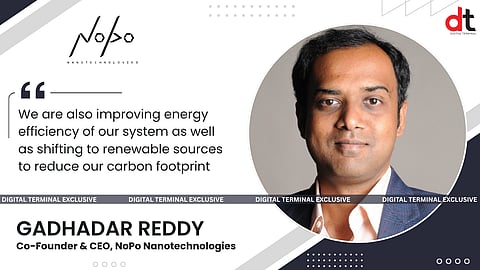

In this exclusive conversation, Rajeev Ranjan, Editor of Digital Terminal, speaks with Gadhadar Reddy, Co-Founder and CEO of NoPo Nanotechnologies for an in-depth discussion on the future of advanced materials. The conversation highlights NoPo’s breakthrough HiPCO process for large-scale production of single-walled carbon nanotubes, its advantages over conventional synthesis methods, and the exceptional performance properties of SWCNTs that are enabling next-generation applications across industries.
Rajeev: Could you elaborate on the core technology enabling large-scale manufacturing of single-walled carbon nanotubes (SWCNTs) at NoPo Nanotechnologies, and how it differs from conventional production approaches?
Gadhadar: NoPo uses a gas-phase continuous flow synthesis process to produce single-walled carbon nanotubes at scale. The process is called HiPCO™, which stands for High-pressure carbon monoxide process. The process uses CO gas along with an iron-based catalyst to produce high-purity SWCNTs. The patented technology has been developed by NoPo.
Unlike batch-based chemical vapor deposition (CVD) methods commonly used in lab or small-scale settings, our approach keeps the reaction environment consistent across larger production volumes, which directly improves yield and material uniformity. The result is a process that can be ramped up without the quality trade-offs that typically come with scaling nanotube production.
Rajeev: How does your proprietary HiPCO process set NoPo’s SWCNTs apart in terms of performance, scalability, and cost efficiency?
Gadhadar: HiPCO, High-pressure Carbon Monoxide is a well-established synthesis route that produces SWCNTs with a narrow diameter distribution and relatively high purity compared to arc discharge or laser ablation methods. NoPo has refined this process to improve catalyst efficiency and reduce post-processing requirements. That translates to more consistent electrical and mechanical properties across batches, which matters when customers are qualifying material for technical applications. On cost, reducing impurities at the synthesis stage is more efficient than removing them later.
Rajeev: SWCNTs are often described as a “material of the future.” What key properties make them superior to traditional materials in advanced applications?
Gadhadar: SWCNT have 100x the tensile strength of steel at 1/16th the weight, and electrical conductivity that surpasses copper properties no single incumbent material comes close to matching. This makes the material an excellent conductive material for multiple applications where conductivity needs to be improved without additional weight. For e.g. electrostatic discharge, or electromagnetic shielding properties in polymers, composites, epoxy, paints and coatings can be added with very little weight addition and change in transparency/color of the material with the help of SWCNTs. These can be used in place of steel/copper where the metals were traditionally used to achieve these properties.
SWCNTs have a high aspect ratio, low density, and depending on their chirality, can behave as either metallic conductors or semiconductors. Their intrinsic electron mobility exceeds that of silicon, and their thermal conductivity is among the highest of any known material.
Rajeev: How can SWCNTs help the semiconductor industry overcome key challenges such as interconnect bottlenecks and the limits of transistor scaling?
Gadhadar: As transistor nodes shrink below 3nm, copper interconnects become a limiting factor resistance increases, and electromigration becomes a reliability concern. Metallic SWCNTs offer a viable alternative: lower resistivity at nanoscale dimensions and better current-carrying capacity than copper at equivalent wire widths. For the channel material itself, semiconducting SWCNTs offer higher carrier mobility than silicon, which is relevant for next-generation transistor architectures. The industry is still working through integration challenges, but the electrical case for SWCNTs in advanced nodes is grounded in real physics, not projection.
Rajeev: How is NoPo ensuring sustainable manufacturing while building a strong, local supply chain?
Gadhadar: NoPo's gas-phase process uses CO as a carbon feedstock, which can be sourced from industrial waste streams, reducing reliance on petrochemical precursors. We have also tested at lab scale to convert industrial CO2 to high-purity CO required as feedstock in our operations. Once the process is adopted at the pilot and mass scale, this will help make wasteful CO2 into useful SWCNTs.
We are focused on building our supply chain within India from precursor sourcing to purification and dispersion rather than depending on imports for critical inputs. More than 95% of our components and raw material are sourced from within the country. This reduces lead times for domestic customers, lowers the carbon footprint associated with logistics, and contributes to building a materials capability that doesn't exist at scale in India today. We are also improving energy efficiency of our system as well as shifting to renewable sources to reduce our carbon footprint. Sustainability for us is about process efficiency and supply chain design, not just compliance. We publish our annual sustainability report based on GRI 1 standards.
Rajeev: What are the future plans of NoPo Nanotechnologies?
Gadhadar: NoPo is working with global battery, electronics and advanced materials makers to bring innovation in SWCNT-led products like advanced batteries, composites, coatings, sensors, and transistors to the market. We are also establishing mass production capacities, which will come live in 2027 to supply the material to the global markets. We are also building innovative electronics products like sensors using our SWCNTs, which we expect to bring to the market by 2030.
𝐒𝐭𝐚𝐲 𝐢𝐧𝐟𝐨𝐫𝐦𝐞𝐝 𝐰𝐢𝐭𝐡 𝐨𝐮𝐫 𝐥𝐚𝐭𝐞𝐬𝐭 𝐮𝐩𝐝𝐚𝐭𝐞𝐬 𝐛𝐲 𝐣𝐨𝐢𝐧𝐢𝐧𝐠 𝐭𝐡𝐞 WhatsApp Channel now! 👈📲
𝑭𝒐𝒍𝒍𝒐𝒘 𝑶𝒖𝒓 𝑺𝒐𝒄𝒊𝒂𝒍 𝑴𝒆𝒅𝒊𝒂 𝑷𝒂𝒈𝒆𝐬 👉 Facebook, LinkedIn, Twitter, Instagram
