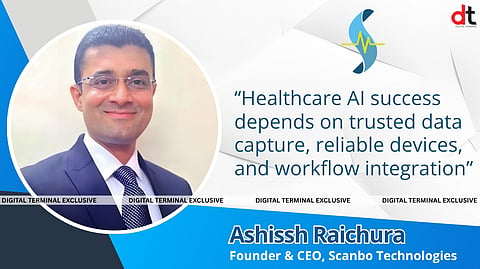

As India’s healthcare ecosystem embraces AI-driven transformation, the real challenge is no longer limited to building smarter models, but creating reliable diagnostic infrastructure capable of delivering accurate outcomes at the point of care. From clean clinical signal capture and device reliability to workflow integration and scalable frontline deployment, the future of healthcare AI depends on how effectively intelligence is translated into real-world clinical impact.
In this exclusive interaction, Rajeev Ranjan, Editor, Digital Terminal speaks Ashissh Raichura, Founder & CEO, Scanbo Technologies about India’s evolving healthcare AI landscape, the importance of diagnostics-led innovation, and the operational realities of scaling trustworthy healthcare intelligence across diverse clinical environments.
Rajeev: India’s healthcare AI ecosystem is gaining momentum through new government initiatives, but do you believe the bigger challenge today lies in diagnostic signal quality rather than model sophistication?
Ashissh: Absolutely. Everyone is obsessed with making models smarter. More parameters, more layers, more compute. But if the data going in is noisy or poorly captured, the sophistication is wasted. We have deployed across 650+ clinical settings and the single biggest lesson from a decade of doing this is that signal quality at the point of capture is everything. India has an extraordinary opportunity here because we are not burdened by legacy infrastructure. We can build the signal layer right, from scratch, at scale. But only if we stop treating AI as a software problem and start treating it as a data engineering problem that begins at the device level.
Rajeev: A large part of the AI conversation focuses on prediction and automation. In real clinical settings, what must go right at the point of care before AI can deliver meaningful outcomes?
Ashissh: Three things. First, the device has to capture clean clinical signals reliably. You would be shocked how many AI companies skip this entirely. Second, the output has to land inside the clinician’s existing workflow. If the doctor has to open a separate app or log into a different system, the insight will be ignored. If it does not appear inside the EMR at the moment of decision, it might as well not exist. Third, the human has to trust it. A clinician practising for twenty years will not change their judgment because a screen tells them to. Trust gets built over months, through consistent, useful outputs that make the doctor’s life easier. There is no shortcut.
Rajeev: How important are factors such as device reliability, clean data capture, and structured outputs in ensuring that healthcare AI becomes clinically trustworthy and scalable?
Ashissh: They are the foundation. Without them, everything else is a demo. Our HridayTaal Cardiac Agent has completed over one million ECG analyses. That is only possible because the D8 device captures waveforms at a resolution that gives the AI something meaningful to work with. On the output side, a physician does not want a probability score. They want a clear, actionable interpretation that fits into their clinical record. We made outputs FHIR R5 compliant, designed to slot directly into clinical documentation. Scalability depends on all of this working together. We designed the entire stack so a new clinic can go live in hours, not months.
Rajeev: In your view, is India’s current healthcare AI narrative still too software-led, while the harder opportunity lies in diagnostics infrastructure and frontline deployment readiness?
Ashissh: Yes. Almost every AI health company in India depends on clean structured data flowing in from somewhere. In most primary care settings, that somewhere does not exist yet. India has over a million ASHA workers already in the field. Put an AI powered diagnostic device in their hands and you multiply their clinical capability tenfold. That requires hardware engineering, manufacturing discipline, and supply chain execution. Software companies do not want to do that work. But it is the work that changes patient outcomes. India is uniquely positioned to lead here. Not by importing models from the West, but by building the diagnostic signal layer those models need.
Rajeev: With Scanbo active across hundreds of clinical settings and millions of analyses completed, what key learnings have emerged about making healthcare intelligence work beyond pilots and controlled demos?
Ashissh: Pilots are easy. Scale is hard. The gap between them is almost entirely about operations, not technology. In a pilot you control everything. The moment you scale, every assumption breaks. Connectivity drops. Staff changes. Devices get used in unexpected ways. Most healthcare AI companies are not set up to solve these problems. We learned early that if you do not own the hardware, you do not control the signal quality. That is why we design, manufacture, and deploy our own devices. The intelligence we deliver at site number 650 is as reliable as it was at site number one. The other learning: a hospital administrator does not care about your model accuracy. They care about whether your platform creates more work or less.
Rajeev: Looking ahead, what should policymakers, healthcare providers, and innovators prioritize to build a stronger point-of-care diagnostics ecosystem that can truly power India’s next phase of healthcare AI growth?
Ashissh: For policymakers: protect the data. India is generating enormous volumes of clinical and biometric data. The health data of a billion people will be one of the most valuable assets on the planet. Ensure this data is governed with citizens at the centre. Build sovereign infrastructure. Create frameworks where Indians participate in the value their health data creates, not just consume services built from it.
For healthcare providers: stop buying technology in silos. Look for integrated platforms where the device, the intelligence, and the clinical record are one system.
For innovators: do the hard work. The world does not need more apps and chatbots. It needs reliable diagnostic infrastructure at the frontline. Devices that work in 40 degree heat. AI that a community health worker can act on without a specialist behind her. That is the work that will transform healthcare for the 800 million Indians who still lack access to basic diagnostics.
The question is not whether India can build world class healthcare AI. It absolutely can. The question is whether we build it in a way that empowers our people and delivers dignity at the point of care.
𝐒𝐭𝐚𝐲 𝐢𝐧𝐟𝐨𝐫𝐦𝐞𝐝 𝐰𝐢𝐭𝐡 𝐨𝐮𝐫 𝐥𝐚𝐭𝐞𝐬𝐭 𝐮𝐩𝐝𝐚𝐭𝐞𝐬 𝐛𝐲 𝐣𝐨𝐢𝐧𝐢𝐧𝐠 𝐭𝐡𝐞 WhatsApp Channel now! 👈📲
𝑭𝒐𝒍𝒍𝒐𝒘 𝑶𝒖𝒓 𝑺𝒐𝒄𝒊𝒂𝒍 𝑴𝒆𝒅𝒊𝒂 𝑷𝒂𝒈𝒆𝐬 👉 Facebook, LinkedIn, Twitter, Instagram
