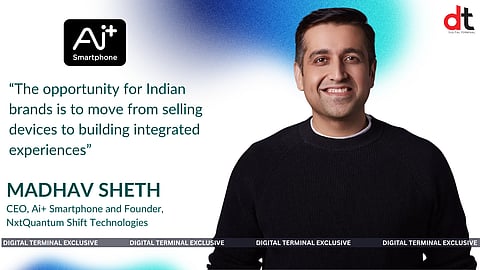

As India's smartphone market evolves beyond specifications toward trust, user experience, and AI-driven innovation, homegrown brands are redefining what consumers expect from technology. In this exclusive conversation with Rajeev Ranjan, Editor, Digital Terminal, Madhav Sheth, CEO, Ai+ Smartphone and Founder, NxtQuantum Shift Technologies, discusses the vision behind the Nova 2 series, Project Trust, India's growing confidence in indigenous brands, AI's future, digital sovereignty, and the company's long-term ambition to build a connected technology ecosystem.
Rajeev: The launch of the Ai+ Nova 2 Pro and Nova 2 Neo comes at an important stage in the brand's journey. What was the core thinking behind these devices, and what do they represent for Ai+ Smartphone?
Madhav Sheth: The Nova 2 Pro and Nova 2 Neo represent the next stage of how we want to build Ai+ Smartphone - listen first, build second. Over the past few months, we have spent a lot of time engaging with reviewers, creators, early users and our own community to understand what they genuinely expect from a smartphone in this segment. Not just in terms of specifications, but in terms of everyday experience - camera quality, software smoothness, reliability, design, battery confidence, and how trustworthy the overall experience feels.
The Nova 2 Neo is designed for users who want an accessible, dependable and future-ready 5G smartphone that delivers the core Nova experience without unnecessary complexity. It is aimed at younger users, first-time 5G buyers and value-conscious consumers who want strong everyday performance with a clean, dependable experience.
The Nova 2 Pro is for users who expect more from their smartphone across imaging, performance and daily productivity. It is a more refined, more capable expression of the Nova philosophy, designed for upgraders, creators and users who want a sharper all-round experience without moving into an unaffordable price band.
Rajeev: Ai+ Smartphone recently crossed INR 350 crore in bookings. Beyond the milestone itself, what does this level of consumer response say about growing confidence in emerging Indian technology brands?
Madhav Sheth: For me, the ₹350 crore milestone is less about one number and more about what that number represents. It tells us that Indian consumers are increasingly willing to place trust in emerging Indian technology brands if those brands show seriousness, product intent and the willingness to stay accountable.
There has always been an aspiration in India to build strong homegrown technology brands, but aspiration alone does not convert into consumer confidence. Confidence comes when people see consistency in product quality, cleaner software experiences, stronger after-sales commitment, and a brand that is willing to listen publicly, improve publicly and stay transparent in how it operates.
Crossing ₹350 crore in bookings and 3 lakh units in May 2026 is encouraging because it tells us that the market is responding to that larger proposition. It suggests that consumers are open to trying new Indian brands, but only when those brands give them a credible reason to believe. For the broader industry, I think it is an important signal. Indian brands do not have to win only on price. They can also win on relevance, trust and the ability to build for Indian users with greater intent.
Rajeev: Project Trust and the Open Review Programme have generated significant attention. Why was it important for Ai+ Smartphone to embrace such a transparent approach to product evaluation?
Madhav Sheth: Because trust cannot be claimed—it has to be earned.
The smartphone industry has historically been very comfortable controlling the narrative around products. Highly managed reviews, polished launch messaging, and a tendency to speak only after the product is in market. We wanted to challenge that mindset.
The Open Review Programme came from a very simple belief: if we are serious about building better products, then feedback has to come before scale and sale and, not after. That is why we chose to put devices into the hands of reviewers, creators and community members early, without trying to over-manage the process. We wanted honest opinions, tough questions and real-world feedback because that is how products improve.
Rajeev: The smartphone market is more competitive than ever. What does it take today to build a differentiated Indian smartphone brand that can earn long-term consumer trust and loyalty?
Madhav Sheth: In today’s market, building a differentiated Indian smartphone brand is no longer just about pricing or specifications. It is about delivering a complete experience that feels relevant, dependable and trustworthy over time. For us, that means building products around real Indian consumer needs, ensuring the software experience is clean and reliable, strengthening privacy and after-sales confidence, and staying transparent in how we engage with users and improve. Ultimately, long-term loyalty will come not from one feature or one campaign, but from consistently delivering on the fundamentals and earning consumer trust over time.
Rajeev: AI is rapidly becoming central to the smartphone experience. How do you see AI evolving from a feature to something that genuinely transforms the way consumers interact with their devices?
Madhav Sheth: I think AI will become meaningful on smartphones only when it stops feeling like a separate category of features and starts becoming part of the device’s natural intelligence.
Today, many AI conversations in the smartphone industry are still very feature-led. There is a lot of emphasis on labels, but not always enough focus on utility. Over time, that will change. AI will matter not because it sounds advanced, but because it quietly makes the device more helpful, more responsive and more personalised to the user’s habits.
Rajeev: As conversations around data privacy and digital sovereignty gain momentum, how important is it for technology solutions to be designed around the needs and expectations of Indian users?
Madhav Sheth: It is absolutely critical, because privacy and sovereignty cannot be treated as abstract policy concepts. They have to be translated into the actual experience of the user.
India is one of the world’s largest and most dynamic digital consumer markets, but Indian users have historically had very little visibility into how their devices and apps handle data. That needs to change. If we want to build meaningful trust in technology, then the user has to feel more informed, more protected and more in control.
For us, designing around Indian expectations means building with a stronger India-first lens across product, software and infrastructure. It means thinking seriously about software governance, cleaner user experiences, permission visibility, data handling practices, and where the broader technology stack is anchored. It also means recognising that the Indian consumer is becoming far more aware and far more demanding when it comes to privacy and transparency.
Rajeev: Many brands are building products, but fewer are building ecosystems. How do you see Ai+ Smartphone evolving beyond smartphones and contributing to a broader connected technology experience?
Madhav Sheth: Smartphones are the starting point, but they are not the full story.
At Ai+, we see the smartphone as the centre of a much larger connected experience. It is the device people use most intimately and most frequently, so it naturally becomes the anchor for everything else - audio, wearables, tablets, connected devices and, over time, a broader software and services layer.
Our ambition is to build that ecosystem thoughtfully rather than chase category expansion for the sake of optics. Every adjacent product has to make sense in the user’s life and has to strengthen the overall Ai+ experience rather than exist as a disconnected SKU. That is how we think about audio products, wearables, tablets and future connected devices - extensions of the same relationship, not isolated businesses.
The opportunity for Indian brands is to move from selling devices to building integrated experiences. If the smartphone is where the relationship begins, then the ecosystem is where loyalty deepens over time. That is very much part of our long-term direction.
Rajeev: When you look at the future of Ai+ Smartphone, what is the larger ambition, both for the brand and for its role in shaping India's technology landscape?
Madhav Sheth: The larger ambition is to build Ai+ into a trusted Indian consumer technology company that is known not just for selling devices, but for raising the standard of what users should expect from technology.
That means building products that are more relevant to Indian consumers, software experiences that are cleaner and more dependable, privacy and trust systems that are stronger and more transparent, and an ecosystem that grows meaningfully over time. It also means contributing to the larger shift India needs to make from being a large technology market to becoming a stronger technology builder.
I have always believed that India has the talent, scale and ambition to build globally relevant technology brands. What we need is more depth in product thinking, software capability, quality discipline and long-term ecosystem vision. If Ai+ can contribute even in a small but meaningful way to that shift by building with greater ownership, greater transparency and greater consumer focus then that would be a very important outcome for us.
𝐒𝐭𝐚𝐲 𝐢𝐧𝐟𝐨𝐫𝐦𝐞𝐝 𝐰𝐢𝐭𝐡 𝐨𝐮𝐫 𝐥𝐚𝐭𝐞𝐬𝐭 𝐮𝐩𝐝𝐚𝐭𝐞𝐬 𝐛𝐲 𝐣𝐨𝐢𝐧𝐢𝐧𝐠 𝐭𝐡𝐞 WhatsApp Channel now! 👈📲
𝑭𝒐𝒍𝒍𝒐𝒘 𝑶𝒖𝒓 𝑺𝒐𝒄𝒊𝒂𝒍 𝑴𝒆𝒅𝒊𝒂 𝑷𝒂𝒈𝒆𝐬 👉 Facebook, LinkedIn, Twitter, Instagram
