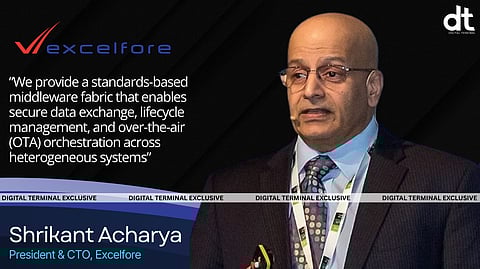

As vehicles become increasingly software-defined and always connected, telecom operators are emerging as key enablers of the automotive software ecosystem. Excelfore, a leading middleware provider, ensures seamless communication between automakers, cloud platforms, edge infrastructure, and telecom networks. In this exclusive conversation, Rajeev Ranjan, Editor, Digital Terminal, speaks with Shrikant Acharya, President & CTO, Excelfore, on the evolving role of telecom in mobility, Excelfore’s middleware solutions, India’s connected vehicle landscape, and the opportunities in OTA updates, monetization, and cybersecurity.
Rajeev: The automotive software market is projected to cross $700 billion by 2034—from your vantage point, how are telecom operators emerging as the new power brokers in this transformation, and where does Excelfore fit into this evolving value chain?
Shrikant: Telecom operators are becoming strategic enablers of the automotive software economy because vehicles are now persistent endpoints on the network, not occasional users.
However, the change is slow.
Mobile operators (MOs) are evolving from bandwidth providers into ecosystem orchestrators: managing device identity, secure provisioning, edge compute access, and service-level guarantees. That positions them as long-term partners to automakers, not just vendors.
Excelfore sits in the middleware layer that makes this ecosystem interoperable. We ensure that vehicle software platforms can securely talk to telecom networks, cloud backends, and edge infrastructure in a standardized, scalable way. Our role is to abstract complexity: automakers innovate at the application layer, telecom ensures transport and scale, and Excelfore ensures reliable orchestration between the two.
From an MO perspective, Excelfore is largely transparent to their core systems. Operators primarily provide an Access Point Name (APN) that is provisioned into the vehicle’s telecom unit (TCU), while the eSync platform establishes secure connectivity to its cloud servers. For operators to move higher up the value chain, they need to combine telecom capability with adjacent technologies, middleware platforms like Excelfore, systems integration, and OEM-facing solution design.
These automotive engagements are highly technical and driven by engineering and platform architecture teams rather than commercial procurement alone. Unless telecom operators engage early in platform design and ecosystem integration, gaining strategic influence with OEMs will remain difficult.
Rajeev: As vehicles become software-defined and always connected, how is Excelfore positioning itself as the middleware layer that connects automakers with telecom infrastructure, cloud platforms, and edge computing ecosystems?
Shrikant: As SDVs behave more like distributed networks of ECUs rather than single end points e.g comm box (TCU). They require synchronization between in-vehicle ECUs, communication clients in the vehicles and cloud servers. Excelfore’s architecture is designed to operate across all three domains.
We provide a standards-based middleware fabric that enables secure data exchange, lifecycle management, and over-the-air (OTA) orchestration across heterogeneous systems. That includes integration with telecom authentication frameworks, cloud-native APIs, and edge deployment models.
The key positioning is neutrality and scalability. Automakers want to have standard based implementations and don’t want to lock themselves into a single telecom or cloud vendor. Our platforms allow them to plug into multiple networks and infrastructure providers while maintaining a consistent operational layer. That flexibility is critical as SDV ecosystems globalize.
Rajeev: With global developments such as AT&T enabling 5G-ready vehicles for GM and Toyota and India witnessing Reliance Jio’s push into connected mobility, how do you compare global telecom strategies with India’s grassroots approach to connected vehicles?
Shrikant: It’s a fascinating contrast in scale and application. The global strategy of companies such as AT&T, General Motors and Toyota centres around experience and premium services. The focus is on 5G-powered infotainment, 8K video streaming for passengers, and high-end V2X (Vehicle-to-Everything) safety features for luxury fleets.
But in India, this begins at the grassroots with companies like Reliance Jio and Hero MotoCorp leveraging their massive 5G footprint and market share in two-wheelers, respectively, to bring connectivity to the "masses", specifically the two-wheeler and commercial EV segments. In India, the "connected car" isn't just a car; it’s a connected scooter or a fleet of delivery 3-wheelers.
But here, I question the need for 5G connectivity for India, unless it is directed towards more data hungry applications like manufacturing or highspeed racing (e.g, Indiapolis 500) as the normal OTA is not real-time and can happen asynchronously. Certainly, what drives US does not necessarily drive India as the user community expectations and affordability are not the same.
Today, Excelfore supports both - providing the standard eSync OTA (Over-the-Air) with plug and play capabilities that can automatically scale the number of devices e.g for US luxury brands while offering the lightweight, scalable "eSync Lite" that fits the cost-sensitive, high-volume Indian EV market.
Both models are valid. Mature markets optimize capability; emerging markets optimize reach. This creates a unique environment: India may leapfrog directly into mass-market connected mobility rather than starting with niche premium service, similar to the way the mobile phones overtook the landline phone market. Once network reliability and edge infrastructure mature, the country could become the largest SDV testbed globally, driven by volume economics.
Rajeev: Connectivity is now a recurring revenue engine for automakers and telecom players alike. How do you see subscription-led models, OTA updates, and features-on-demand reshaping monetization, and what role does reliable telecom infrastructure play in making this sustainable?
Shrikant: While it is a recurring revenue stream for Telecom (albeit not great), the OTA updates serve to reduce warranty costs for the OEMs, by preventing the cars to come the dealers as getting to the dealers in itself will cost the OEM about $200. However, having said this, OEMs in large part are still struggling to effortlessly deliver updates to their vehicles, Tesla is an exception. Where the OEMs can start to make recurring revenue is to provide services such as autonomous feature, EV boost, change of skins on the displays, apps, mood lights, etc. For instance, Tesla provides the autonomous feature as an upgrade after purchase.
Challenge for OTA is the difficulty in managing the vehicle asset under circumstances when it is not reachable, e.g. if the car is parked in a sub-basement garage and the cell connection does not reach that deep through the walls of the parking structure or in if in some cases when the battery is dead. Then you cannot establish a connection.
The revenue model is shifting from one-time vehicle sales to lifecycle monetization (ideal case for the OEMs, but not a reality today). Features-on-demand, subscription services, and OTA-enabled upgrades allow automakers to extend revenue across the vehicle’s lifespan.
But this only works if connectivity is invisible and dependable. Consumers will not tolerate failed updates, latency, or inconsistent service. Telecom reliability becomes part of the user experience and brand trust.
For monetization to scale, three elements must align: secure OTA pipelines, predictable network performance, and edge intelligence for localized delivery. Excelfore’s role is to ensure that software distribution is efficient and resilient, while telecom infrastructure guarantees reach and uptime. The combination enables recurring digital revenue without operational friction.
Rajeev: From a technology standpoint, could you explain how Excelfore’s eSync OTA and SDVconnect platforms enable secure, large-scale updates across ECUs and smart sensors, and why telecom reliability and edge computing are critical to making software-defined vehicles viable at scale?
Shrikant: Excelfore’s eSync OTA platform provides a secure, standards-based framework for updating software and firmware across distributed vehicle components, ECUs, gateways, and smart sensors, at fleet scale. It ensures cryptographic integrity, version control, rollback safety, and bandwidth-efficient delivery.
SDVconnect extends this by providing a unified communication backbone inside the vehicle and between the vehicle and external infrastructure. Together, these platforms create a continuous software lifecycle pipeline from cloud to car.
Telecom reliability is critical because OTA updates are not occasional events — they are operational necessities. Vehicles must receive updates predictably regardless of geography or network variability. Edge computing further improves viability by caching, optimizing, and localizing data distribution, reducing latency and network strain.
At SDV scale, the challenge is not just moving data — it’s orchestrating trust, timing, and consistency across millions of endpoints. That’s where middleware and telecom must function as a single coordinated system.
Today, MOs have a quite a reliable network. Earlier, the calls would just cut without warning but it is less frequent or none at all.
Rajeev: How do you see telecom operators monetizing vehicle data beyond connectivity?
Shrikant: Telecom operators have an opportunity to move into analytics, edge services, and mobility platforms. Aggregated vehicle data, anonymized and compliant with privacy regulations, can enable smart city services, traffic optimization, predictive maintenance ecosystems, and fleet intelligence platforms.
Operators that build developer ecosystems around automotive data pipelines will capture long-term value beyond connectivity fees.
Rajeev: What cybersecurity challenges arise when telecom and automotive ecosystems converge?
Shrikant: The attack surface expands when multiple systems are brought together, however it may not have effect on the vehicles themselves so long as the only way to connect is through one single link which is established with TCU, so it becomes a matter of securing the TCU. eSync provides a multilayered security umbrella where all links regardless of their manifestation or origin have to be secured. Typically, the links are secured with either TLS 1.2/1.3 with X509 certificates.
While links such as CAN and LIN because of legacy have lowered security, the main architecture of the car is moving towards all ethernet links and that would enable a better secured vehicle. Even the enhanced CAN interface, CANFD having a larger packet size, can implement better security over standard CAN packets.
Other threats include OTA supply-chain attacks, identity spoofing, and distributed endpoint compromise.
Security must be designed as a shared responsibility between automakers, middleware providers, and telecom operators. Zero-trust architecture, hardware-rooted identity, and continuous verification models are essential. The future SDV stack must assume constant connectivity, and constant threat exposure.
𝐒𝐭𝐚𝐲 𝐢𝐧𝐟𝐨𝐫𝐦𝐞𝐝 𝐰𝐢𝐭𝐡 𝐨𝐮𝐫 𝐥𝐚𝐭𝐞𝐬𝐭 𝐮𝐩𝐝𝐚𝐭𝐞𝐬 𝐛𝐲 𝐣𝐨𝐢𝐧𝐢𝐧𝐠 𝐭𝐡𝐞 WhatsApp Channel now! 👈📲
𝑭𝒐𝒍𝒍𝒐𝒘 𝑶𝒖𝒓 𝑺𝒐𝒄𝒊𝒂𝒍 𝑴𝒆𝒅𝒊𝒂 𝑷𝒂𝒈𝒆𝐬 👉 Facebook, LinkedIn, Twitter, Instagram
