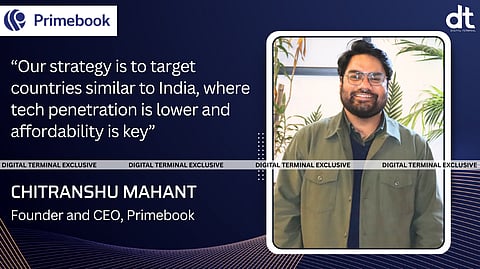

In this exclusive conversation, Rajeev Ranjan, Editor of Digital Terminal, sits down with Chitranshu Mahant, Founder and CEO of Primebook, to discuss how the company is redefining the laptop landscape. They explore Primebook’s approach to delivering high-performance, affordable laptops, integrating AI-driven features, targeting emerging markets, and building strategic partnerships to scale both in India and globally.
Rajeev: What inspired the shift from a hardware-focused company to building a full-stack deep tech ecosystem?
Chitranshu: We have always been a software-first company. Initially, we created an innovative operating system based on Android for the laptop experience. As the industry evolved, we realized the problems we could solve for our users were increasing daily. This led us to focus on deep tech within our operating system.
Initially, we had a product operating system based on Android open source. Then we built our own app store and browser, integrated it with a cloud PC, and now we are working on integrating AI into the OS. In the near future, users will be able to perform complex tasks using only voice commands or prompts, such as booking tickets directly through the OS. This shift is essential in today’s fast-moving technology landscape.
Rajeev: How does PrimeOS stand out from Android or Chrome OS in performance, security, and efficiency on budget laptops?
Chitranshu: When we started building PrimeOS, our first goal was to provide a laptop in the budget segment under ₹20,000 without compromising on performance. The major challenge in this category was that all existing players offered very poor-performing machines. Even though India is a price-sensitive market, this segment hadn’t seen significant disruption. Traditional solutions delivered poor performance, and users often felt cheated, not getting value for money, they only felt value for money at around ₹35,000.
The first thing we did with the operating system was make it very lightweight, so it uses minimal resources, similar to the Qualcomm ecosystem in smartphones. ARM-based chipsets, which are designed for affordable yet high performance, consume very little power and deliver efficiency. We brought that same ecosystem to laptops, and we were the first to do so. Unlike earlier laptops that relied on Intel or AMD chipsets, we chose ARM-based chipsets, the same ones used in smartphones and tablets to deliver high performance at an affordable price point.
Rajeev: What AI-powered features in PrimeOS are transforming how users interact with their devices?
Chitranshu: Sure. We’re introducing two AI modes: Companion Mode and Operator Mode.
Companion Mode is already live in our Generation 2 devices. Think of it like this: while you’re browsing or watching a YouTube video, you can activate Companion Mode, which shares your screen with an intelligent model. You can ask questions about anything on the screen in real time. There’s no need to take a screenshot or upload content to an external AI. It’s like having an AI assistant who is actively watching what you’re doing and providing contextual insights instantly.
Operator Mode is the next step and will be live in about two months. Unlike Companion Mode, which only observes and provides insights, Operator Mode can perform actions on your behalf. For example, while working in Excel, you could instruct the operator to update a number in a specific cell, and it will execute that action directly. This is a game-changer in terms of productivity because the OS itself becomes interactive and action-oriented.
We’re still finalizing pricing and positioning for these AI capabilities, but the idea is to make AI an integral part of how users interact with their devices, enhancing both learning and productivity.
Rajeev: How are you planning to scale globally with your hybrid laptops, and are there specific markets you’re targeting first?
Chitranshu: India itself is a huge market with significant potential. Around 1.5 crore laptops are sold annually, and we sold 50,000 last year. Now, we aim to reach around 1 lakh units, so there’s still enormous room for growth in India.
When it comes to global expansion, laptops are geography-agnostic—they aren’t dependent on language or region. Our strategy is to target countries similar to India, where tech penetration is lower and affordability is key. This includes markets in Southeast Asia like Vietnam and Indonesia, the Middle East and North Africa including Saudi Arabia, and South America such as Mexico and Brazil.
Rajeev: How are you tailoring your products for the next billion users in emerging markets?
Chitranshu: Reaching the next billion laptop users is only possible by offering high performance at an affordable price. Our users consistently tell us that they choose Primebook because it runs seamlessly and delivers superior performance compared to competitors. On platforms like Flipkart and Amazon, our ratings are 4.4–4.5, while competitors typically score around 3.6–3.7. The difference is performance, nothing else.
Rajeev: Which partnerships are helping PrimeOS grow and innovate?
Chitranshu: In this business, partnerships primarily revolve around channel partners. A brand has multiple touchpoints to manage, large-format retail stores, regional retail chains, e-commerce platforms like Flipkart, Amazon, and Chroma as well as B2B engagements. Managing all of these directly is not advisable.
Our focus has been on finding the right channel partners. This is challenging because the top partners are already tied up with the leading brands. As a challenger brand, we had to identify “challenger channel partners”, partners willing to explore a new brand and help create a new category.
Through this search, we’ve identified some excellent partners and are aiming to expand to 30–40 partners across the country to cover different touchpoints. These seller partners distribute our products to governments, schools, and coaching centers, helping us reach the key segments effectively.
Rajeev: Could you share which areas you’re focusing on for partner expansion, and what criteria you’re looking for in potential partners?
Chitranshu: Our partnership strategy is structured sector-wise. For regional retail chains, we are focusing on stores like Vijay Sales in the North and West, Aditya Vision in the East, and Sangeeta Electronics and Purvi Electronics in the South, while deliberately avoiding large-format retailers like Chroma. In the B2B segment, we have found strong product-market fit in CSR initiatives, particularly for the distribution of educational devices.
Another key focus is on call centers and BPOs, where affordable machines with a layer of security are in high demand. Overall, by working with regional retail partners and specialized B2B channels, we aim to cover different touchpoints across the country and reach segments where our products deliver the most value.
𝐒𝐭𝐚𝐲 𝐢𝐧𝐟𝐨𝐫𝐦𝐞𝐝 𝐰𝐢𝐭𝐡 𝐨𝐮𝐫 𝐥𝐚𝐭𝐞𝐬𝐭 𝐮𝐩𝐝𝐚𝐭𝐞𝐬 𝐛𝐲 𝐣𝐨𝐢𝐧𝐢𝐧𝐠 𝐭𝐡𝐞 WhatsApp Channel now! 👈📲
𝑭𝒐𝒍𝒍𝒐𝒘 𝑶𝒖𝒓 𝑺𝒐𝒄𝒊𝒂𝒍 𝑴𝒆𝒅𝒊𝒂 𝑷𝒂𝒈𝒆𝐬 👉 Facebook, LinkedIn, Twitter, Instagram
