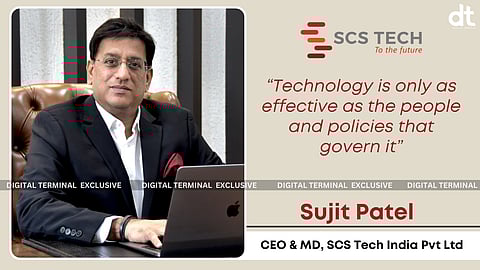

As AI-driven threats escalate, building cyber resilience is no longer optional—it’s mission-critical. In this exclusive conversation, Rajeev Ranjan, Editor of Digital Terminal, speaks with Sujit Patel, CEO & MD of SCS Tech India Pvt Ltd, on how Indian enterprises and government bodies can future-proof their cybersecurity strategies.
Rajeev: How can Indian enterprises and government bodies build stronger cyber resilience in the era of AI?
Sujit: Building cyber resilience today requires shifting from reactive defenses to an “Adaptive Cyber Trust Fabric” powered by AI. At its core, would be Cognitive Security Operations Centers (SOCs), which would ingest telemetry from networks, endpoints, cloud workloads, OT systems, and third-party feeds. Proprietary AI models would continuously refine risk scores, automatically reconfiguring controls to neutralize emerging threats in seconds. We layer on a Digital Twin for Attack Simulation for each enterprise environment, which would uncover supply-chain vectors prophylactically before the intended strike by hostile vectors / adversaries.
Collaborative Threat Intelligence sharing would propagate countermeasures across sectors in real time. Finally, as part of Agile Governance & Continuous Upskilling, bespoke AI-governance blueprints could be crafted which are aligned with India’s AI regulations & / or organization specific SOPs / guidelines. Furthermore, large number of analysts could be trained in AI-driven forensics and red-blue teaming, thereby closing skill gaps and ensuring preparedness against the most advanced adversaries.
Rajeev: What strategies should Indian organizations adopt to tackle advanced ransomware attacks?
Sujit: Defeating polymorphic ransomware demands a “Resilience-First” posture that combines containment, deception, rapid recovery, and regulatory alignment. As part of step 1, Zero Trust Micro-segmentation need to be implemented to isolate compromised zones instantly. In step 2, deception traps and honeyfarms could be deployed to turn every intrusion into actionable threat intelligence. Next is the need to orchestrate immutable, air-gapped backups following the 3-2-1 rule, with monthly recovery drills guaranteeing sub-hour RTOs. Step 4 would involve integration of AI-driven Threat Hunting to correlate attacker tactics, techniques, and procedures, while pre-approved incident-response playbooks coordinate legal, PR, and technical measures in parallel.
Final step would be Insurance & Regulatory Alignment, which would involve collaboration with cyber insurers to validate policy scopes, and ensure CERT-In compliance with automated reporting. This layered approach minimizes dwell time, contains lateral movement, and accelerates restoration – all while protecting reputation and regulatory standing.
Rajeev: How is SCS Tech helping secure financial platforms without compromising performance?
Sujit: In banking and finance, milliseconds matter. SCS Tech’s solution involves deployment of FPGA-accelerated, High-throughput AI Firewalls for deep-packet inspection at line rate, quarantining threats without adding latency. Further action would involve tokenization of customer data end-to-end and leverage homomorphic encryption for sensitive computations, ensuring data remains unintelligible even in memory. Behavioral-biometric engines profile user “digital gait” in real time – mouse movements, keystroke dynamics, and device posture – to score sessions and transparently trigger step-up authentication, reducing false declines by 40%.
A Zero Trust API Gateway then enforces schema validation and anomaly throttling on third-party integrations, neutralizing supply-chain exploits with negligible overhead. All regulatory mandates – RBI, PCI DSS, NCIIPC and CERT-In – are codified into a continuous compliance engine, generating audit reports on demand and freeing banks to innovate while staying audit-ready.
Rajeev: How can organizations embed AI/ML cybersecurity and automation without losing agility?
Sujit: Embedding AI/ML securely hinges on orchestrating human-machine synergy through DevSecAIOps. Step 1 would involve incremental AI adoption. Begin with a narrow use case – such as phishing triage – and refine models on local data until accuracy surpasses 95%. Step 2 would use MLOps pipelines and feature stores to manage data ingestion, model training, and deployment as code, with CI/CD gates preventing disruptions. This would be followed by integrating SOAR for context-aware automation, i.e. isolation of threats with low-impact steps during business-critical windows, thereby preserving continuity.
The basic underlying philosophy being to maintain a human-in-the-loop approach, where AI surfaces prioritize alerts with recommended actions, while analysts validate and retrain models to adapt to new TTPs. Finally, deliver all modules as microservices or Kubernetes pods, allowing security to scale alongside applications without becoming a bottleneck.
Rajeev: What role do training and policy play in building a secure culture?
Sujit: Technology is only as effective as the people and policies that govern it. Training could be transformed into immersive, gamified experiences – live-fire exercises, tabletop war games, and an e-learning portal where employees earn Cyber Badges and climb leaderboards. Policies follow a risk-tiered framework: enterprise, departmental, and role-specific, each mapped to real workflows to ensure behavioral compliance rather than checkbox exercises.
Automated policy scanners detect drift, for example, insecure cloud buckets, orphaned privileges, patch gaps, etc. and feed live dashboards for continuous validation. Leadership scorecards embed security KPIs – Mean Time to Detect, Phish-Click Rate, etc. into executive performance metrics, aligning incentives and making cybersecurity everyone’s priority, from the helpdesk to the boardroom.
Rajeev: What is SCS Tech’s strategic roadmap for 2025 and beyond?
Sujit: Our roadmap centers on delivering anticipatory, AI-native defense and resilience at scale. We’re pioneering post-quantum cryptographic software to future-proof critical assets against emergent quantum threats – like ShardSecure. Building on our National Landslide Forecasting Centre work & work with multiple disaster management agencies in India, we’re creating national-scale digital twins that orchestrate traffic, energy, water, and security in real time. In partnership with telecom OEMs, we’re embedding network-slice isolation and edge-AI security into 5G standalone networks, delivering sub-10 ms threat detection for telemedicine and defense applications.
We’re also in the process of launching a AI Center of Excellence with premier universities, incubating autonomous cyber threat-hunting and ISR projects. Finally, by 2026, we aim to expand through joint ventures in Middle East Asia, Southeast Asia & Africa, exporting India’s tech prowess while tailoring solutions for local markets.
𝐒𝐭𝐚𝐲 𝐢𝐧𝐟𝐨𝐫𝐦𝐞𝐝 𝐰𝐢𝐭𝐡 𝐨𝐮𝐫 𝐥𝐚𝐭𝐞𝐬𝐭 𝐮𝐩𝐝𝐚𝐭𝐞𝐬 𝐛𝐲 𝐣𝐨𝐢𝐧𝐢𝐧𝐠 𝐭𝐡𝐞 WhatsApp Channel now! 👈📲
𝑭𝒐𝒍𝒍𝒐𝒘 𝑶𝒖𝒓 𝑺𝒐𝒄𝒊𝒂𝒍 𝑴𝒆𝒅𝒊𝒂 𝑷𝒂𝒈𝒆𝐬 👉 Facebook, LinkedIn, Twitter, Instagram
