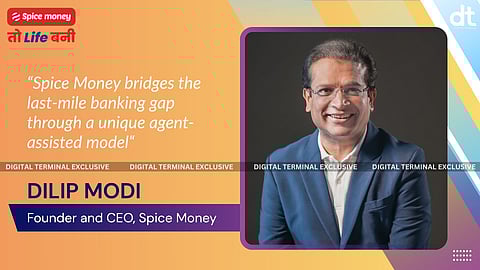

In a rapidly digitizing India, financial inclusion remains one of the most critical pillars for equitable growth, especially in the underserved rural and semi-urban regions. At the forefront of this transformation stands Spice Money, a pioneering rural fintech platform. In this exclusive conversation, Rajeev Ranjan, Editor of Digital Terminal, speaks with Mr. Dilip Modi, Founder and CEO of Spice Money to explore the platform’s inspiring journey and impact. The conversation delves into crucial themes such as financial empowerment, digital trust, regulatory foresight, rural entrepreneurship, and the evolving roadmap of rural fintech in India.
Rajeev: Spice Money has emerged as a pioneer in rural fintech. What was the initial vision behind launching the platform, and how has that evolved over the years?
Dilip: The vision behind Spice Money was rooted in the need to bridge the digital and financial divide between urban and rural India. When we started in 2015, the idea was simple but transformative—to bring essential financial services to the doorsteps of those in underserved regions. Over time, this has evolved into a full-stack rural fintech platform that not only offers cash access through AePS and utility bill payments via Bharat Connect, but also promotes banking inclusion through CASA services, access to responsible credit, and more recently, IRCTC ticketing.
Spice Money operates under a robust compliance framework, holding key licenses such as the BBPOU license from the RBI for bill payments, a PPI (Prepaid Payment Instruments) license for wallet-based solutions, and IRCTC Principal Agent status for railway ticketing. These regulatory approvals, combined with our deep on-ground presence across 95% of rural PIN codes, empower us to deliver secure, assisted, and hyperlocal financial solutions that are trusted by millions.
Rajeev: With a GTV of ₹11,485 crore in March 2025 and a major contribution from AePS, what do these numbers say about the changing face of financial access in rural India?
Dilip: These numbers reflect a fundamental transformation in how rural India engages with formal financial systems. The Gross Transaction Value (GTV) of ₹11,485 crore in March 2025 alone, and the staggering ₹51,221 crore processed through AePS for FY25, underscore a shift from mere access to active financial participation. Over 21 crore AePS transactions in the year are a testament to the scale of trust and reliance rural customers now place in digital and assisted finance.
This adoption is not superficial—it is sustained and embedded. The increase in cash deposit volumes via AePS and the high rate of repeat usage indicate that rural users are not just testing digital financial services; they are integrating them into their daily lives. What was once a gap in infrastructure and trust is now an ecosystem of inclusion and empowerment.
This growth also highlights the success of assisted models like Spice Money’s Adhikari network, which helps build financial literacy and comfort with technology on the ground. It signals that rural Bharat is no longer on the fringes of India’s digital revolution—it is becoming a driving force in it.
Rajeev: Spice Money now has over 1.5 million Adhikaris. How do you empower and train this massive network to serve as digital financial enablers in their communities?
Dilip: Empowering our Adhikari network is central to Spice Money’s mission of enabling last-mile financial inclusion. We do this through a robust, multi-pronged approach that combines digital training, entrepreneurial enablement, and policy advocacy.
However, our commitment goes beyond skill-building. We see our Adhikaris as rural nano-entrepreneurs and invest significantly in enabling their success through a structured, digital-first learning platform—Spice Money Academy. Accessible via web and mobile, the Academy has trained over 5.28 lakh Adhikaris across India through self-paced, multilingual courses that cover critical financial services like AePS, BBPS, domestic money transfers, CASA, micro ATM operations, and PAN issuance. This focus on upskilling has driven measurable results, including a 6.9% increase in AePS withdrawals, a 17% rise in BBPS transactions, and a 93% surge in CASA usage.
The platform offers certification-based learning, regional language support, quizzes, and engaging in-app content to promote retention and relevance. We’ve also taken a strong step towards gender inclusion, with nearly 3,000 women Adhikaris trained in 2024 alone through sessions tailored to their convenience.
Through this model—complemented by transparent commissions, a zero-CAC (Customer Acquisition Cost) model, and access to a comprehensive product suite—we empower Adhikaris to earn ₹15,000 to ₹50,000 monthly, depending on their location and services offered. They are not just service providers but entrepreneurs driving financial inclusion at the last mile.
Additionally, we have been advocating for stronger policies and formal recognition for non-bank business correspondents (BCs)—who form the backbone of India’s financial inclusion journey. By ensuring better grievance redressal mechanisms, financial safety nets, and digital infrastructure support, we aim to strengthen the role of BCs as trusted, long-term partners in India's rural financial ecosystem.
Rajeev: What are your upcoming plans for expanding your portfolio, particularly in introducing credit solutions and UPI-based offerings for rural customers?
Dilip: We are actively scaling our credit and UPI-led financial solutions. Through partnerships with NBFCs and fintech lenders, we offer small-ticket, collateral-free loans for consumption and business needs. In FY25 alone, we disbursed ₹83 crore+ in credit.
Our Bharat connect-powered EMI repayment model ensures seamless, traceable repayments. On the UPI front, we hold a PPI license and are integrating Spice Pay wallet offerings to make UPI more accessible, especially in cash-dominant rural areas. The goal is to build a complete ecosystem from access and payments to savings and credit, under one assisted, trusted platform.
Rajeev: Semi-urban and rural regions often lack access to mainstream banking. How is Spice Money bridging this gap and creating an ecosystem of trust and reliability?
Dilip: Spice Money bridges the last-mile banking gap through a unique agent-assisted model that combines technology, trust, and accessibility. Our 1.5 million-strong network of Adhikaris—who are often embedded in the very communities they serve—act as the first point of contact for essential financial services such as cash withdrawal and deposit (via AePS), bill payments (through our BBPOU license), IRCTC ticketing, prepaid instruments (PPI), savings accounts (CASA), insurance, and PAN card issuance.
Unlike traditional banking models that rely on brick-and-mortar branches, our model brings the bank to the customer, even in areas where there is little or no physical infrastructure. The agent network is backed by a secure digital backbone, including biometric, facial, and Aadhaar-based authentication, which makes transactions tamper-proof, accessible, and inclusive, even for users with limited literacy, formal IDs, or digital familiarity.
What truly sets us apart is the deep social capital our Adhikaris carry. They are not just service providers but trusted community partners, enabling two-way trust in an otherwise formal financial ecosystem. By combining regulatory compliance, robust digital infrastructure, and hyperlocal presence, we’ve created a scalable and inclusive financial model, one that is tailor-made for Bharat and rooted in the principle of "access with dignity."
Rajeev: Looking ahead, what is your long-term vision for Spice Money, and how do you see the rural fintech space evolving in India over the next 3–5 years?
Dilip: Our long-term vision is to build India’s most trusted and comprehensive rural fintech platform, one that empowers users across the country through a widespread network of Adhikaris, delivering a full suite of services spanning banking, utility payments, credit, insurance, and digital commerce.
Over the next few years, we see the rural fintech space entering a new phase of maturity - driven by the convergence of data-led credit models, voice-enabled digital tools, and inclusive innovations built on India Stack. Technologies like Account Aggregator and OCEN will help unlock responsible, small-ticket credit for underserved users, while AI will transform how rural consumers engage with finance—through hyper-personalized learning, intuitive customer support, and real-time fraud prevention.
As government-led digital public infrastructure expands, rural users will increasingly move from being service beneficiaries to active economic participants. At Spice Money, we are committed to leading this transformation responsibly through ethical innovation, localized delivery, and a sustainable ecosystem of empowered nano-entrepreneurs. Our belief is simple: Bharat shouldn’t just be included in India’s digital story, it should shape it.
𝐒𝐭𝐚𝐲 𝐢𝐧𝐟𝐨𝐫𝐦𝐞𝐝 𝐰𝐢𝐭𝐡 𝐨𝐮𝐫 𝐥𝐚𝐭𝐞𝐬𝐭 𝐮𝐩𝐝𝐚𝐭𝐞𝐬 𝐛𝐲 𝐣𝐨𝐢𝐧𝐢𝐧𝐠 𝐭𝐡𝐞 WhatsApp Channel now! 👈📲
𝑭𝒐𝒍𝒍𝒐𝒘 𝑶𝒖𝒓 𝑺𝒐𝒄𝒊𝒂𝒍 𝑴𝒆𝒅𝒊𝒂 𝑷𝒂𝒈𝒆𝐬 👉 Facebook, LinkedIn, Twitter, Instagram
