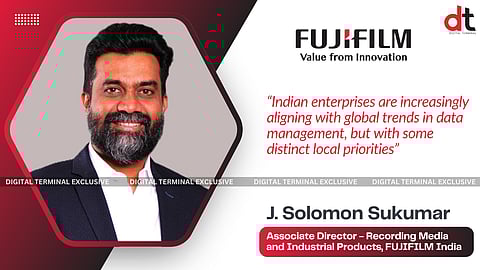

As data security, scalability, and sustainability take center stage in enterprise IT planning, organizations are exploring smarter, hybrid storage strategies to stay ahead of threats and compliance demands. In this exclusive interaction, Rajeev Ranjan, Editor, Digital Terminal, speaks with Mr. J. Solomon Sukumar, Associate Director – Recording Media and Industrial Products, FUJIFILM India, to discuss evolving data storage trends, enterprise challenges, and how Indian businesses are reshaping their infrastructure strategies to ensure security, efficiency, and future-readiness.
Rajeev: What is driving the resurgence of modern tape storage systems like LTO-10, especially in ransomware-prone environments?
J. Solomon: Tape storage has long been a foundation of secure data archiving, and the LTO format continues to grow steadily due to its inherent architectural advantages in an increasingly risk-laden digital environment. Unlike always-connected storage systems, the LTO format offers an air-gapped design by default - physically isolating data from network access, thereby creating a highly effective safeguard against ransomware and other cyber threats. This isn’t a new feature; it’s a fundamental strength of the technology that has made it a reliable choice for enterprises across industries.
With the introduction of LTO-10, organizations benefit from an even more efficient and scalable platform. Offering up to 75TB of compressed capacity per cartridge, LTO-10 enhances storage density while retaining the core attributes of security, durability, and cost-effectiveness. As data volumes surge and cyber risks grow more sophisticated, this next-generation tape format continues to play a vital role in long-term data protection and hybrid disaster recovery models.
Rajeev: With ransomware attacks surging in India, how are air-gapped storage solutions emerging as a critical, last line of defense for organizations? Can you share specific scenarios where this approach has proven vital?
J. Solomon: In an age where ransomware threats are not just frequent but also increasingly sophisticated, the concept of air-gapped storage has gained renewed urgency. Tape technology, by design, provides this offline safeguard - isolating backups from the attack surface entirely. Unlike other backup formats that remain network-connected and therefore exposed, tapes remain inherently secure by being disconnected, creating an effective barrier against unauthorized access or encryption attempts.
This architectural advantage has made magnetic tape an essential component in business continuity planning. With LTO-10, organizations are now able to scale this protection further, supporting larger datasets and longer retention windows without incurring excessive cost or energy consumption. In several data-sensitive industries across India, one can see enterprises revalidate tape as their final fail-safe. The format isn’t reactive; it’s resilient by nature, and LTO-10 is the latest evolution that extends this resilience.
Rajeev: How are Indian enterprises, particularly in sensitive sectors like BFSI, healthcare, and government, adopting hybrid disaster recovery frameworks that combine cloud and tape storage?
J. Solomon: Indian enterprises are increasingly embracing hybrid disaster recovery models as they navigate the dual imperatives of scalability and resilience. In sectors like BFSI, healthcare, and government, where data sensitivity and regulatory compliance are paramount - leaders are realizing that relying solely on cloud-based solutions can expose them to high costs, latency, and cybersecurity vulnerabilities.
This is driving a shift toward hybrid architectures where the cloud is used for active workloads, while magnetic tape storage is deployed for long-term retention and air-gapped backups. Nowadays institutions configure tiered storage strategies: mission-critical, frequently accessed data remains in the cloud or on disk, whereas backup and archival data is migrated to tape. This optimizes storage costs alongside ensuring compliance with data retention mandates and audit-readiness.
Rajeev: From your perspective, how do data storage behaviors and priorities in India compare to global trends? Are Indian businesses now more open to investing in long-term, scalable storage like LTO?
J. Solomon: Indian enterprises are increasingly aligning with global trends in data management, but with some distinct local priorities. While cloud adoption continues to grow, there is now a stronger recognition of the need for diversified, long-term data storage strategies. In fact, India’s regulatory climate, rising cybersecurity concerns, and the sheer pace of data generation are accelerating the adoption of scalable storage like LTO.
What sets India apart is the value-conscious approach. Businesses here are not just looking for capacity - they want security, sustainability, and cost efficiency over the long term. LTO-10 fits this sweet spot with its massive capacity. There is a shift in mindset where tape is being viewed as an essential part of a future-ready, hybrid infrastructure. That shift mirrors global best practices, but is now firmly rooted in India’s unique digital transformation journey.
Rajeev: Energy efficiency is becoming a critical factor in IT infrastructure decisions. How does tape storage align with the sustainability goals of modern enterprises, and how is FUJIFILM supporting this shift?
J. Solomon: Energy efficiency is no longer a peripheral consideration, rather it is central to every IT infrastructure decision, especially as enterprises face mounting pressures around sustainability, ESG compliance, and operational cost. Tape storage, particularly the LTO format, inherently supports this shift. Unlike hard disk-based systems that require continuous power and cooling, LTO systems consume almost no energy when not actively reading or writing, making them exceptionally efficient for long-term archival and backup use cases.
As a brand, our commitment to sustainable innovation is deeply embedded in our technology roadmap. With LTO-10, we not only offer 75TB of compressed capacity per cartridge - drastically reducing the number of physical units needed, but also enable a significantly lower carbon footprint across the storage lifecycle. Our proprietary fine hybrid magnetic particles improve areal density without increasing power consumption. We believe tape is one of the greenest storage options available today, and we are working closely with Indian enterprises to help them embed this advantage into their broader data and climate strategies.
Rajeev: What can we expect next in the evolution of tape technology? How will LTO-10 further strengthen enterprise resilience, and what new capabilities will it bring to the table?
J. Solomon: The evolution of tape storage is far from static. It is accelerating to meet the needs of data-heavy, digitally transforming enterprises. LTO-10 is a significant leap forward in this journey. With a substantial increase in capacity over LTO-9. it allows organizations to consolidate more data in less physical space, reducing storage footprints and overall costs. But beyond sheer capacity, our LTO-10 enhances areal recording density while maintaining exceptional data integrity and durability. This ensures that organizations can store mission-critical data for longer periods, with greater confidence.
Looking ahead, the LTO roadmap is already charting a course ahead with expectations of surpassing 144TB per cartridge. We’re also seeing more integration of AI-driven monitoring, enhanced encryption protocols, and compatibility with cloud-native workflows. For enterprises in India, especially those balancing rapid growth with regulatory compliance, LTO-10 provides storage alongside strategic resilience, data sovereignty, and long-term sustainability.
𝐒𝐭𝐚𝐲 𝐢𝐧𝐟𝐨𝐫𝐦𝐞𝐝 𝐰𝐢𝐭𝐡 𝐨𝐮𝐫 𝐥𝐚𝐭𝐞𝐬𝐭 𝐮𝐩𝐝𝐚𝐭𝐞𝐬 𝐛𝐲 𝐣𝐨𝐢𝐧𝐢𝐧𝐠 𝐭𝐡𝐞 WhatsApp Channel now! 👈📲
𝑭𝒐𝒍𝒍𝒐𝒘 𝑶𝒖𝒓 𝑺𝒐𝒄𝒊𝒂𝒍 𝑴𝒆𝒅𝒊𝒂 𝑷𝒂𝒈𝒆𝐬 👉 Facebook, LinkedIn, Twitter, Instagram
