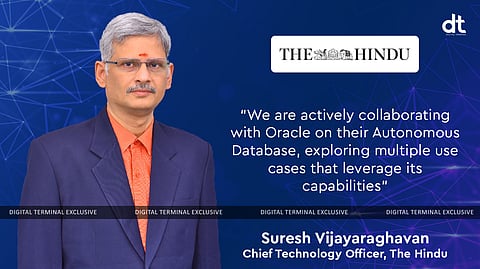

The evolution of the print media industry over the past ten years, especially in the last five years during the COVID era, has been quite challenging. Rajeev Ranjan, Editor-in-Chief of Digital Terminal, spoke with Suresh Vijayaraghavan, Chief Technology Officer at The Hindu, about the transformational journey of the renowned media house. He shared insights on the responsible approach taken to address consumer demands while aligning with the organization’s technological needs, their partnership with Oracle, and much more. Read the excerpts to explore the details.
Rajeev: How has The Hindu evolved as a leading print media house in recent years, especially post-pandemic?
Suresh: The transformation of print media is similar to the shift from film cameras to mobile photography. It’s not just about the availability of new technology but the emergence of a supporting digital ecosystem. Earlier, newspapers were the primary source of daily news, but now, breaking news is available 24/7 across multiple platforms.
This shift is both technological and cultural, driven by digital advancements that enable seamless interactions with readers, subscribers, industry partners, and technology providers like Oracle. Recognizing this, The Hindu began its digital transformation journey about five years ago and is now at an advanced stage, fully embracing the digital landscape to stay relevant and sustainable.
Rajeev: What led The Hindu to collaborate with Oracle, and what goals are you aiming to achieve through this partnership?
Suresh: Our digital transformation required a highly resilient and scalable infrastructure, something our existing setup lacked. As a content-driven company, we wanted our technology team to focus on innovation rather than managing complex IT infrastructure.
Oracle stood out among hyperscalers for its performance, cost predictability, and transparent billing—free from hidden charges. Its infrastructure allows us to scale seamlessly, deploying additional resources during high-traffic periods and scaling down when needed, ensuring efficiency and cost-effectiveness. This flexibility is crucial as we navigate our digital growth, making Oracle the right partner for this journey.
Rajeev: Could you walk us through the implementation of Oracle’s solutions (OCI)? Were there any customized approaches involved?
Suresh: We started with a Proof of Concept (POC) using our most critical system—the 147-year archival system, which holds nearly 90 terabytes of data. If Oracle Cloud could handle this efficiently, we knew it could support the rest of our operations.
Our content platform provider, Stibo DX, initially worked with Oracle’s competitors and was surprised by our choice. However, after deployment, they reported a 30% performance improvement over other hyperscalers, reinforcing our decision.
During implementation, we faced technical challenges, but Oracle’s experts provided swift, customized solutions. After successfully migrating our archives, we transitioned our entire content creation and publishing platform to Oracle Cloud, completing a seamless shift from our data centers. This move greatly enhanced our efficiency and system performance.
Rajeev: Did the Oracle team customize solutions to meet your unique business needs, given the distinct nature of your operations?
Suresh: Oracle team always go extra mile to support your deployment or migration. This is a key differentiator for Oracle, and I often tell their sales team to highlight it more and let the world know about such support. During our archival system implementation, we faced challenges securing archive data from the public internet, as the object storage initially didn’t meet our specific requirements.
But to resolve this challenge, Oracle’s core object storage team stepped in, thoroughly assessed our needs, and custom-built a proxy server solution—at no additional cost. This solution eliminated bottlenecks and allowed us to use the system seamlessly. Unlike other hyperscalers, where such support often comes with extra charges, Oracle’s commitment to solving our challenges without added costs truly sets them apart. This kind of commitment is a genuine differentiator and a testament to their customer-centric approach.
Rajeev: Before your journey with Oracle, what technologies were you using for your applications? What challenges led you to partner with Oracle?
Suresh: Like many traditional enterprises, we operated an in-house data center with VMware based virtualization solutions. Our IT team had to juggle multiple responsibilities, as we couldn’t afford dedicated specialists for each function. This meant frequent reliance on external support whenever infrastructure issues arose.
Scalability was another major challenge. Since we couldn't instantly add virtual machines, we had to overprovision resources maintaining 20% extra capacity just in case of demand spikes. This approach led to inefficiencies and unnecessary cost as much of that infrastructure often went unused.
Managing our own data center also came with occasional downtime, impacting the subscriber experience. Transitioning to the Oracle cloud eliminated these infrastructure complexities, ensuring 99.99% uptime. My team can now focus on applications rather than infrastructure management, handling advanced support issues (L4/L5) without worrying about compute, storage, or networking.
With Oracle Cloud, scaling is effortless and we can spin up virtual machines in minutes or deploy new containers in seconds. This migration has eliminated infrastructure headaches, improved efficiency, and since moving to the cloud, we’ve had zero downtime.
Rajeev: Based on your extensive experience in the media industry, what advice would you offer to other CTOs or industry leaders considering digital transformation? What key recommendations would you give to those embarking on a similar journey?
Suresh: My first piece of advice is to choose a vendor that can meet at least 80-90% of your infrastructure needs instead of relying on multiple vendors for different services. When we selected Oracle Cloud, it provided a one-stop solution covering everything from security and web application firewalls to running applications and helping us streamline operations and reduce complexity.
The second critical factor is cost predictability. Hidden costs can be a major challenge with cloud services. Often, unexpected charges appear when the bill arrives. With Oracle, we have full visibility into our consumption and can accurately predict our costs, ensuring complete transparency.
My final advise will be looking ahead your journey with generative AI as this will be a game changer for all organisations. When choosing a cloud provider, it’s essential to consider not just current capabilities but also future innovations. While we at ‘The Hindu’ have been leveraging generative AI for over a year and a half, many businesses may not need it immediately. However, partnering with a vendor that stays ahead of technological advancements ensures you’re future-ready without needing to switch solutions later.
Rajeev: How do cybersecurity threats especially those tied to new tech like AI may impact digital transformation journey?
Suresh: Connecting a computer to a network exposes it to cybersecurity threats, even something as simple as plugging in a USB drive. To be completely secure, you will need an isolated system, but that's unrealistic today.
Cybersecurity must be built into system design from the start. With AI, while it strengthens security, it also enables more sophisticated attacks. In the media industry, AI can be transformative, but only when applied strategically. While AI improves efficiency, it doesn’t always lead to direct business outcomes, like reducing workforce or boosting profits.
At The Hindu, we are integrating AI in content workflows—like summarizing articles, generating headlines, and automating video captions. The real impact of AI comes when it’s fully embedded in daily operations, enhancing productivity and requiring proper controls for effective use.
Rajeev: How do you see this partnership evolving in years to come? Are there any upcoming projects or innovations you plan to leverage OCI for?
Suresh: We are actively collaborating with Oracle on their Autonomous Database, exploring multiple use cases that leverage its capabilities. Through this process, we've worked closely with Oracle's solution architects and subject matter experts to refine our approach. One of the key areas of focus has been integrating Generative AI (GenAI) with the Autonomous Database, enabling natural language interaction with data.
At present, we are in the experimental phase, but I anticipate deeper adoption of Oracle’s Autonomous DB in the near future. The broader vision is to integrate GenAI natively within the database architecture, reducing the need for external AI-driven solutions. This approach will allow us to streamline operations, enhance efficiency, and ensure seamless AI-powered insights without additional overhead.
While some AI-driven capabilities, such as text-to-speech, speech-to-text, and video generation, are still in the experimental stage, we are actively working with our platform providers to embed these technologies into our content generation workflows. By leveraging Oracle’s AI models, we aim to seamlessly integrate these capabilities into our publishing platform, unlocking new possibilities for content creation and automation. The future of this partnership looks promising, with a clear focus on innovation, automation, and AI-driven transformation.
𝐒𝐭𝐚𝐲 𝐢𝐧𝐟𝐨𝐫𝐦𝐞𝐝 𝐰𝐢𝐭𝐡 𝐨𝐮𝐫 𝐥𝐚𝐭𝐞𝐬𝐭 𝐮𝐩𝐝𝐚𝐭𝐞𝐬 𝐛𝐲 𝐣𝐨𝐢𝐧𝐢𝐧𝐠 𝐭𝐡𝐞 WhatsApp Channel now! 👈📲
𝑭𝒐𝒍𝒍𝒐𝒘 𝑶𝒖𝒓 𝑺𝒐𝒄𝒊𝒂𝒍 𝑴𝒆𝒅𝒊𝒂 𝑷𝒂𝒈𝒆𝐬 👉 Facebook, LinkedIn, Twitter, Instagram

