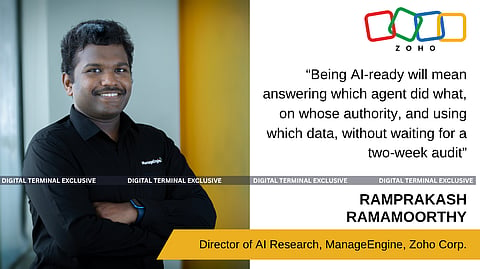

As enterprises move from AI experimentation to scaled deployment, AI readiness is becoming a key differentiator in turning investments into measurable business outcomes. In this exclusive conversation with Rajeev Ranjan, Editor, Digital Terminal, Ramprakash Ramamoorthy, Director of AI Research, ManageEngine, Zoho Corp., shares his insights on building a strong AI foundation, strengthening governance, and helping organizations scale AI securely and responsibly.
Rajeev: Why do you believe AI readiness will be the biggest differentiator between enterprises that successfully scale AI and those that remain stuck in pilot mode?
Ramprakash: Every enterprise I speak to has run an AI pilot; many have run five or six. The demonstration goes well, leadership is impressed, then the initiative loses momentum between pilot and production. The model is rarely the reason; it is everything underneath it. That gap between having access to AI and being ready to operationalise it is what I mean by AI readiness. It will separate companies extracting meaningful value from this wave from those renewing licences and documenting experiments.
AI doesn't fix a broken process; it inherits it. If your procurement cycle runs through eleven approvals, four systems, and a WhatsApp group where the decisions get made, an agent will produce eleven approvals worth of confusion, only faster. Organisations scaling AI successfully are doing the unglamorous work first: simplifying processes, cleaning up data, and automating deterministic tasks with rules before introducing a model.
Rajeev: What are the most common gaps you see in enterprise IT environments that prevent organizations from deploying AI at scale?
Ramprakash: The most common gap isn't sophistication, it is fragmentation. A typical mid-to-large enterprise now runs more than a hundred SaaS applications. Each carries its own identity model, schema, audit trail, and definition of a "customer record". Most stopped communicating effectively after an integration someone built in 2022 and forgot about.
That is the real structural problem. When tools do not talk, departments often do not either. Finance closes the books on one version of reality, sales forecasts on a second, and support resolves tickets on a third. A human can bridge those gaps by asking someone; an AI system cannot. It answers from whichever information source it is working with, and confidence isn't the same as correctness. AI that delivers real business value has to reason across those islands, making deferred integration a critical part of the AI journey.
Rajeev: How can enterprises build a strong AI foundation by aligning infrastructure, data, governance, and IT operations rather than treating them as separate initiatives?
Ramprakash: Infrastructure, data, governance, and IT operations are often funded as four separate initiatives with four separate owners, and organisations find that these pieces do not automatically work together.
A few things help. Put identity at the centre, so every call, human or machine, resolves to an entity whose access is inspectable. Extend existing observability to AI services rather than creating a parallel stack; a model call is essentially a service call, with different latency and failure patterns. Treat data lineage as non-negotiable for anything that feeds an agent. Route AI changes through the same change management processes used for everything else. A separate AI governance committee meeting monthly will inevitably be behind teams shipping weekly.
Rajeev: As organizations accelerate AI adoption, how should CIOs balance innovation with security, compliance, and responsible AI governance?
Ramprakash: Governance used to be a quarterly exercise. Someone ran a report, someone signed it, and everyone moved on. AI has changed that rhythm. Data now moves at inference time, into unreviewed contexts, often outside the country. With the DPDP Act coming into force, Indian CIOs need a clear answer: where did that prompt go, and what was in it? If the answer depends on a vendor's marketing page rather than a clear data-flow visibility, that is a finding waiting to happen.
This makes a case for right-sizing rather than reaching for the largest model every time. Little enterprise work requires a frontier model. Much can be served by smaller models on infrastructure an organisation controls, with larger hosted models reserved for tasks that justify the exposure. That is as much a privacy decision as it is a cost decision.
Rajeev: Beyond technology, what organizational and cultural changes are essential for enterprises to transition from AI experimentation to measurable business outcomes?
Ramprakash: Most stalled AI programmes I've seen have failed for reasons that had little to do with the technology. Ownership is usually the issue. IT builds the solution, the business is expected to adopt it, and nobody's performance is measured on whether it actually delivers. Fix that alignment and half the problem disappears. Define the metric before the pilot and make it specific enough to prove itself right or wrong. "Improve productivity" is not a metric. "Cut mean time to resolution on tier-one tickets by 30%" is, so you can determine whether it worked, and give teams permission to shut things down. An organisation that has never stopped an AI project is not necessarily experimenting, it may simply be collecting pilots.
Rajeev: Looking ahead, what will define an AI-ready enterprise over the next three to five years, and how is ManageEngine enabling organizations to prepare for this next phase of enterprise AI adoption?
Ramprakash: Machine identities are likely to outnumber human identities inside the enterprise, and many will be agents acting on somebody's behalf. That shifts the hard problems towards identity, entitlement, audit, and observability for software making its own decisions. Being AI-ready will mean answering which agent did what, on whose authority, and using which data, without waiting for a two-week audit.
That is the foundation ManageEngine has been working on for two decades, long before "AI-ready" became a phrase. Service management, endpoint and identity management, observability, and analytics operate as one connected system rather than disconnected islands. That is the foundation enterprises will need as they move from experimenting with AI to running it at scale.
𝐒𝐭𝐚𝐲 𝐢𝐧𝐟𝐨𝐫𝐦𝐞𝐝 𝐰𝐢𝐭𝐡 𝐨𝐮𝐫 𝐥𝐚𝐭𝐞𝐬𝐭 𝐮𝐩𝐝𝐚𝐭𝐞𝐬 𝐛𝐲 𝐣𝐨𝐢𝐧𝐢𝐧𝐠 𝐭𝐡𝐞 WhatsApp Channel now! 👈📲
𝑭𝒐𝒍𝒍𝒐𝒘 𝑶𝒖𝒓 𝑺𝒐𝒄𝒊𝒂𝒍 𝑴𝒆𝒅𝒊𝒂 𝑷𝒂𝒈𝒆𝐬 👉 Facebook, LinkedIn, Twitter, Instagram
