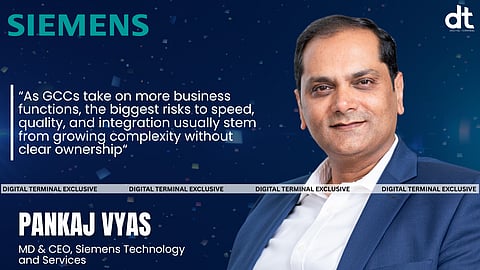

As Global Capability Centres in India enter a new phase of transformation, the shift from cost efficiency to value creation is becoming increasingly pronounced. In this insightful conversation, Rajeev Ranjan, Editor of Digital Terminal, engages with Pankaj Vyas, MD and CEO of Siemens Technology and Services, to decode how agentic AI is reshaping GCC strategies, driving ownership-led innovation, and redefining leadership, governance, and talent models for the next era of global engineering and digital excellence.
Rajeev: As agentic AI reduces traditional cost advantages, how should India’s GCCs redefine their value proposition to global headquarters beyond efficiency and scale?
Pankaj: As agentic AI reduces labour arbitrage globally, India’s GCCs must reposition themselves from execution centres to ownership-led engineering hubs. The next phase of value creation lies in outcome accountability, i.e, owning platforms, architectures and long-term technology roadmaps rather than delivering discrete tasks. India’s advantage is no longer just scale, but its ability to absorb complex tasks and engineer solutions that work reliably in real-world conditions.
That shift requires GCCs to move upstream into problem definition, system architecture, and validation, and to be measured on business outcomes, not throughput.
In practice, differentiation will come from translating emerging technologies into production-grade capabilities by building resilient systems, integrating data intelligently, embedding compliance by design, and shortening innovation cycles responsibly.
For instance, at Siemens Technology and Services, teams are expanding their mandate to co-design platforms and systems tied to measurable business outcomes. As a result, we have tripled the number of inventions, and the value created out of India will continue to grow as we take deeper ownership of core platforms and roadmaps.
Rajeev: When GCCs take on true end-to-end ownership, what changes most fundamentally—decision rights, accountability, or leadership mindset?
Pankaj: The fundamental shift is the leadership mindset, because decision rights and accountability only work when leaders internalise ownership. End-to-end responsibility requires leaders to think like product and platform owners by prioritising long-term system health and being accountable for outcomes across the full lifecycle.
To make that ownership real, leaders need comfort with ambiguity, accountability when things fail, and a willingness to place long-term bets. This is sustained by trust, built through a strong delivery track record, risk-management maturity, and clear governance.
Once the mindset shifts, decision authority and accountability follow naturally, enabling GCCs to operate as integral parts of global R&D and engineering organisations rather than downstream executors.
Rajeev: How should GCC leaders think about the “go deeper vs go wider” dilemma—is it possible to pursue both without diluting impact?
Pankaj: The “go deeper vs go wider” dilemma is largely a sequencing problem: depth creates credibility, breadth creates leverage. GCCs that expand horizontally before establishing deep expertise often end up pulled in too many directions and find it harder to anchor strategically.
Leaders should prioritise depth in a few areas where they can genuinely own architectures, platforms, or critical engineering decisions. That depth enables reusable assets: frameworks, tooling, reference designs that make expansion into adjacent areas repeatable. Without those foundations, going wider mainly increases coordination cost and governance overhead.
For example, at Siemens Technology and Services, deeper capability in select domains has enabled teams to support businesses without duplicating effort, as breadth became an outcome of platform maturity rather than headcount growth. So, pursuing both is possible, but only when “wider” is driven by reuse and architectural leverage, not by parallelising new domains too early.
Rajeev: What operating model and governance shifts are required when product, platform, and engineering ownership move fully into India-based GCCs?
Pankaj: When product, platform and engineering ownership move fully into India-based GCCs, it’s no longer about supporting work done elsewhere, it’s about owning outcomes end to end. That requires a clear operating model shift: stop equating scale with headcount and start measuring value delivered. Smaller, empowered teams with well-defined product goals can move faster and shorten innovation cycles.
As ownership deepens, roles naturally broaden product managers, systems integrators and cross-functional leaders become more central to how work gets done. Orchestration also becomes a much bigger part of the job, stitching together engineering, product, cybersecurity and operations so delivery stays coherent.
Governance, in turn, has to become tighter and more outcome-led. Accountability can’t be spread across layers or geographies; it must rest with leaders can truly own end-to-end results, including customer and business impact. Clear role definition and visible performance metrics in this scenario reduce overlap, avoid rework and keep decisions moving. And as speed increases, quality has to be non-negotiable.
Strong release discipline, rigorous testing and operational oversight ensure reliability doesn’t slip. In essence, deeper ownership in India demands stronger orchestration and clear accountability, without compromising quality.
Rajeev: As GCCs add more business functions, what are the biggest risks to speed, quality, and integration, and how can leaders mitigate them?
Pankaj: As GCCs take on more business functions, the biggest risks to speed, quality, and integration usually stem from growing complexity without clear ownership. When roles and decision rights are unclear, decisions slow down, and accountability weakens. As different functions expand within the GCC, new silos can emerge, with teams focusing on their own goals rather than the broader business outcome.
This often leads to duplication, gaps, and inconsistent quality. Another common risk is leadership overload, where a small group of leaders is expected to manage an expanding scope without the right structure or governance, creating bottlenecks and fatigue.
To mitigate these challenges, leaders need a clear operating charter that defines what the GCC owns end to end and how different functions work together. Just as important, you need cross‑functional communities of practice and guilds for architects, product owners, data and AI specialists, cybersecurity, and domain experts. These expert communities cut across business functions, define common standards and share best practices.
The focus should also shift from managing functions to delivering outcomes, supported by clear decision boundaries and shared performance metrics. Cross-functional teams can help maintain speed, while shared standards and simple governance ensure consistency and integration as the GCC scales.
Rajeev: Looking ahead, how will this next phase of GCC evolution reshape organisation design, talent strategy, and capability building in India over the next five years?
Pankaj: Over the next five years, India’s GCCs will continue to increase in numbers and will begin to resemble global product organisations rather than just extended delivery arms. India’s GCCs are quickly evolving into centres of AI capability, integrating AI across core workflows, establishing focused Centres of Excellence, and enabling AI-driven decision-making at scale. The emphasis is no longer on adopting AI, but on advancing innovation through it.
Talent strategy will prioritise hybrid skill sets, engineers who combine domain knowledge, software engineering and data-driven thinking. The ‘polymath engineer’ will become the norm, not the exception. Capability building will prioritise reusable platforms, automation, and engineering excellence (quality, reliability, security-by-design). There will be a greater focus on more internal academies, structured apprenticeship models, and partnerships with startups and academia to build differentiated IP and encourage innovation.
𝐒𝐭𝐚𝐲 𝐢𝐧𝐟𝐨𝐫𝐦𝐞𝐝 𝐰𝐢𝐭𝐡 𝐨𝐮𝐫 𝐥𝐚𝐭𝐞𝐬𝐭 𝐮𝐩𝐝𝐚𝐭𝐞𝐬 𝐛𝐲 𝐣𝐨𝐢𝐧𝐢𝐧𝐠 𝐭𝐡𝐞 WhatsApp Channel now! 👈📲
𝑭𝒐𝒍𝒍𝒐𝒘 𝑶𝒖𝒓 𝑺𝒐𝒄𝒊𝒂𝒍 𝑴𝒆𝒅𝒊𝒂 𝑷𝒂𝒈𝒆𝐬 👉 Facebook, LinkedIn, Twitter, Instagram
