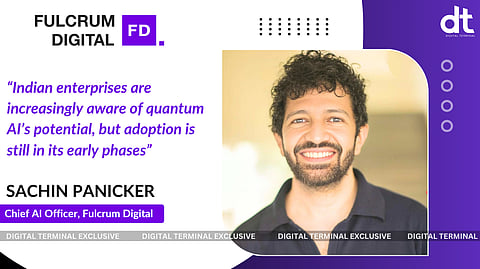

In an era where artificial intelligence is reshaping global industries, the frontier of quantum-powered AI is rapidly emerging as a game-changer. To gain deeper insights into this transformative shift, Rajeev Ranjan, Editor, Digital Terminal, exclusively talked to Sachin Panicker, Chief AI Officer at Fulcrum Digital. From overcoming LLM limitations to the promise of photonic quantum AI, Sachin shares how this next-gen technology is set to transform industries like finance, logistics, and cybersecurity.
Rajeev: What key limitations are you seeing in current LLMs, and how do quantum-native agents promise to overcome them?
Sachin: That’s a great starting point. From my experience working in generative AI, I’ve observed that while LLMs are powerful, they face several limitations that quantum-native agents are uniquely positioned to overcome:
Hallucinations and Reliability: We’ve all seen LLMs occasionally generate incorrect or entirely fabricated responses with confidence. This stems from their lack of true reasoning capabilities—they function more as statistical pattern recognition engines than logical thinkers. Quantum-native agents, however, process information in fundamentally novel ways, offering the potential to minimize hallucinations and deliver more accurate and reliable outputs.
Contextual Understanding and Memory: Current LLMs often struggle to maintain coherence over long interactions or documents. They tend to "forget" earlier parts of a conversation. Quantum approaches, on the other hand, are expected to enable significantly larger and more persistent context windows, making long-form dialogue or in-depth analysis much more feasible.
Computational Bottlenecks: Training and deploying large-scale LLMs is resource-intensive and energy-consuming. In contrast, photonic quantum AI offers the potential for faster and dramatically more energy-efficient computation—especially for complex, high-dimensional tasks.
In essence, quantum-native agents can move beyond today’s probabilistic predictions toward near-instant, optimized decisions at scale.
Rajeev: Photonic quantum AI is being touted as a breakthrough in real-time adaptability and scalability. How does it differ from classical or traditional quantum approaches—and why does it matter for enterprise-grade applications?
Sachin: Photonic quantum AI is generating significant excitement because it represents a major leap beyond both classical AI and traditional quantum computing. Unlike classical systems that rely on binary bits and sequential processing, and traditional quantum systems that use superconducting qubits requiring extreme cooling, photonic quantum AI leverages photons—particles of light—as its computational medium. This shift not only eliminates some of the most pressing limitations of current quantum approaches but also unlocks new possibilities for speed, energy efficiency, and scalability.
Why this matters for enterprises is clear:
Photonic systems can potentially operate at room temperature, dramatically reducing the complexity and cost of deployment compared to cryogenic quantum setups. They offer near-zero latency, thanks to the speed of light—critical for real-time decision-making in sectors like finance, logistics, and autonomous systems. Their inherent energy efficiency aligns perfectly with today’s sustainability goals, while their ability to handle massive parallel computations makes them ideal for use cases such as fraud detection, demand forecasting, and supply chain optimization.
Additionally, photonic quantum AI is designed for hybrid integration, allowing seamless adoption alongside existing classical infrastructure. Most importantly, these systems offer a scalable and practical path forward, enabling enterprises to tackle problems that are beyond the reach of classical AI alone.
Rajeev: Which industries in India stand to benefit the most from quantum-powered AI in the next 3–5 years? Can you share specific use cases in finance, logistics, or cybersecurity?
Sachin: India’s diverse and fast-evolving industrial ecosystem is well positioned to leverage quantum-powered AI. In the next 3–5 years, I foresee several high-impact applications:
Finance: Quantum-native agents will enable real-time portfolio optimization, advanced risk simulations, and fraud detection. These agents can model market permutations at speeds that classical systems simply can't match.
Logistics: For India's complex, multimodal supply chains, quantum AI can optimize routing, minimize delays, and reduce costs—especially during peak demand and disruption scenarios.
Cybersecurity: With cyber threats becoming more sophisticated, quantum-enhanced anomaly detection and quantum-secure communication protocols will become essential in protecting critical systems.
These aren’t distant possibilities—we are already seeing early-stage experiments in these domains, and real-world applications will emerge sooner than we expect.
Rajeev: How prepared are Indian enterprises for the adoption of quantum AI? What are the biggest hurdles—technology, talent, or mindset—that need to be addressed?
Sachin: Indian enterprises are increasingly aware of quantum AI’s potential, but adoption is still in its early phases. The biggest challenges I see are:
Talent: This is the most pressing issue. There’s a shortage of professionals with expertise in quantum mechanics, quantum algorithms, and their practical application to AI. Building a robust talent pipeline through specialized education and upskilling programs is critical.
Technology Maturity & Access: Enterprises are waiting for more accessible and cloud-based quantum platforms. The supporting hardware ecosystem is still evolving and not yet plug-and-play for most businesses.
Mindset and ROI Perception: There's natural hesitancy in investing heavily in what is still seen as a frontier technology. Many stakeholders need clearer visibility into the ROI. Targeted education, awareness campaigns, and early success stories will help shift this mindset.
With the right push in these areas, Indian enterprises could quickly become global leaders in quantum AI innovation.
Rajeev: As quantum computing enters the AI mainstream, how will the infrastructure stack evolve—especially regarding data handling, model training, and deployment?
Sachin: As quantum computing becomes an integral part of the AI mainstream, we can expect a significant shift toward hybrid infrastructure—designed to harness the strengths of both classical and quantum systems. These future architectures will be hybrid by design, combining CPUs, GPUs, and TPUs with quantum processors (QPUs). While classical hardware will continue to handle general-purpose AI tasks, QPUs will take on complex, high-dimensional computations that demand exponential processing power. To make this accessible, cloud-based quantum platforms will play a crucial role, lowering the entry barrier and enabling businesses to leverage quantum capabilities without investing in specialized hardware.
This transformation will also necessitate quantum-aware data handling—developing pipelines that can convert classical data into quantum-compatible formats and efficiently reintegrate quantum-derived insights back into traditional systems. Supporting this will be a new generation of middleware and orchestration tools, built to ensure seamless interaction between classical and quantum components. Collectively, these innovations will drive infrastructure evolution toward greater flexibility, modularity, and intelligent task allocation across the quantum-classical divide.
Rajeev: Do you foresee a point where quantum-native agents fully replace traditional generative AI models? What role will coexistence vs. replacement play in this transition?
Sachin: I don’t foresee a full replacement of classical models by quantum-native agents—at least not within the next decade. Instead, coexistence will be the prevailing paradigm, with each technology complementing the other. Classical large language models (LLMs) will continue to excel in areas like language fluency, creative content generation, and summarization. They are well-suited for a broad range of general-purpose AI applications and will remain foundational in many enterprise use cases.
Quantum-native agents, on the other hand, will carve out specialized roles in domains where classical AI hits its limits—such as high-dimensional optimization, probabilistic planning, and complex simulations. Their potential shines in fields like drug discovery, molecular modeling, and materials science, where precision and scale are critical. Over time, we’ll see the emergence of hybrid intelligence—systems where classical and quantum components operate in tandem, each handling the tasks they’re best suited for. Rather than a binary switch, the future of AI will be a dynamic fusion, leveraging the combined strengths of both paradigms to unlock outcomes that were previously out of reach.
𝐒𝐭𝐚𝐲 𝐢𝐧𝐟𝐨𝐫𝐦𝐞𝐝 𝐰𝐢𝐭𝐡 𝐨𝐮𝐫 𝐥𝐚𝐭𝐞𝐬𝐭 𝐮𝐩𝐝𝐚𝐭𝐞𝐬 𝐛𝐲 𝐣𝐨𝐢𝐧𝐢𝐧𝐠 𝐭𝐡𝐞 WhatsApp Channel now! 👈📲
𝑭𝒐𝒍𝒍𝒐𝒘 𝑶𝒖𝒓 𝑺𝒐𝒄𝒊𝒂𝒍 𝑴𝒆𝒅𝒊𝒂 𝑷𝒂𝒈𝒆𝐬 👉 Facebook, LinkedIn, Twitter, Instagram
