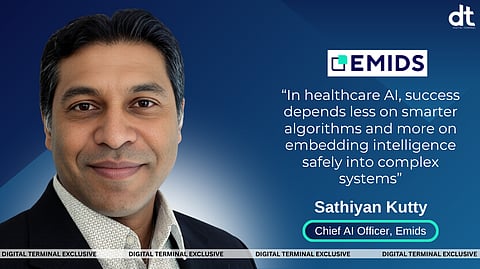

Healthcare AI is moving beyond pilots, yet traditional systems integrator models often fail to deliver real-world outcomes. In this interview, Rajeev Ranjan, Editor at Digital Terminal, talks with Sathiyan Kutty, Chief AI Officer at Emids, about how Emids’ Service as a Software model is driving faster, scalable, and measurable results. They also explore why India is emerging as a key proving ground for healthcare AI.
Rajeev: Why is the traditional systems integrator (SI) model increasingly failing to deliver measurable outcomes in healthcare, especially as AI and digital initiatives move beyond pilot stages?
Sathiyan: The traditional SI model was designed for an era where success was measured by delivery milestones such as systems implemented, features shipped, and integrations completed. That model breaks down in healthcare today, particularly as AI and digital initiatives move from pilots to production. Healthcare is not a greenfield environment. It is deeply fragmented, highly regulated, and shaped by decades of operational and clinical complexity. Delivering technology without embedding that context rarely translates into measurable outcomes.
Most SI-led AI programs stall after pilots because they treat AI as a technology overlay rather than an operational transformation. Models are trained and dashboards are built, but workflows remain unchanged, data quality issues persist, and accountability for outcomes is diffused. The result is innovation theater where proof points exist without scale and investments lack clear ROI. In healthcare, delivering technology without owning outcomes is no longer acceptable.
Traditional SIs also optimize for utilization and billable effort rather than speed to outcome. Their delivery models are linear, handoff-heavy, and detached from frontline realities such as claims operations, care management workflows, clinical decision-making, and regulatory constraints. In healthcare, those gaps are decisive.
As AI becomes embedded in core processes like utilization management, prior authorization, care coordination, and revenue cycle, tolerance for ambiguity drops sharply. Healthcare leaders now demand predictability, KPI ownership, and sustained business impact. The SI model, built around customization and effort-based economics, is increasingly misaligned with that expectation.
Rajeev: How does Emids’ Service as a Software approach fundamentally change the way healthcare enterprises achieve faster, predictable, and KPI-linked outcomes?
Sathiyan: Service as a Software reframes delivery by removing the traditional separation between services, platforms, and outcomes. Instead of selling effort or tools, the model is designed around business KPIs from the start, including cycle time reduction, cost savings, accuracy improvements, regulatory compliance, and member experience outcomes. This shift is particularly relevant in healthcare, where outcomes must be predictable and defensible. Service as Software works because it aligns incentives around results, not activity.
At Emids, Service as a Software brings together healthcare-native expertise, reusable AI-enabled platforms, and outcome-linked delivery accountability into a single operating layer. Engagements begin with clearly defined operational objectives and measurable success metrics rather than long transformation roadmaps. Technology, workflows, and governance are engineered backward from those goals.
This approach significantly shortens time to value. Reusable accelerators, pre-built workflows, and domain-specific AI patterns reduce reinvention. Forward-deployed experts work directly within client environments, minimizing friction between business intent and technical execution. Accountability also extends beyond deployment to sustained performance.
Commercially, the model changes incentives. When outcomes matter more than hours billed, delivery becomes leaner, automation-first, and continuously optimized. In healthcare, where margins are under pressure and regulatory scrutiny is constant, this level of predictability is essential. The result is confidence that AI and digital investments will scale and deliver measurable value over time.
Rajeev: In healthcare AI deployments, why has context become a bigger bottleneck than code, and how do forward-deployed context engineers help bridge this gap?
Sathiyan: The technical barriers to building AI models have dropped significantly, but the complexity of the healthcare environment has not. Context, spanning clinical, operational, regulatory, and human factors, has become the biggest bottleneck to successful AI deployment.
In healthcare AI, context is the difference between insight and impact. Healthcare data is inherently contextual. The same data element can mean different things depending on payer policy, care setting, regulatory rules, or workflow timing. Without understanding how decisions are made by nurses, physicians, claims analysts, and care managers, AI systems generate outputs that may be technically correct but operationally unusable or unsafe.
Forward-deployed context engineers are designed to address this gap. They are healthcare-native professionals with deep domain experience who work embedded alongside client teams. Their role is to translate real-world workflows, constraints, and decision logic into structures that AI systems can reliably interpret and act upon.
By being embedded, they eliminate the lag between design and reality. They observe how work actually happens, surface edge cases early, and ensure regulatory and compliance considerations are built directly into models. They also continuously refine systems based on live operational feedback.
In healthcare AI, success depends less on smarter algorithms and more on embedding intelligence safely into complex systems. Forward-deployed context engineers make that translation possible.
Rajeev: How do platforms like Pacca AI and a healthcare-native ontology enable AI solutions to scale reliably in complex, regulated, and safety-critical healthcare environments?
Sathiyan: Scaling AI in healthcare requires more than model accuracy. It requires trust, governance, repeatability, and resilience across regulated and safety-critical environments. Emids’ Pacca AI, combined with a healthcare-native ontology, provide the foundation needed for reliable scale. At scale, governance matters as much as intelligence.
A healthcare ontology captures institutional knowledge in a formal and reusable way. It defines relationships between data, workflows, personas, policies, and outcomes. Instead of relying on tribal knowledge or hardcoded rules, it creates a shared semantic layer that AI systems can reason over consistently. This is essential in healthcare, where ambiguity and variation are common.
Pacca AI operationalizes this ontology through pre-built workflows, guardrails, and governance mechanisms. It enables AI systems to operate within clear boundaries, defining what can be automated, what requires human oversight, and how exceptions are managed. This structure supports compliance, auditability, and patient safety.
Together, the platform and ontology reduce the risk of brittle, one-off implementations. They enable reuse across use cases while maintaining consistency and control. They also accelerate deployment by eliminating the need to rebuild foundational logic for each initiative.
In healthcare, scale is about confidence as much as speed. By embedding context and governance into the architecture, AI can scale responsibly and predictably.
Rajeev: What lessons can other industries learn from healthcare’s shift toward outcome-based commercial models, and why do you see India as an ideal testbed for healthcare AI at scale?
Sathiyan: Healthcare’s shift toward outcome-based models offers a clear lesson for other industries. Technology delivers value only when accountability is tied to results rather than activity. As margins tighten and regulatory scrutiny increases, healthcare organizations are demanding commercial models aligned to measurable impact, including cost reduction, quality improvement, and operational efficiency.
This shift forces solution providers to design systems that work in real-world conditions, not just controlled environments. It rewards simplicity, automation, and reuse, while penalizing complexity and ambiguity. Other regulated industries such as financial services, energy, and the public sector are moving in a similar direction and can learn from healthcare’s discipline around governance and safety.
India plays a unique role in this evolution. It combines scale, diversity, and deep engineering talent in a way few markets can. India has large and varied patient populations, expanding digital health infrastructure, and growing adoption of AI-driven care and operations.
For healthcare AI, India offers an ideal environment to test scalability and resilience across diverse contexts. Solutions that perform reliably at scale in India are inherently more robust globally. When paired with outcome-based delivery models, India becomes not just a delivery hub, but a proving ground for the future of healthcare AI.
𝐒𝐭𝐚𝐲 𝐢𝐧𝐟𝐨𝐫𝐦𝐞𝐝 𝐰𝐢𝐭𝐡 𝐨𝐮𝐫 𝐥𝐚𝐭𝐞𝐬𝐭 𝐮𝐩𝐝𝐚𝐭𝐞𝐬 𝐛𝐲 𝐣𝐨𝐢𝐧𝐢𝐧𝐠 𝐭𝐡𝐞 WhatsApp Channel now! 👈📲
𝑭𝒐𝒍𝒍𝒐𝒘 𝑶𝒖𝒓 𝑺𝒐𝒄𝒊𝒂𝒍 𝑴𝒆𝒅𝒊𝒂 𝑷𝒂𝒈𝒆𝐬 👉 Facebook, LinkedIn, Twitter, Instagram
