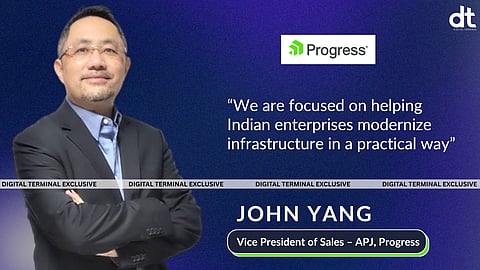

As enterprises accelerate digital transformation across the Asia Pacific region, the need for scalable, secure, and high-performance application delivery is becoming critical. Progress is addressing this with its Kemp LoadMaster, enabling organizations to optimize IT investments while ensuring reliability and security across hybrid environments. In this interaction, Rajeev Ranjan, Editor, Digital Terminal, speaks with John Yang, Vice President of Sales – APJ, Progress, to explore the company’s strategy, innovation approach, and growing focus on India as a key market.
Rajeev: How is Progress Kemp LoadMaster helping enterprises optimize IT investments while scaling their digital infrastructure?
John Yang: Across APJ, we see enterprises under intense pressure to do more with less—tight budgets, lean IT teams, and highly unpredictable demand. Progress helps customers optimize IT investments by enabling them to scale reliability, performance, and security without overbuilding infrastructure.
At the core of this is a shift away from “just in case” capacity planning. With Progress Kemp LoadMaster, organizations can intelligently distribute traffic and scale applications as demand grows, instead of buying excess capacity upfront. That alone has a significant impact on cost efficiency.
We also help reduce total cost of ownership through simplified operations and licensing flexibility. As customers expand from one critical application to many, they benefit from a predictable cost model and lower administrative overhead.
Another important factor is consolidation. LoadMaster combines application delivery and security capabilities—such as load balancing, WAF, authentication, and access control—into a single platform. This reduces tool sprawl, licensing duplication, and operational complexity.
At scale, LoadMaster 360 plays a key role. It provides a unified interface to manage performance, configuration, and security across LoadMaster deployments, which significantly lowers operational overhead as environments grow.
Overall, our approach reflects what we call a practical path to modernization: start small, prove value quickly, then expand—while maintaining enterprise-grade visibility, control, and resilience.
Rajeev: How does Progress Kemp LoadMaster ensure consistent application availability and performance across on‑premise, cloud, and containerized environments?
John Yang: Hybrid is no longer a transition state—it’s the reality for most enterprises in APJ. LoadMaster is designed to act as a consistent traffic management and resilience layer across on-premises, cloud, and hybrid environments.
One of the foundations is continuous health checks combined with automated failover. LoadMaster constantly monitors application health and reroutes traffic automatically when issues occur, minimizing downtime and protecting the user experience.
For customers operating across multiple sites or regions, Global Server Load Balancing is critical. LoadMaster supports GSLB for multisite and multi-cloud deployments, enabling geographic traffic steering and disaster recovery—essential for always-on digital services.
Equally important is deployment consistency. LoadMaster can be deployed on-premise, as a virtual appliance, or in public cloud environments, while delivering the same capabilities for availability, scalability, and security. That means customers can expand gradually without a disruptive rip and replace strategy.
In practical terms, this delivers what enterprises care about most: stable performance during peak usage, automated continuity during disruptions, and the ability to evolve infrastructure at their own pace.
Rajeev: In today’s threat landscape, how does Progress Kemp LoadMaster’s built‑in WAF and security features strengthen application protection?
John Yang: The modern threat landscape is increasingly focused on the application layer, especially as enterprises expose more services to the internet and operate in hybrid environments. Our approach with LoadMaster is to embed security, access control, and trust enforcement directly at the application entry point, rather than treating them as separate silos.
At the foundation is a natively integrated Web Application Firewall (WAF), which protects against Layer‑7 attacks while preserving performance and availability. Because the WAF is built directly into the ADC, security does not come at the cost of user experience or scalability.
Beyond traditional WAF protection, LoadMaster supports Zero Trust principles by enforcing identity aware, application level access controls. Through integrated authentication, preauthentication, and single sign-on, LoadMaster enables a ZTNA style model where users are verified before they ever reach the application—reducing attack surface and eliminating implicit trust based on network location.
This is complemented by broader protections covering the OWASP Top Ten and additional threat categories such as IP reputation filtering, bot and malware detection, webshell protection, and HTTP denial-of-service attacks.
LoadMaster also delivers layered edge security, including reverse proxy capabilities, multifactor authentication, IPS, and SSL inspection. Together, these controls allow customers to secure public facing and internal applications using a least privilege, application centric access model.
With LoadMaster 360, we’ve further simplified how teams operate these security controls. Recent enhancements focus on smarter WAF tuning, reduced false positives, and improved visibility—critical because security must be effective without disrupting legitimate users or increasing operational overhead.
The result is a unified platform that brings WAF, ZTNA-aligned access control, and application security together, helping enterprises strengthen cyber resilience while keeping operations simple and scalable.
Rajeev: How is Progress Kemp LoadMaster supporting modern workloads like Kubernetes and cloud‑native applications?
John Yang: Modernization doesn’t mean abandoning existing systems—it means running cloud native and traditional applications side by side. LoadMaster supports this through its Kubernetes Ingress Controller, which integrates Kubernetes environments with enterprise-grade traffic management and security.
The Ingress Controller automatically provisions virtual services and ingress policies using Kubernetes APIs, adapting dynamically as microservices are added, updated, or scaled.
Architecturally, it operates outside the cluster and routes north south traffic directly to pods, avoiding unnecessary double load balancing. This improves efficiency and simplifies operations.
When pods scale up or down, LoadMaster automatically updates endpoints in real time, ensuring traffic is always routed correctly without manual intervention.
Importantly, customers can apply the same enterprise services—WAF, access control, Layer‑7 traffic management, and geographic routing—to Kubernetes workloads as they do to legacy applications. This provides consistency across the entire application portfolio.
Rajeev: How does your partnership with RoundRobin strengthen your go‑to‑market strategy and customer engagement in India?
John Yang: In markets like India, partners are essential—not just for reach, but for execution. RoundRobin strengthens our go-to-market strategy by bringing strong local technical capability and deep product expertise.
They have certified teams on the ground who can support proof of‑ ‑concepts, demonstrations, training, and full implementations. This lowers adoption risk and accelerates time to value for customers.
RoundRobin also has accreditations across multiple Progress solutions, including Kemp LoadMaster, Progress Flowmon, Progress MOVEit, Progress WhatsUp Gold, Progress Sitefinity and Progress DataDirect. That allows us to engage customers across the full lifecycle—from infrastructure performance and security to data movement and visibility.
Their presence in India, combined with regional ties to Singapore and Dubai, aligns well with how many APAC enterprises operate—regionally but with local execution. It’s a strong example of our partner led growth strategy in action.
Rajeev: What are the key focus areas and growth priorities for Progress in the Indian market in 2026?
John Yang: India is a strategic market for Progress, both as a growth engine and as a center of excellence.
First, we are continuing to scale India as a hub for engineering talent and AI-driven innovation through our Global Capability Center model. Our teams across Hyderabad, Bengaluru and New Delhi play an increasingly important role in product development and long-term innovation.
Second, we are focused on helping Indian enterprises modernize infrastructure in a practical way, addressing hybrid environments, budget constraints and rising expectations for always-on digital services. Load balancing remains a mission critical foundation for performance, availability and security under unpredictable demand.
Third, security forward infrastructure is a major priority. Features like integrated WAF, smarter tuning, and centralized visibility through LoadMaster 360 directly address customer concerns around cyber resilience without increasing complexity.
Finally, partner led execution is central to our growth strategy. Relationships like RoundRobin reflect our commitment to enabling partners with the technical depth and accreditation needed to scale adoption across India’s diverse enterprise and midmarket landscape.
𝐒𝐭𝐚𝐲 𝐢𝐧𝐟𝐨𝐫𝐦𝐞𝐝 𝐰𝐢𝐭𝐡 𝐨𝐮𝐫 𝐥𝐚𝐭𝐞𝐬𝐭 𝐮𝐩𝐝𝐚𝐭𝐞𝐬 𝐛𝐲 𝐣𝐨𝐢𝐧𝐢𝐧𝐠 𝐭𝐡𝐞 WhatsApp Channel now! 👈📲
𝑭𝒐𝒍𝒍𝒐𝒘 𝑶𝒖𝒓 𝑺𝒐𝒄𝒊𝒂𝒍 𝑴𝒆𝒅𝒊𝒂 𝑷𝒂𝒈𝒆𝐬 👉 Facebook, LinkedIn, Twitter, Instagram
