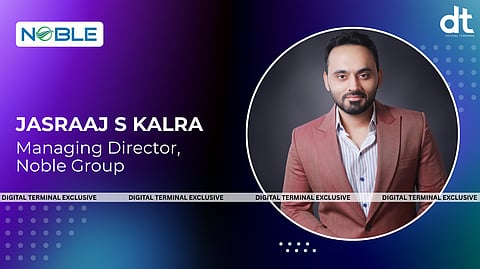

India’s electronics manufacturing ecosystem is undergoing a rapid transformation, driven by deeper localization, rising domestic demand, and increasing emphasis on design-led production. As global brands strengthen their commitment to the Indian market, the role of integrated OEMs and ODM partners has become more crucial than ever. In this context, Rajeev Ranjan, Editor, Digital Terminal, engaged in an exclusive conversation with Jasraaj S. Kalra, Managing Director, Noble Group, to understand how the company is contributing to India’s manufacturing self-reliance, strengthening supply chains, and shaping the next phase of the Make in India journey.
Rajeev: How do you see localization transforming India’s electronics manufacturing sector, and what role is Noble Group playing in advancing the Make in India vision?
Jasraaj: Localization is reshaping Indian electronics in a very fundamental way. Earlier, a large part of the value sat outside the country in the form of imported components and semi-finished products. Now, more design, engineering and production happens within India. This keeps more value in the ecosystem and makes the supply chain more resilient.
For me, Make in India is not only about assembling in India. It is about building capability here. That includes tooling, plastics, PCB assembly and testing. At Noble Group we have spent years building these blocks under one roof. We support OEM and ODM production for consumer appliances and work closely with brands that want to localise more of their portfolio in India.
As localisation deepens I believe India will move from being a cost centre for manufacturing to being a capability centre. That is the shift we want to be part of.
Rajeev: Why is vertical integration and in-house product design becoming critical for reducing import dependence and strengthening India’s manufacturing self-reliance?
Jasraaj: Vertical integration and in-house design give manufacturers control over three important things. Quality, speed and cost. When you depend heavily on imported tools and key parts you are exposed to currency swings, logistics delays and policy changes in other countries. It also becomes harder to respond quickly to changes in demand.
When design, tooling, plastics, sheet metal and PCB assembly sit inside one ecosystem, the feedback loop is much faster. Engineering teams can improve products in shorter cycles. Procurement and production teams can plan with better visibility. This is how you gradually cut down import dependence without compromising on performance.
For India, self reliance in manufacturing will not come from one big shift. It will come from many medium sized steps. More in-house design. More local component development. More integration between different processes on the shop floor. Vertical integration is a very practical way to move in that direction.
Rajeev: With India’s electronics manufacturing projected to cross USD 300 billion by 2026, what capacity expansion strategies should OEMs adopt to stay competitive?
Jasraaj: The growth projection is encouraging. At the same time it brings responsibility for OEMs. Capacity expansion cannot only be about adding more lines or more square feet. It has to be planned around demand patterns, product mix and technology shifts.
I see three priorities. First, build flexible capacity. Lines that can handle more than one model or category offer better utilisation across the year. Second, invest in automation and data visibility. This helps in improving yields and reducing rework as volumes grow. Third, align expansion with stronger localisation. Additional capacity should pull in more local suppliers and component partners.
For OEMs, scale without discipline can create as many problems as it solves. The focus should be on smart capacity. Factories that can grow with demand and adapt to new products without long lead times. That will decide who stays competitive over the next decade.
Rajeev: How is Noble Group building resilient, localized supply chains, and what advantages do such supply chains offer to global electronics brands operating in India?
Jasraaj: Resilient supply chains start with clarity on what must be built close to the factory and what can sit further away. For key parts and tools we prefer closer control. We have in-house tool rooms, plastics and sheet metal facilities and our own PCB assembly. This reduces our reliance on long and complex import chains.
We also work with a network of local suppliers for materials and sub assemblies. The goal is to shorten lead times and reduce single point dependencies. During periods of global disruption this approach has helped us maintain continuity for our customers.
Rajeev: Indian OEMs are moving from contract manufacturing toward co-innovation. How is Noble Group enabling co-development and design-led manufacturing for leading brands?
Jasraaj: The conversation with brands has definitely changed. Earlier, many engagements were limited to “build as per this drawing”. Now, more partners want support in design improvement, cost engineering and feature innovation. This is a positive shift for the whole ecosystem.
At our end, we involve our design, tooling and process teams early in the product discussion. We look at how the product can be made more efficient to manufacture, how components can be standardised, and where we can improve performance or durability. Sometimes these are small changes that have a large impact over volume.
Rajeev: As global demand rises, what are the biggest opportunities and challenges for India to achieve full value-chain ownership in electronics manufacturing?
Jasraaj: The opportunity is clear. India has a large domestic market, strong engineering talent and supportive policy frameworks. If we build the full value chain here, from design to components to final assembly, we can serve both India and global markets from the same base. That is a very powerful position to be in.
The challenges are also real. Component ecosystems in some categories are still developing. Skill gaps in advanced processes need attention. Long term capital investment in tools, testing and automation requires confidence and patience. Coordination between different stakeholders is not always easy.
To achieve full value chain ownership we will need three things working together. Deep localisation of components. Continuous investment in skills and technology. And a long term commitment from both industry and policy makers. If we stay consistent on these three fronts, I believe India can move from being a manufacturing alternative to being a manufacturing leader in electronics.
𝐒𝐭𝐚𝐲 𝐢𝐧𝐟𝐨𝐫𝐦𝐞𝐝 𝐰𝐢𝐭𝐡 𝐨𝐮𝐫 𝐥𝐚𝐭𝐞𝐬𝐭 𝐮𝐩𝐝𝐚𝐭𝐞𝐬 𝐛𝐲 𝐣𝐨𝐢𝐧𝐢𝐧𝐠 𝐭𝐡𝐞 WhatsApp Channel now! 👈📲
𝑭𝒐𝒍𝒍𝒐𝒘 𝑶𝒖𝒓 𝑺𝒐𝒄𝒊𝒂𝒍 𝑴𝒆𝒅𝒊𝒂 𝑷𝒂𝒈𝒆𝐬 👉 Facebook, LinkedIn, Twitter, Instagram
