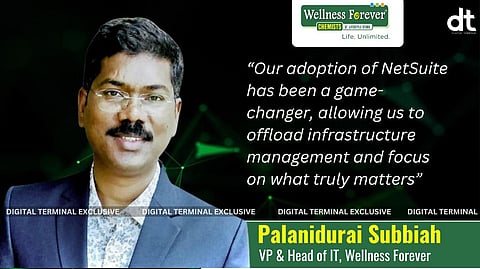

In today’s fast-evolving technology world, adopting the right solution like NetSuit can assist companies to focus more on strategic initiatives. Rajeev Ranjan, Editor of Digital Terminal indulged with Palanidurai Subbiah, Vice President & Head of IT, Wellness Forever in a candid discussion on emerging technologies, their journey of digital transformation, and many other pressing topics. Here is the excerpt:
Rajeev: Could you provide an overview of your organization and describe the nature of its business operations?
Palanidurai: Wellness Forever is a prominent retail pharmacy chain in India, recognized as the third-largest in the country. We operate over 450 stores nationwide, with a significant presence in Maharashtra, Karnataka, Goa, and Madhya Pradesh. Our organization comprises a dedicated team of approximately 5,000 professionals. We pride ourselves on being a 24/7 service provider, with most of our pharmacies open around the clock to ensure uninterrupted access to essential medications. Our commitment to customer convenience is further enhanced by our hyperlocal delivery model, seamlessly integrating online and offline platforms to meet diverse healthcare needs.
Rajeev: Could you provide an overview of your organization's digital journey over the past 4-5 years? What specific challenges did you encounter during this period, and how did these experiences influence your decision to adopt the Oracle platform?
Palanidurai: We previously operated on a decade-old legacy system, which presented significant challenges, particularly in integration and real-time data retrieval. In today's interconnected ecosystem, seamless integration with e-commerce channels, aggregators, and partners is essential. To address these challenges, we developed bespoke middleware applications to meet emerging needs promptly.
Additionally, we continuously evolved our infrastructure and application ecosystem to shorten our go-to-market timelines. For instance, five years ago, we embarked on our e-commerce journey, enabling real-time inventory tracking across all stores and committing to two-hour medicine deliveries. Today, we are integrated with various marketplaces, payment gateways, and delivery systems, creating a well-connected ecosystem.
Rajeev: Could you provide an overview of your digital transformation journey, especially focusing on the adoption of Oracle NetSuite? When did this initiative commence?
Palanidurai: Last year, we successfully implemented Oracle NetSuite, which has significantly transformed our operations. NetSuite now serves as the foundational platform for our entire application ecosystem, enhancing our integration capabilities across various systems. This shift has resolved previous challenges associated with our legacy systems, particularly in achieving seamless and secure integrations with external partners. Additionally, NetSuite has introduced substantial automation within our enterprise processes, notably in finance and partner collaborations, streamlining operations and fostering a more cohesive and efficient environment.
Rajeev: Could you please elaborate on the implementation and integration processes, including the final deployment? Were there any challenges encountered during these phases?
Palanidurai: We started the project last year, but due to organizational changes, it was delayed and resumed in December, requiring us to restart from scratch with just 90 days. We took a structured approach, beginning with market data corrections and a minimum viable deployment to ensure efficiency.
To drive adoption, we implemented a "train the trainer" model with a dedicated learning platform, ensuring a smooth transition from the decade-old system. Data migration was prioritized early, focusing on cleaning and seamless integration with NetSuite’s native automation features. A major challenge arose in March when processing 100,000+ invoices, leading us to develop a custom script that scaled transaction handling to over 200,000 entries, significantly improving efficiency. Today, we process 150,000 invoices monthly and 30,000–40,000 payments weekly with just a few clicks.
Beyond payments, we automated rental transactions, term loan interest, and franchise royalty calculations, drastically reducing manual work. Our in-house team leveraged NetSuite’s JavaScript framework to build these capabilities with minimal training. Overall, this transition has been transformative, enhancing scalability, automation, and operational efficiency, positioning us for future growth.
Rajeev: How has the work experience been after implementing Oracle NetSuite?
Palanidurai: The speed of delivery has improved significantly, especially in corporate processes. Communication, once spread across multiple channels, is now centralized within NetSuite. Requests automatically convert into purchase orders, with a seamless approval process, eliminating the need for manual follow-ups or email confirmations.
Everything is now within a collaborative platform, providing complete visibility and reducing manual effort. Additionally, we’re extending this system to partners and vendors, enabling direct access to financial statements and receivables, enhancing efficiency and transparency while minimizing back-and-forth communication.
Rajeev: With IT and finance playing a crucial role, how do you see growth and innovation evolving, especially with AI shaping the future?
Palanidurai: We've seen a major transformation, with teams across functions becoming more self-reliant. Today, many employees create dashboards, saved searches, and customized records in NetSuite with minimal training, reducing tech team dependency. This empowerment has boosted confidence, engagement, and productivity.
To support this, our Train the Trainer program ensures continuous learning and problem-solving. We're also integrating machine learning and AI agents to automate complex tasks beyond traditional RPA. In accounts payable, we've implemented OCR automation in the US and developed an in-house APA solution for India.
Looking ahead, AI agents will streamline AP, customer support, and cost management, improving efficiency while maintaining a human touch where needed. By empowering teams, leveraging AI, and collaborating with partners, we're driving continuous innovation and operational excellence.
Rajeev: How can partner solutions like Oracle NetSuite drive efficiency and growth? What advice do you have for emerging IT leaders navigating these tools for the first time?
Palanidurai: Technology should never be viewed as a one-size-fits-all solution. Organizations must carefully evaluate platforms like Oracle NetSuite to ensure they align with their specific industry needs and market dynamics. The right choice of technology can streamline operations, enhance productivity, and provide long-term scalability.
For emerging IT leaders, the key is to stay informed and adaptable. The technology landscape is constantly evolving, with disruptive innovations like DeepSeek, shaping entire industries. Leaders must keep an eye on emerging trends and be willing to explore alternative solutions beyond traditional, high-cost options. Sometimes, it's not just about budget constraints but about finding efficient, scalable, and innovative approaches to problem-solving.
Even with limited resources, IT teams can achieve significant efficiencies by leveraging open-source tools, cloud solutions, and automation frameworks. A small setup with an 8GB machine or a basic multi-core processor can still run powerful use cases if optimized effectively. The most important aspect is mindset—embrace new possibilities, experiment with innovative tools, and continuously seek ways to optimize and scale.
Ultimately, success in IT leadership comes from a combination of strategic thinking, adaptability, and a proactive approach to technology adoption.
Rajeev: Looking ahead, how do you see your organization’s digital transformation evolving over the next 1 to 3 years with Oracle solutions? What are your key expectations for growth and innovation, and what would be your core message for the future?
Palanidurai: Our adoption of NetSuite has been a game-changer, allowing us to offload infrastructure management and focus on what truly matters which is scaling efficiently and driving innovation. With streamlined financial processes and automated workflows, we can allocate more resources to enhancing customer experience, optimizing front-end applications, and improving employee engagement.
A major focus for us is personalization—both for our customers and employees. We aim to deliver a seamless in-store experience while ensuring our workplace fosters collaboration and efficiency. On the data front, we are working towards integrating conversational AI, enabling employees, partners, and stakeholders to interact with data effortlessly and derive personalized insights in real time.
Looking ahead, our core message remains clear: embrace agility, prioritize innovation, and leverage data-driven decision-making to stay ahead in a rapidly evolving landscape.
𝐒𝐭𝐚𝐲 𝐢𝐧𝐟𝐨𝐫𝐦𝐞𝐝 𝐰𝐢𝐭𝐡 𝐨𝐮𝐫 𝐥𝐚𝐭𝐞𝐬𝐭 𝐮𝐩𝐝𝐚𝐭𝐞𝐬 𝐛𝐲 𝐣𝐨𝐢𝐧𝐢𝐧𝐠 𝐭𝐡𝐞 WhatsApp Channel now! 👈📲
𝑭𝒐𝒍𝒍𝒐𝒘 𝑶𝒖𝒓 𝑺𝒐𝒄𝒊𝒂𝒍 𝑴𝒆𝒅𝒊𝒂 𝑷𝒂𝒈𝒆𝐬 👉 Facebook, LinkedIn, Twitter, Instagram

