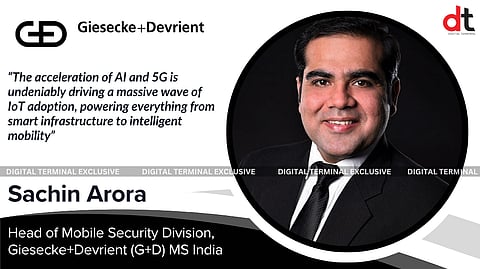

As India embraces rapid digitalization, the need for secure and sustainable connectivity has never been greater. Technologies like eSIM and iSIM are now at the heart of this transformation. In an exclusive interaction, Rajeev Ranjan, Editor, Digital Terminal, spoke with Sachin Arora, Head of Mobile Security Division at Giesecke+Devrient (G+D) MS India, to explore how next-gen SIM technologies are enabling greener, more scalable IoT ecosystems.
Rajeev: What roles do technologies like eSIMs play in enabling more sustainable and scalable IoT solutions?
Sachin: As IoT adoption accelerates across sectors from smart cities and connected healthcare to industrial automation and mobility—we need to have solutions that are both sustainable and scalable. Traditional challenges here are hardware waste, frequent replacements, and high energy usage, making it imperative to rethink how devices are connected and managed over their lifecycle.
Technologies like eSIMs are central to addressing these challenges. G+D together with Fraunhofer IZM conducted an independent life cycle assessments, which confirmed that eSIMs are significantly more eco-friendly than traditional SIM cards. Giesecke+Devrient (G+D) is the only company in the market with published life cycle data demonstrating these sustainability benefits.
From a sustainability standpoint, eSIMs reduce hardware waste, transportation and carbon footprint by enabling remote provisioning and supporting multiple profiles on a single device. This eliminates the need for frequent physical SIM replacements, streamlines logistics, and extends the operational lifespan of connected devices—making large-scale IoT deployments more resource-efficient and cost-effective.
Looking ahead, the shift toward integrated SIM (iSIM) technology marks a major step forward. At just one-tenth the size of an eSIM, iSIMs further minimize material usage and power consumption. They also unlock even greater scalability and energy efficiency, which are essential for powering the next generation of smart infrastructure, mobility solutions, and low-power IoT applications.
Rajeev: With AI and 5G accelerating IoT adoption, how do you envision balancing rapid connectivity with environmental responsibility?
Sachin: The acceleration of AI and 5G is undeniably driving a massive wave of IoT adoption, powering everything from smart infrastructure to intelligent mobility. However, this surge in connectivity must be met with a clear-eyed view of its environmental footprint especially when it comes to data centre operations, which underpin much of this digital ecosystem.
At Mobile Security, G+D balances rapid digitalization with environmental responsibility. The approach begins with small, energy-efficient data centres designed for purpose rather than scale. In fact, data centres account for only 7% of our electricity consumption, despite supporting the activation and management of millions of SIM profiles annually.
To offer perspective: if end users behind those profiles watched just 1h of YouTube on a small smart phone screen, this one hour would consume 79 times the electricity used by our data centres in one year.
This underscores two important points:
1. Not all digital infrastructure has to be power-hungry, especially when designed with optimization and sustainability in mind.
2. The environmental narrative around data centres is nuanced size, design efficiency, and electricity sourcing matter.
G+D ensure that 100% of the electricity used in SIM-related data centres is sourced from renewable energy. Even in environments with strict data security requirements, like our facility in Stockholm, we’ve proven that sustainability and data security are not mutually exclusive—through practices such as hardware reuse and efficient lifecycle management.
As the ecosystem scales with AI and 5G, responsible tech adoption will hinge on smart design, conscious energy choices, and a commitment to lifecycle sustainability. It’s not just about connecting more devices but doing so in a way that respects both the user and the planet.
Rajeev: How does secure connectivity contribute to sustainability in the IoT space? Is there a trade-off between security and environmental impact?
Sachin: Secure connectivity is not only compatible with sustainability, but also a key enabler of it. In the Internet of Things (IoT) ecosystem, devices often operate in remote or resource-constrained environments, where energy efficiency and long-term functionality are critical. Secure connectivity solutions ensure that these devices remain resilient against cyber threats, thereby avoiding data breaches, service disruptions, or hardware damage all of which could lead to premature device replacement or increased energy use.
Far from being a trade-off, security in IoT reinforces environmental responsibility. By safeguarding smart grids, connected transportation, and energy monitoring systems, secure connectivity ensures that the environmental benefits of these technologies—such as reduced emissions, optimised energy use, and efficient resource management—are reliably delivered over time.
In summary, sustainability, and security in the IoT space go hand in hand. Investing in secure connectivity is not just about protection, it’s about enabling the full potential of sustainable digital transformation.
Rajeev: Are there any regulatory or standards-based interventions that you believe are essential to support sustainable IoT growth in India?
Sachin: To unlock the full potential of sustainable IoT in India, regulatory and standards-based interventions are essential across several foundational areas. Without these, the rapid proliferation of connected devices could lead to fragmentation, inefficiencies, and increased digital waste.
1. Standardization of IoT Protocols and Security Frameworks:
Currently, India lacks harmonized standards for IoT implementations, especially when it comes to technologies like eSIMs. While there are some domain-specific mandates such as AIS 140 for automotive telematics, broader adoption of GSMA standards like SGP.32 for Remote SIM Provisioning (RSP) remains limited. Most IoT deployments today still rely on traditional SIMs in MFF2 form factors with limited profile management. Establishing national guidelines aligned with global standards—but tailored to India's unique market—can ensure interoperability, improve device longevity, and reduce digital obsolescence.
2. Regulations on Data Privacy and Device Identity Management:
Sustainable IoT isn’t just about reducing hardware waste it’s also about secure, long-term usability. Enforcing standards for secure device onboarding, remote lifecycle management, and the use of embedded secure elements (such as eSIMs) will ensure that connected devices remain secure, updateable, and serviceable over extended periods.
3. Mandating Lifecycle Transparency and Device Management:
There is a critical need for regulatory frameworks that promote visibility into the entire lifecycle of an IoT device—from provisioning and active usage to deactivation and retirement. Mandating lifecycle management protocols can help reduce the number of inactive or "zombie" devices that clutter networks and consume unnecessary resources.
At Giesecke+Devrient (G+D), we strongly advocate for collaborative efforts between government, regulatory bodies, and industry stakeholders to shape a forward-looking, sustainable IoT ecosystem in India.
Rajeev: What are the top priorities for G+D in driving sustainable digital connectivity in India over the next few years?
Sachin: At G+D India, sustainability is deeply embedded in our innovation and connectivity strategy. As India accelerates its digital transformation, our top priorities in driving sustainable digital connectivity over the next few years include:
Promoting eSIM and Remote SIM Provisioning (RSP) for Scalable IoT Adoption: eSIM technology is central to reducing environmental impact in large-scale IoT deployments. By eliminating the need for frequent physical SIM replacements and enabling remote profile management, eSIMs significantly lower plastic usage and improve operational efficiency. G+D is actively working with telecom operators and enterprises across sectors—such as smart cities, logistics, and manufacturing—to accelerate eSIM and RSP adoption in India.
Driving Secure and Efficient Device Lifecycle Management: We are focused on solutions that support secure device onboarding, seamless remote updates, and efficient end-of-life management. These capabilities reduce the need for manual intervention, lower system-level waste, and ensure that IoT devices remain secure and functional over extended lifespans.
Localizing Sustainable Innovation: G+D is committed to building a green and resilient digital ecosystem in India. This includes localized SIM personalization, the establishment of secure and energy-efficient data centers, and the development of orchestration platforms that reduce energy consumption while maintaining high performance.
Advocating Digital Sustainability Across the Ecosystem: We continue to engage with regulators, OEMs, and service providers to push for sustainability best practices—such as adoption of modular SIM form factors, reduced packaging, and responsible device decommissioning. Our goal is to ensure that sustainability is built into the DNA of every digital connectivity solution.
By aligning our technological leadership with strong sustainability goals, G+D aims to play a catalytic role in shaping a greener and more responsible digital infrastructure in India.
𝐒𝐭𝐚𝐲 𝐢𝐧𝐟𝐨𝐫𝐦𝐞𝐝 𝐰𝐢𝐭𝐡 𝐨𝐮𝐫 𝐥𝐚𝐭𝐞𝐬𝐭 𝐮𝐩𝐝𝐚𝐭𝐞𝐬 𝐛𝐲 𝐣𝐨𝐢𝐧𝐢𝐧𝐠 𝐭𝐡𝐞 WhatsApp Channel now! 👈📲
𝑭𝒐𝒍𝒍𝒐𝒘 𝑶𝒖𝒓 𝑺𝒐𝒄𝒊𝒂𝒍 𝑴𝒆𝒅𝒊𝒂 𝑷𝒂𝒈𝒆𝐬 👉 Facebook, LinkedIn, Twitter, Instagram
