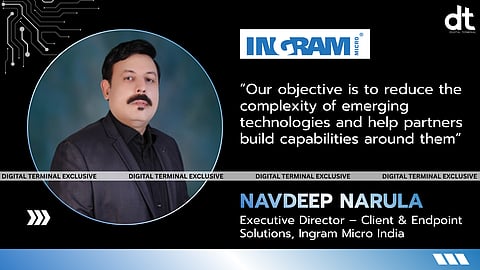

As India’s consumer technology landscape shifts towards AI-powered devices, connected ecosystems, and experience-led adoption, the role of technology distribution is evolving beyond traditional product fulfilment. In this exclusive conversation with Rajeev Ranjan, Editor, Digital Terminal, Navdeep Narula, Executive Director – Client & Endpoint Solutions, Ingram Micro India, shares his perspective on emerging consumer technology trends, the growing opportunity around AI, IoT and smart devices, the transformation of digital distribution, and how Ingram Micro is enabling its partner ecosystem to capture the next phase of technology growth in India.
Rajeev: Consumer technology in India is evolving rapidly, with growing demand for connected devices and smart solutions. What key trends are currently driving growth in this segment, and where do you see the biggest opportunities over the next few years?
Navdeep: Consumer technology market is undergoing a fundamental shift. We are moving from a world where consumers bought individual devices to one where they increasingly invest in experiences, ecosystems and outcomes.
One of the most important trends is the convergence of devices. The smartphone, for example, is no longer simply a communication device; it is becoming the orchestrator of a much larger connected ecosystem encompassing wearables, hearables, smart homes, automobiles, entertainment and increasingly AI-enabled experiences. I see this as a shift from the “smartphone as the centre of the universe” to the smartphone as the conductor of a connected orchestra.
AI is going to accelerate this transformation significantly. AI-enabled PCs, smartphones and other endpoints will increasingly make technology more contextual, personalised and useful. We are already seeing AI move from being a feature to becoming an integral part of the user experience.
Another important trend is premiumisation. Indian consumers are increasingly willing to pay for utility and experience, not merely specifications. This trend is also moving beyond the metros, as better connectivity and increasing digital fluency democratise access to premium technology across Tier 2, Tier 3 and smaller markets.
The biggest opportunities, therefore, will be around AI-powered computing, smart homes, gaming, connected devices, cybersecurity, wearables and solutions that bring multiple technologies together into a seamless experience.
Rajeev: Technology distribution today goes far beyond product availability. How is the role of distributors evolving to help brands and partners deliver integrated, solution-led offerings to customers?
Navdeep: Distribution is no longer simply about moving boxes from point A to point B. The distributor is increasingly becoming the connective tissue between technology innovation, vendors, partners and end customers. Technology is becoming more complex, while customers want the experience to become simpler. That is where the distributor's role becomes increasingly important.
A channel partner today needs much more than product availability. They need access to technology expertise, financing, digital marketplaces, training, solution design, logistics, lifecycle management and increasingly, business intelligence. Our role is to bring these capabilities together and help partners convert technology complexity into customer value.
This is particularly important as we move from selling products to selling solutions and experiences. Whether it is an AI PC, a smart-home environment, a cybersecurity solution or a cloud service, the customer is ultimately looking for an outcome rather than a specification sheet.
At Ingram Micro, we have been investing in this evolution through our digital capabilities, ecosystem of technology vendors, financial solutions, technical enablement and the Xvantage platform. The objective is to make distribution more intelligent, more intuitive and more valuable to the partner.
Rajeev: As businesses increasingly adopt IoT, automation, and connected technologies, what are the biggest challenges channel partners face, and how is Ingram Micro helping them capitalize on these emerging opportunities?
Navdeep: The opportunity is enormous, but the biggest challenge is that technology ecosystems are often developing faster than the ecosystem around them.
Take smart homes as an example. We have smart lighting, smart security, surveillance, appliances, entertainment and automation solutions, but many manufacturers continue to operate within proprietary platforms. The customer therefore faces a fragmented experience, with questions around interoperability, security and ease of management.
This is where the channel has an important role to play. Partners must evolve from being product resellers to becoming solution curators and integrators.
I believe there is a significant opportunity for partners and ISVs to build “smart home in a box” or modular solutions that bring multiple technologies together and allow consumers to progressively build their connected environment. The same principle applies to enterprise IoT and AI.
At Ingram Micro, we help partners make that transition through vendor access, technical training, solution expertise, financing and business enablement. Our objective is to reduce the complexity of emerging technologies and help partners build capabilities around them.
The partner who can explain not just what the technology is, but what problem it solves and what business outcome it creates, will be the partner who wins. And our goal is to reduce complexity for partners so they can focus on creating value for their customers and expanding into higher-growth technology segments.
Rajeev: Digital procurement and e-commerce platforms are transforming how businesses purchase technology. How do you see digital platforms reshaping the distribution ecosystem and enhancing partner efficiency?
Navdeep: Digital transformation is changing distribution from transactions to interactions.
Partners increasingly expect a digital experience that is as intuitive as the consumer experience they encounter in their personal lives. They want to discover products, check availability, obtain pricing, transact, access financing, manage subscriptions and receive support through a seamless digital journey.
This is why platforms such as Xvantage are important. The opportunity is not simply to digitise the traditional distribution process, but to use data, AI and intelligence to make the ecosystem more proactive and relevant.
I have always believed that consumerisation has an important role to play in IT distribution. The end customer should have a simpler and more intuitive buying experience, while the partner should have better tools to make faster and more informed business decisions.
The next phase will go beyond e-commerce. AI will increasingly help partners understand what customers need, recommend solutions, simplify procurement and identify new opportunities. This can fundamentally improve productivity and enable partners to scale without adding the same level of operational complexity.
Rajeev: Looking ahead, how is Ingram Micro preparing its partner ecosystem for the next phase of growth in India? Do share more about your partner strength and partner program as well.
Navdeep: I see the next phase of growth being driven by AI, intelligent endpoints, cloud, cybersecurity, networking, IoT, smart surveillance, collaboration, edge computing and data-driven infrastructure.
AI will be the biggest catalyst because it is not confined to one category. It is influencing smartphones, PCs, data centres, applications, security and increasingly the way people interact with technology. AI PCs and intelligent endpoints, in particular, will become important as workloads increasingly move between the cloud and the device, enabling greater personalisation, responsiveness and privacy.
At the same time, India’s technology opportunity is becoming much more geographically distributed. We see technology adoption move rapidly into Tier 2, Tier 3 and smaller markets. Better connectivity is acting as a great equaliser, while rising digital fluency and aspirations are creating demand for more sophisticated technology experiences.
Another structural shift will be Everything-as-a-Service. Businesses increasingly want technology without the traditional constraints of ownership, obsolescence and large upfront capital expenditure. Subscription, leasing, financing and pay-per-use models can make advanced technology more accessible while creating recurring revenue opportunities for partners.
For Ingram Micro, preparing our ecosystem for this next phase means enabling partners across the entire technology lifecycle—not simply giving them access to products. We bring together a broad vendor ecosystem with digital platforms, technical enablement, training, financing and specialised capabilities to help partners move into emerging technology categories. Our partner programs are designed to help partners build new competencies, develop solution-led businesses and create recurring revenue streams.
Ultimately, I believe the future of distribution will be defined by how effectively we can create value for the entire ecosystem—vendors, partners and customers. Our role is to make technology easier to access, easier to integrate and easier to monetise.
India is entering an exciting phase where technology adoption is no longer just about owning the latest device. It is about creating connected, intelligent and increasingly personalised experiences. The opportunity for the channel is to be at the centre of that transformation.
𝐒𝐭𝐚𝐲 𝐢𝐧𝐟𝐨𝐫𝐦𝐞𝐝 𝐰𝐢𝐭𝐡 𝐨𝐮𝐫 𝐥𝐚𝐭𝐞𝐬𝐭 𝐮𝐩𝐝𝐚𝐭𝐞𝐬 𝐛𝐲 𝐣𝐨𝐢𝐧𝐢𝐧𝐠 𝐭𝐡𝐞 WhatsApp Channel now! 👈📲
𝑭𝒐𝒍𝒍𝒐𝒘 𝑶𝒖𝒓 𝑺𝒐𝒄𝒊𝒂𝒍 𝑴𝒆𝒅𝒊𝒂 𝑷𝒂𝒈𝒆𝐬 👉 Facebook, LinkedIn, Twitter, Instagram
