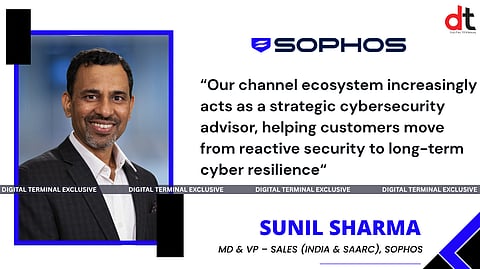

With businesses placing sharper focus on security, compliance, and uninterrupted operations, Sophos is emerging as a preferred cybersecurity partner for organizations navigating an increasingly complex threat landscape. In an exclusive interaction with DT, Sunil Sharma, Managing Director & Vice President – Sales (India & SAARC), Sophos, shares perspectives on business growth, AI-led innovation, partner strategy, and priorities for the year ahead.
Q: Please tell us about your overall business performance in 2025. What have been the most significant factors driving the company’s growth?
A: 2025 was a strong year of growth for Sophos in India and the SAARC region, driven by a structural shift in how organizations approach cybersecurity. Businesses are moving away from isolated security tools toward integrated, outcome-driven platforms that deliver measurable resilience.
The biggest growth driver was accelerated adoption of Managed Detection and Response (MDR) and Extended Detection and Response (XDR), particularly among mid-market and distributed enterprises that lack large in-house security teams. As cyberattacks continue to increase in speed and scale with India reportedly facing hundreds of millions of attempted attacks annually, organizations are prioritizing continuous protection and rapid response over traditional perimeter defenses.
Another key factor was our partner-led expansion. Our channel ecosystem increasingly acts as a strategic cybersecurity advisor, helping customers move from reactive security to long-term cyber resilience. In India’s fast-digitizing economy, trusted local partnerships backed by global intelligence are becoming essential.
Q: With AI becoming central to innovation, what does your 2026 product roadmap look like, particularly in terms of AI powered advancements?
A: At Sophos, AI is not an add-on, it is embedded across the security lifecycle. Our 2026 roadmap focuses on adaptive, AI-native protection that automatically adjusts based on user behavior, device posture, identity signals, and risk context.
We are expanding behavioral AI models that detect attacker techniques rather than just malware signatures. This includes AI-assisted investigation, automated case summarization, and guided remediation workflows that reduce response times from days to minutes.
However, we firmly believe AI must be human led. The goal is not to replace security professionals, but to scale their judgment. Transparent, explainable, and human-in-the-loop Responsible AI will shape the next era of cybersecurity innovation.
In a market like India, where the cybersecurity skills gap remains significant, AI serves as a force multiplier that brings enterprise-grade protection within reach of organizations of every size.
Q: What concrete steps are you taking to further strengthen partner engagement and long term channel collaboration?
A: Sophos is fundamentally channel-led. Our strategy is centered on enabling partners to deliver security outcomes, not just deploy products.
We are expanding managed service enablement, advanced training programs, and access to global threat intelligence so partners can operate as full-scale security providers. Our focus is on recurring, service-led business models that create predictable growth and long-term customer relationships.
In India, we are also investing in deeper technical engagement, solution architecture support, and localized expertise so partners can confidently support increasingly complex hybrid environments.
The future of cybersecurity in India will be partner-delivered security operations that are powered by global AI and intelligence but executed with local trust and accountability.
Q: How is your organization supporting the Make in India initiative, and what role does localization play in your future growth plans?
A: In cybersecurity, localization is about trust, capability, and resilience. Our approach supports India’s digital sovereignty by strengthening regional expertise, expanding local technical resources, and aligning with evolving regulatory requirements such as the DPDP Act. Our FW & EP are empanelled as Make In India Product on Government e-market portal.
We are investing in talent development, partner upskilling, and faster regional incident response capabilities. As India’s digital economy expands, organizations require global-grade protection delivered with local understanding.
Localization ensures innovation is embedded within India’s cybersecurity ecosystem not simply imported.
Q: What are your top strategic priorities for 2026 across revenue, expansion, and market positioning?
A: Our primary priority is helping organizations transition from reactive security to measurable cyber resilience.
In 2026, we will focus on:
Expanding MDR and platform adoption across new industry verticals
Strengthening partner-led security operations beyond metro markets
Deepening integration across identity, cloud, endpoint, and network security
Positioning cybersecurity as a business outcome — measured in uptime, reduced risk, and operational continuity
As the industry consolidates around integrated platforms, Sophos is positioned at the intersection of AI-native architecture, human-led expertise, and a strong partner ecosystem.
Our mission remains clear: democratize cybersecurity leadership so every organization in India regardless of size has access to superior security outcomes.
Quick Bytes
A global tech leader you admire? - Sundar Pichai
AI as a co-pilot or AI as a disruptor? - Co-pilot
A market segment you believe is about to explode? - SMB
Talent gap or technology gap, what worries you more? - Talent gap
Data-driven decisions or gut instinct under pressure? - Combination of both
Collaboration or competition, which drives faster innovation? - Collaboration
𝐒𝐭𝐚𝐲 𝐢𝐧𝐟𝐨𝐫𝐦𝐞𝐝 𝐰𝐢𝐭𝐡 𝐨𝐮𝐫 𝐥𝐚𝐭𝐞𝐬𝐭 𝐮𝐩𝐝𝐚𝐭𝐞𝐬 𝐛𝐲 𝐣𝐨𝐢𝐧𝐢𝐧𝐠 𝐭𝐡𝐞 WhatsApp Channel now! 👈📲
𝑭𝒐𝒍𝒍𝒐𝒘 𝑶𝒖𝒓 𝑺𝒐𝒄𝒊𝒂𝒍 𝑴𝒆𝒅𝒊𝒂 𝑷𝒂𝒈𝒆𝐬 👉 Facebook, LinkedIn, Twitter, Instagram
