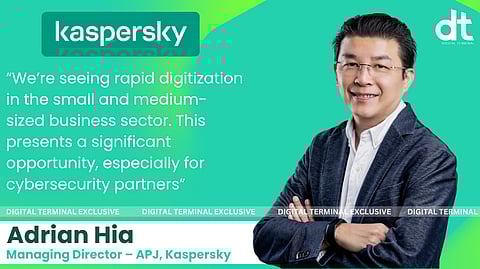

With AI and Gen AI reshaping the cybersecurity landscape, businesses face both new opportunities and unprecedented threats. Rajeev Ranjan, Editor of Digital Terminal, engaged in an insightful conversation with Adrian Hia, Managing Director – APJ, Kaspersky, to discuss India's remarkable growth in cybersecurity, the integration of AI-driven threat intelligence, and the future of security solutions. Adrian also sheds light on how Kaspersky is expanding its presence in India, investing in talent, and supporting enterprises.
Rajeev: As the leader overseeing the entire APAC market, how would you assess India’s performance and growth under your leadership? What key factors have contributed to this success?
Adrian: I wouldn’t take full credit for this—it’s really been a collective effort, and I must highlight the incredible work of Jaydeep Singh and the India team. India achieved the highest growth in the APAC region, outperforming other regions. From a team perspective, we also doubled our workforce last year. As we head towards FY25 (2025), we’ve expanded our sales, pre-sales, and technical teams.
Additionally, we’ve increased our presence in major metropolitan cities by establishing physical offices, ensuring we have a representative in every key city. While we continue to work with over 1,000 active partners in India, we felt it was essential to offer a physical presence to support our partners better and, ultimately, improve customer satisfaction.
Rajeev: How do you view India's market growth, and what key factors will drive success this year?
Adrian: From a solution perspective, last year was about launching new products, with 11 new products introduced. This year, our focus shifts to execution. We're now extending our offerings beyond IT, with plans to integrate OT traffic into our solutions. We have several significant OT projects in the pipeline, and you’ll hear more about them soon.
We're also witnessing the convergence of IT, OT, and IoT, and many of our enterprise customers are seeking a unified platform to manage both IT and OT assets. This convergence is becoming a reality, particularly with the rise of digital meters, QR code passports, and other OT devices that need not only monitoring but also protection.
Another key area we’re focusing on is our threat intelligence capabilities. Many of our customers, having matured beyond simply outsourcing their security, are now looking at prevention strategies. To effectively prevent security breaches, it's crucial to identify indicators of compromise and attacks early. This is where our threat intelligence, digital footprint brand protection, and similar initiatives come into play. We're investing resources to strengthen these capabilities.
Finally, we’re seeing rapid digitization in the small and medium-sized business sector. This presents a significant opportunity, especially for cybersecurity partners. There’s a growing number of SMEs, including smart manufacturing companies, sprouting up across India, driven by foreign investment. These companies need cybersecurity expertise to comply with regulations like the DPDP Act, RBI guidelines for the financial sector, SEBI for listed entities, and others.
As regulations continue to tighten, the demand for cybersecurity solutions will only increase. These three factors—OT integration, threat intelligence, and the rise of small and medium enterprises—will be crucial for Kaspersky's growth in India in 2025.
Watch The Exclusive Video Interview:
Rajeev: What key cybersecurity threats should CTOs, CISOs, and CIOs prepare for, especially with the rise of AI?
Adrian: AI and generative AI are undeniably here to stay, whether we like it or not. If we fail to embrace and implement these technologies, we risk falling behind. Unfortunately, cybercriminals are also leveraging AI and generative AI to their advantage. For example, ten years ago, creating a deepfake video required significant infrastructure and investment. Now, with just a $1.99 app on your phone, anyone can create deepfakes. This highlights how easily accessible these capabilities have become.
As a result, the only direction we see moving forward is upward. In the past, we detected around 400,000 new malware samples daily. Recently, we saw that number rise to 467,000, an increase of 15-20%. This is largely due to machine-generated malware, meaning we can expect attacks, such as DDoS, targeted attacks, and phishing, to worsen.
My advice to everyone in the cybersecurity field is this: we need to focus not just on protection, which we are already good at, but also on prevention. Through threat intelligence (TR intelligence) and C2 capabilities, we can anticipate potential threats and better defend against them. However, the final step is to be able to respond effectively when an attack does occur. In the world of cybersecurity, it’s essential to adopt a mindset of "assume breach." You need to assume that you will eventually face a ransomware attack or similar threat, and your goal should be to minimize the damage and respond swiftly. The speed of incident response and the ability to isolate compromised systems are critical in these situations.
At Kaspersky, we plan to harness AI to guide our customers in making quick decisions during an attack. AI and generative AI will play a key role in helping us react efficiently. In conclusion, the best way to fight AI-generated attacks is to use AI and generative AI ourselves. For those unsure of where they stand in their cybersecurity preparedness, I recommend starting with a security or vulnerability assessment. This will provide a benchmark of your current situation and help you plan the next steps for your cybersecurity transformation over the next three to five years.
Rajeev: With AI’s growing momentum, how is your organization leveraging this trend, and what AI-driven innovations are in the pipeline?
Adrian: There are three key areas where we’re leveraging AI. First, in managing the 467,000 new malware samples we receive daily, we have been using machine learning for the past 10 years, which is a form of AI application. The second area is in using AI to enable quick reactions and provide recommendations to customers on how to respond when they are infected or penetrated. While human expertise is invaluable, AI can react much faster, making it an essential tool for efficient response.
Finally, we are integrating AI assistants into our solutions. In our consumer portfolio, you will soon encounter an AI assistant named Kira, who will guide users with advice on configuration and alert them if something isn't set up properly. We plan to extend this AI assistant concept to our enterprise solutions as well, enhancing the customer experience by offering real-time assistance and proactive advice. These are some of the ways we are incorporating AI into our solutions in the near future.
Rajeev: What investments have you made in India, including the Noida office and staff expansion, and what are your future growth plans?
Adrian: There are two main aspects to our strategy. First, we are focused on strengthening our internal capabilities to better support customers engaged in significant transformational projects. This includes expanding our expertise in Security Services, as well as growing our local team of Solution Architects who can assist customers in navigating their transformation journey. We are committed to continuing this investment to improve customer satisfaction and shift from product-based selling to solution-based selling, ultimately driving business outcome-based sales.
Second, we are placing significant emphasis on upskilling our Channel Partners. With the launch of our new unified partner program this year, we have introduced a new category called "deploy status," encouraging partners to specialize and become certified to deploy our more strategic solutions. This will enable them to extend our reach, particularly to small and medium-sized enterprises, and help customers leverage our enhanced capabilities.
We recognize that we cannot do this alone, and our partner community is essential to our success. Beyond simply reselling antivirus products, we are working to elevate our key partners, pushing them up the value chain. We are investing resources in supporting our partner team to ensure they can successfully navigate this transformation.
Rajeev: Can you highlight key breakthroughs, including collaborations with IITs and government cybersecurity agencies? How are you engaging with PSUs in this space?
Adrian: We recently collaborated on a joint white paper with SETA, sharing our perspective on the application of AI in cybersecurity. I encourage you to download and explore it. Additionally, I just returned from Mumbai, where we participated in a panel with the state government. It's clear that increasing cybersecurity awareness is critical, and we remain committed to this effort.
Our collaboration with the government has been ongoing for nearly 20 years, and we continue to work closely with them. Regarding educational institutions, we’ve made significant strides, including enhancing cybersecurity curricula and conducting "train the trainer" programs to equip lecturers.
Furthermore, we are focusing on providing insights and trends from a global perspective, helping the government implement initiatives like RBI security guidelines, SEBI regulations, and the DPDP Act. As I mentioned at the Mumbai event, we thank the government for its continued enforcement, as it motivates all of us to elevate our capabilities. Most importantly, it allows our customers to justify the investments in cybersecurity. It’s an encouraging direction, and now it’s about execution. If we continue to support our partners and customers, we will ultimately achieve a much more secure and resilient environment.
Rajeev: What message would you like to share with your partners and customers?
Adrian: I believe it's important not to stop at the basics. If you're currently using next-gen antivirus, it's time to move toward EDR, as that’s a crucial next step. Incorporating threat hunting, root cause analysis, and establishing quick response and remediation processes is vital. If you're already on an EDR platform, don’t stop there—expand to network protection with our NDR solution and move toward XDR. Additionally, focus on threat intelligence and building your own security operations (SecOps).
This journey won’t happen overnight or within a year—it will likely take 3 to 5 years. However, it’s essential to start now, and we’ll be here to support you. Whether through our partners or directly with our customers, we must come together and plan for the future of cybersecurity architecture.
𝐒𝐭𝐚𝐲 𝐢𝐧𝐟𝐨𝐫𝐦𝐞𝐝 𝐰𝐢𝐭𝐡 𝐨𝐮𝐫 𝐥𝐚𝐭𝐞𝐬𝐭 𝐮𝐩𝐝𝐚𝐭𝐞𝐬 𝐛𝐲 𝐣𝐨𝐢𝐧𝐢𝐧𝐠 𝐭𝐡𝐞 WhatsApp Channel now! 👈📲
𝑭𝒐𝒍𝒍𝒐𝒘 𝑶𝒖𝒓 𝑺𝒐𝒄𝒊𝒂𝒍 𝑴𝒆𝒅𝒊𝒂 𝑷𝒂𝒈𝒆𝐬 👉 Facebook, LinkedIn, Twitter, Instagram

