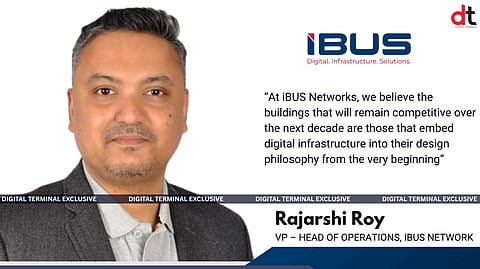

As India's digital infrastructure evolves with 5G, AI, and smart buildings, seamless in-building connectivity is becoming as essential as traditional utilities. In this exclusive conversation with Rajeev Ranjan, Editor, Digital Terminal, Rajarshi Roy, Vice President – Head of Operations, iBUS Network and Infrastructure, shares how digital infrastructure is reshaping commercial and residential developments, the importance of connectivity-first design, and the future of intelligent, connected spaces.
Rajeev: As India accelerates its digital transformation with 5G, AI, and smart infrastructure, how has the demand for in-building connectivity evolved over the past few years, and what trends are you seeing across commercial and residential developments?
Rajarshi: In-building connectivity has evolved from being an additional feature to becoming an essential part of modern building infrastructure. A few years ago, the primary focus was on providing basic internet access and mobile coverage. Today, the expectations are significantly higher, there are significantly higher expectations today. Office buildings require cloud-based application support, hybrid working facilities, artificial intelligence-based workflows and operations, and thousands of internet-connected devices to operate at one time. Similar trends can also be observed in residential complexes, where demand for smart homes, digital entertainment, remote workspaces, and connectivity-enabled services are rapidly rising.
More importantly, what has changed is the industry's perception of digital infrastructure. Developers increasingly recognise that digital infrastructure directly influences both the long-term value of an asset and the experience it delivers to its occupants. We see it in the projects that involve commercial offices, residential communities, hospitals, airports, and mixed-use properties, where connectivity is becoming an integral part of providing a better user experience. As buildings become more digitized, connectivity is moving from being an amenity to being a core utility.
Rajeev: Despite rapid advancements in telecom networks, indoor connectivity remains a major challenge. What are the key reasons behind this gap, and how can developers address it during the planning and design phase?
Rajarshi: The challenge is no longer network availability. It is how effectively those networks perform inside buildings. Contemporary building materials like reinforced concrete, energy-saving glazing, and faccedilade reduce the power of mobile signals, and the increase in the number of connected devices further increases the burden on the network. Usually, in most projects, connectivity is installed afterwards, thus it becomes challenging to ensure consistency in terms of coverage without making any changes.
The answer lies in treating digital connectivity as part of the building's core design rather than as a post-construction addition. Planning for the installation of fibre paths, equipment rooms, in-building wireless systems, and shared digital infrastructure right from the start helps to create scalable, efficient, and modern property. At iBUS Networks, we advocate a neutral host approach that enables multiple telecom operators to deliver services over a common digital infrastructure.
Rajeev: Developers have traditionally focused on physical infrastructure. What is driving the shift toward treating digital connectivity as a core building utility alongside power, water, and security systems?
Rajarshi: The functionality of buildings has undergone a significant transformation over the last decade. Today, almost every critical building system depends on reliable digital connectivity. Building access control, building security and surveillance, visitor management, building automation, cloud applications, digital payments, and occupant services depend on stable network infrastructure. Connectivity is no longer serving individual users alone. It has become the backbone of how modern buildings function.
Moreover, the needs of today's markets drive development in this direction. Enterprise tenants consider the digital readiness of a facility when making their leasing decision, and residents require constant connectivity to perform work and leisure activities. Consequently, the implementation of digital infrastructure becomes not just a requirement but a strategic step towards efficient building management and tenant satisfaction. At iBUS Networks, we believe digital connectivity should be planned with the same priority as every other essential building utility.
Rajeev: With enterprises increasingly relying on cloud applications, hybrid work, AI, and IoT, how does robust in-building connectivity directly impact business productivity, operational efficiency, and tenant experience?
Rajarshi: Digital connectivity has now moved from being an IT need to being an operational enabler. The current generation of businesses relies on continuous availability of cloud services, video collaboration solutions, AI-based software, ERP platforms and the connected workplaces. A lack of connectivity affects productivity, operations and performance of the businesses.
In terms of the occupier's expectations, the approach is clear-cut. There should be a consistent availability of connectivity regardless of whether it is the workstation, conference room or anywhere else in the building. It takes a comprehensive digital infrastructure to enable such connectivity, and this includes fibre networks, in-building wireless technology, managed wi-fi and multi-carrier capability.
At iBUS Networks, we see digital infrastructure as an integral part of the workplace experience, enabling businesses to operate efficiently today while preparing them for the technologies of tomorrow.
Rajeev: India is witnessing rapid growth in smart offices, residential communities, hospitals, airports, and malls. Which sectors are leading the adoption of integrated digital infrastructure, and what best practices are emerging from these deployments?
Rajarshi: The adoption of integrated digital infrastructure is accelerating across sectors where uninterrupted connectivity directly influences operations and user experience. Commercial office developments continue to lead this transformation as enterprises demand digitally ready workplaces capable of supporting hybrid work, cloud applications, and intelligent building systems. We are also seeing strong momentum across airports, hospitals, retail destinations, residential communities, and mixed-use developments, where connectivity has become essential to delivering seamless services.
One common trend across these sectors is the shift towards planning digital infrastructure from the earliest stages of development. Rather than deploying multiple independent networks, developers are increasingly adopting shared, carrier-agnostic infrastructure that simplifies operations while ensuring consistent coverage for occupants. Our experience across more than 1,500 sites spanning over 1.2 billion square feet has reinforced a simple principle: buildings perform more efficiently when digital infrastructure is treated as a foundational layer rather than an afterthought.
Rajeev: Looking ahead, how do you see technologies such as 5G, private networks, AI, and IoT reshaping the future of connected buildings in India, and what should developers prioritize today to make their projects future-ready?
Rajarshi: The next generation of buildings will be defined by their ability to support intelligent, data-driven operations. Technologies such as 5G, AI, private networks, and IoT will continue to transform how commercial and residential spaces are managed, making them more responsive, efficient, and connected. However, these technologies can only deliver their full potential when supported by robust digital infrastructure.
For developers, the priority should be to design buildings with scalability in mind. This means planning for fibre-rich network architecture, in-building mobility solutions, shared digital infrastructure, and sufficient capacity to accommodate future technology upgrades without extensive retrofitting. Future readiness is not achieved by deploying the latest technology today, but by creating an infrastructure foundation that can evolve with tomorrow's requirements.
At iBUS Networks, we believe the buildings that will remain competitive over the next decade are those that embed digital infrastructure into their design philosophy from the very beginning.
𝐒𝐭𝐚𝐲 𝐢𝐧𝐟𝐨𝐫𝐦𝐞𝐝 𝐰𝐢𝐭𝐡 𝐨𝐮𝐫 𝐥𝐚𝐭𝐞𝐬𝐭 𝐮𝐩𝐝𝐚𝐭𝐞𝐬 𝐛𝐲 𝐣𝐨𝐢𝐧𝐢𝐧𝐠 𝐭𝐡𝐞 WhatsApp Channel now! 👈📲
𝑭𝒐𝒍𝒍𝒐𝒘 𝑶𝒖𝒓 𝑺𝒐𝒄𝒊𝒂𝒍 𝑴𝒆𝒅𝒊𝒂 𝑷𝒂𝒈𝒆𝐬 👉 Facebook, LinkedIn, Twitter, Instagram
