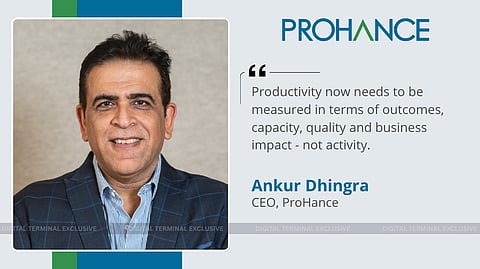

As AI transforms how businesses operate, enterprises are rethinking productivity, workforce planning and the way work is measured. In this exclusive interaction, Rajeev Ranjan, Editor, Digital Terminal, speaks with Ankur Dhingra, CEO, ProHance, about navigating this shift. From outcome-driven productivity and responsible workforce data usage to AI-led automation, capacity planning and emerging workforce models, Dhingra shares his perspective on building more agile, data-driven and future-ready organisations.
Rajeev: As AI changes the nature of work, how should enterprises redefine what “productivity” actually means in the modern workplace?
Ankur: AI is making the traditional definition of productivity less relevant. Hours worked, activity levels or the number of tasks completed rarely show the value being created.
In my experience, productivity now needs to be measured in terms of outcomes, capacity, quality and business impact - not activity. If AI reduces a task from three hours to 30 minutes, the three-hour benchmark stops mattering. What matters is what happens with the time that's freed up: higher-value work, problem-solving, or more face-to-face customer engagement.
The shift enterprises need to make is what I think of as building a bridge between activity and outcome - moving from measuring activity to understanding how work actually gets done and what business value it creates.
Rajeev: How can organisations use workforce data to make better business decisions without creating a culture where employees feel constantly measured or monitored?
Ankur: It starts with being clear about why the data is being collected in the first place. At ProHance, I see the goal as understanding work patterns at an operational level so people can work in a better, more productive way - not to watch individuals. Used well, this data helps identify uneven workloads, capacity constraints, process bottlenecks and repetitive work that's consuming too much time, so managers can distribute work and support their teams better.
Transparency matters just as much as the data itself. Employees should know what's being measured, why, and how it will be used. The line between useful visibility and a surveillance culture is determined by intent and transparency - not by the technology itself.
Rajeev: What new workforce risks emerge when organisations introduce AI and automation without understanding how work is actually being performed across teams?
Ankur: The biggest risk is automating a process before understanding how it actually works. A workflow that looks straightforward on paper often involves manual steps, dependencies and exceptions that aren't visible from the outside — and AI can only deliver meaningful business outcomes when organisations have real visibility into how work actually gets done.
Get that wrong, and automation lands on the wrong areas, creating new bottlenecks instead of removing old ones - and it can create capacity the organisation has no plan to redeploy. AI is also changing roles faster than most organisations expect. Without visibility into capacity, workload and skills, it's hard to know which roles are being augmented, which tasks are disappearing, and where new skills will be needed.
Rajeev: With hybrid teams, automation and changing job roles becoming the norm, what are enterprises still getting wrong about workforce planning?
Ankur: Most organisations still plan the workforce as a headcount exercise - how many people, in which functions, at what cost. That model breaks down once you account for how enterprises actually deliver work today: through four worker types - employees, vendors, AI copilots and autonomous agents - most of which are never planned or governed together.
Workforce planning needs to look at capacity, skills and workload across all four, not just employee count. Hybrid working makes this more urgent, since visibility based on physical presence no longer means anything. Some tasks will be automated, others augmented, and new responsibilities will emerge - planning has to account for that shift rather than assume today's roles and workloads hold steady.
Rajeev: Could AI-powered workforce insights become as important to enterprise leadership as financial and operational reporting, and why?
Ankur: It already is, in the organisations doing this well. Financial and operational reporting tells leadership what happened. AI-powered workforce insights tell them why - how work is actually being performed and where capacity is being used or wasted.
As AI reshapes workflows, that visibility becomes more valuable, not less. Leaders need to know where teams have excess capacity, where workloads are unsustainable, which processes create friction, and where AI is genuinely improving outcomes.
That's the idea behind what we've built at ProHance as a Productivity Control Room - one connected view of human, vendor and AI productivity, already supporting 450,000+ users across 200+ enterprises in 55 countries, rather than fragmented reporting across each. Over time, I expect AI-powered workforce insights to sit alongside financial and operational metrics as a standard part of the management view. The organisations that connect workforce data to business outcomes will make better calls on capacity, technology investment and the way they work — now and longer term.
𝐒𝐭𝐚𝐲 𝐢𝐧𝐟𝐨𝐫𝐦𝐞𝐝 𝐰𝐢𝐭𝐡 𝐨𝐮𝐫 𝐥𝐚𝐭𝐞𝐬𝐭 𝐮𝐩𝐝𝐚𝐭𝐞𝐬 𝐛𝐲 𝐣𝐨𝐢𝐧𝐢𝐧𝐠 𝐭𝐡𝐞 WhatsApp Channel now! 👈📲
𝑭𝒐𝒍𝒍𝒐𝒘 𝑶𝒖𝒓 𝑺𝒐𝒄𝒊𝒂𝒍 𝑴𝒆𝒅𝒊𝒂 𝑷𝒂𝒈𝒆𝐬 👉 Facebook, LinkedIn, Twitter, Instagram
