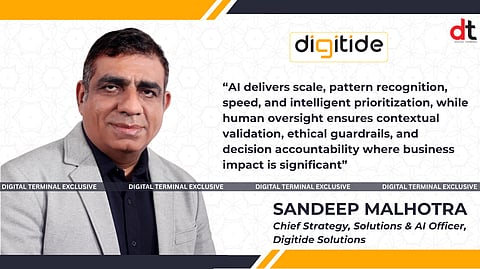

As Artificial Intelligence rapidly transforms the global tech landscape, enterprises are increasingly focusing on models that combine automation with human judgment. While AI delivers speed, scalability, and intelligent insights, complex business processes still require contextual decision making and accountability. In this exclusive interaction, Rajeev Ranjan, Editor, Digital Terminal, speaks with Sandeep Malhotra, Chief Strategy, Solutions and AI Officer, Digitide Solutions, about the importance of the AI plus human-in-the-loop model, enterprise AI adoption strategies, ROI drivers, and the role of responsible AI governance in sustainable transformation.
Rajeev: As AI adoption accelerates across global BPM, why do you believe the “AI + human-in-the-loop” hybrid model is proving more sustainable than fully automated operations?
Sandeep: In enterprise environments, sustainability is defined by accountability, not by the degree of automation. Most large-scale business processes are non-linear, exception-driven, and risk-sensitive. While fully autonomous systems perform well in controlled, rules-based scenarios, real-world operations involve ambiguity, regulatory interpretation, and contextual judgment.
The AI + human-in-the-loop model aligns with this operational reality. AI brings scale, pattern recognition, speed, and intelligent prioritization. Human oversight ensures contextual validation, ethical guardrails, and decision accountability where business impact is significant. In addition, human expertise plays a critical role in continuously training and refining cognitive systems, enabling AI models to learn from exceptions, improve accuracy, and enhance decision-making over time.
This is not a transitional phase. It represents the operating equilibrium enterprises are adopting, balancing productivity with trust. In environments where decisions carry financial, regulatory, or reputational consequences, that balance is what makes AI adoption sustainable.
Rajeev: You describe AI as a lifecycle capability rather than a one-time deployment — how should enterprises structure their AI journey from strategy and engineering to ongoing governance and optimization?
Sandeep: AI should be institutionalized as a capability, not executed as a series of pilots. Enterprises that scale AI successfully approach it across four integrated layers.
First, Strategic Blueprinting — define measurable business outcomes, economic value pools, risk thresholds, and governance principles upfront. Without strategic clarity, AI initiatives fragment and stall.
Second, Workflow-Centric Engineering — models must be embedded into core processes, not layered externally. This requires interoperability, process redesign, and clearly defined human–AI interaction frameworks.
Third, Operational Stewardship — AI systems are dynamic. They require continuous monitoring, recalibration, compliance validation, and performance optimization as data and market conditions evolve.
Finally, Responsible AI by Design — explainability, security, and data governance must be architected into the system from inception. Governance cannot be retrofitted.
When structured as a lifecycle capability, AI transitions from experimentation to enterprise infrastructure.
Rajeev: From an ROI standpoint, what are the three most critical lenses — industry, process, and persona — that determine whether an AI investment truly delivers business impact?
Sandeep: AI ROI is contextual and must be evaluated through three strategic lenses. Industry defines economic logic and regulatory context. Every sector has distinct value drivers—risk management, operational efficiency, customer experience, cost optimization, and increasingly revenue generation and growth. Understanding where value concentrates is foundational.
Process determines scalability. AI generates compounding returns in high-volume, decision-intensive workflows that directly influence customer or employee outcomes. Task automation yields incremental benefits; end-to-end workflow redesign drives structural margin improvement.
Persona ensures executive alignment. AI must directly map to leadership priorities—financial performance, operational throughput, workforce productivity, revenue growth, or customer lifetime value. When AI initiatives align to board-level KPIs, adoption accelerates and ROI becomes measurable.
Rajeev: In sectors like BFSI, insurance, and healthcare, where is AI value compounding the fastest today, and what differentiates successful workflow redesign from superficial “quick wins”?
Sandeep: AI value compounds fastest in environments characterized by high decision frequency, structured data availability, and operational complexity. Areas such as risk monitoring, customer lifecycle management, fraud analytics, workforce optimization, and revenue operations are demonstrating sustained returns.
In insurance, this includes underwriting, claims adjudication, and fraud detection. In BFSI, risk monitoring, collections, and customer experience management are seeing strong momentum. In healthcare, care coordination and revenue cycle management are emerging as high‑impact areas.
The distinction between quick wins and transformation lies in workflow architecture.
Quick wins automate isolated tasks—document classification, conversational interfaces, single-point predictions. They validate potential but rarely alter economic fundamentals.
Transformation redesigns workflows end-to-end—how cases are triaged, how exceptions are routed, how decisions are explained, and how accountability is embedded. When AI reshapes decision chains rather than tasks, value compounds over time instead of plateauing.
Rajeev: As Responsible AI becomes central to enterprise adoption, how should organizations balance explainability, governance, and compliance without slowing innovation?
Sandeep: The belief that Responsible AI slows innovation is increasingly outdated. In practice, it accelerates enterprise adoption by reducing uncertainty. Innovation stalls when risk boundaries are ambiguous. It scales when autonomy thresholds, oversight models, and explainability standards are defined upfront.
Governance must be embedded into system architecture—not imposed after deployment. Explainability should exist within operational workflows, not just in audit documentation. Compliance principles should inform model behavior, not simply monitor outputs.
Responsible AI creates the structural confidence required for AI to scale across the enterprise. It is not a constraint—it is an enabler.
Rajeev: How is Digitide orchestrating partnerships and services-led models to deliver scalable, customer-centric AI transformation?
Sandeep: Digitide’s approach is rooted in orchestration, not ownership. Enterprise AI is too complex for any single organization to build in isolation.
We operate a services‑led, ecosystem‑driven model. Hyperscalers and technology partners provide core capabilities. Analysts and advisors help shape market‑aligned strategies. Digitide brings domain expertise, process depth, and execution rigor to translate these capabilities into business outcomes. Innovation is customer‑driven. Through structured MVP frameworks, our AI Innovation Lab, and flexible engagement models like AI lab hours, we co‑create solutions that are grounded in real operational needs.
Crucially, we do not lead with products. We lead with industry context, process understanding, and executive priorities. That allows us to design AI systems that are explainable, governed, and embedded into enterprise workflows from day one—enabling scalable, responsible, and customer‑centric transformation.
𝐒𝐭𝐚𝐲 𝐢𝐧𝐟𝐨𝐫𝐦𝐞𝐝 𝐰𝐢𝐭𝐡 𝐨𝐮𝐫 𝐥𝐚𝐭𝐞𝐬𝐭 𝐮𝐩𝐝𝐚𝐭𝐞𝐬 𝐛𝐲 𝐣𝐨𝐢𝐧𝐢𝐧𝐠 𝐭𝐡𝐞 WhatsApp Channel now! 👈📲
𝑭𝒐𝒍𝒍𝒐𝒘 𝑶𝒖𝒓 𝑺𝒐𝒄𝒊𝒂𝒍 𝑴𝒆𝒅𝒊𝒂 𝑷𝒂𝒈𝒆𝐬 👉 Facebook, LinkedIn, Twitter, Instagram
