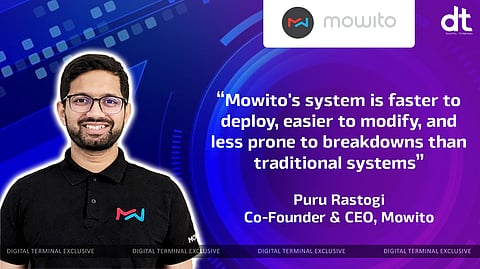

In this exclusive interview, Rajeev Ranjan, Editor, Digital Terminal, speaks with Puru Rastogi, Co-Founder and CEO of Mowito, to discusses the company’s innovative AI-powered automation solutions. He highlights how Mowito’s technology enables robotic arms to perform complex tasks across industries, offering flexibility, reducing costs, and addressing challenges
Rajeev: What key challenges in warehouse and factory automation led to the founding of Mowito, and how does your AI-powered vision software address these issues?
Puru Rastogi: The key challenge we identified in warehouse and factory automation is that, while robotic hardware has advanced, intelligent software often needs to catch up. Many robotic arms struggle with tasks like picking items of varying shapes and sizes without causing damage, especially in dynamic environments. Picking is essential in factories and warehouses, yet traditional automation systems cannot cope with the unpredictability of real-world scenarios.
To address this, Mowito was founded in 2021, and we developed AI-powered software that uses camera feed to drive the robots. This technology enables robots to handle diverse items in unpredictable and dynamic environments, efficiently performing complex tasks like picking, sorting, and packing. By adapting to their surroundings in real-time, Mowito’s solution ensures smooth operations, whether items are in heaps, on conveyors, or while the robotic arm is in motion. This improves throughput, optimizes equipment usage, and allows businesses to scale and adapt to evolving production demands, making automation more efficient and versatile.
Rajeev: What are Mowito's latest innovations in robotic vision software, and how do they address the needs of different industries?
Puru Rastogi: Mowito’s latest innovations in robotic software focus on AI models that enable robotic arms to be mounted on wheels or legs, move around factories, and perform different tasks at different locations. This increases the utilization of robotic arms and brings them closer to humans in terms of efficiency. With successful deployments in machine tending, Mowito is now developing solutions for sortation in warehouses and automating chemical lab processes, addressing the evolving needs of industries like manufacturing and logistics.
Further, Mowito has developed AI models that can learn the specifics of a task by interacting with people or observing people doing the task. For example, a robot can learn to fold and pack a shirt by talking to someone or watching a video of a person folding and packing the shirt, reducing the time and skills needed for configuration and broadening the range of tasks robots can automate.
Rajeev: How does Mowito reduce long deployment times and system breakdowns compared to traditional systems?
Puru Rastogi: Mowito's AI-powered software streamlines deployment and minimizes system breakdowns compared to traditional systems, by offering flexibility and real-time adaptability. It uses visual feedback to reduce the need for fixed infrastructure and can identify and handle various objects, including delicate items like fruits and vegetables, by estimating orientation and adjusting grip.
The hardware-agnostic design allows compatibility with various robotic arms and cameras, enabling users to choose the best options for their needs. With a no-code interface, factory workers can quickly reconfigure the system without requiring specialized engineers. As a result, Mowito's system is faster to deploy, easier to modify, and less prone to breakdowns than traditional systems.
Rajeev: What training is required for workers to use no-code interface of Mowito and how long does it take?
Puru Rastogi: Workers require roughly 2 to 3 hours of training. This includes training to operate the complete system, maintain it, and reconfigure it for different purposes. Mowito has developed chat-based interfaces, through which human operators can talk to the robot, and specify instructions, with minimal training.
Rajeev: What advancements in AI technology do you believe will have the most significant impact on the future of automation in the manufacturing sector?
Puru Rastogi: Advancements in AI technology are set to impact the future of automation in the manufacturing sector significantly. One key development is vision-based AI, which learns processes and tasks by observing humans. This technology enhances adaptability and provides valuable insights into operational processes. By learning from visual feedback, AI can effectively manage unexpected situations, such as utilizing tools designed for humans and working in dynamic environments.
Additionally, it is essential to leverage data from all the sensors on the robot to train AI models, such as tactile sensors in the grippers or fingers of robot arms. This will improve robots' physical intelligence, making them more aware of their surroundings.
Once these AI models are trained, they can be adapted for various types of robots and robotic arms, allowing the AI to adjust based on the specific robot and its tasks. These systems continuously learn from the data they collect, leading to ongoing improvements in efficiency and their ability to address evolving operational challenges.
Rajeev: How do you envision the future of human-robot collaboration in the workplace, particularly in industries like manufacturing and logistics?
Puru Rastogi: The future of human-robot collaboration in the workplace, especially in industries like manufacturing and logistics, will be marked by seamless interaction between humans and robots, where each complements the other's strengths. Robots will handle repetitive, dangerous, or physically demanding tasks, allowing humans to focus on more strategic, creative, and complex problem-solving roles. In manufacturing, robots will work alongside humans on production lines, performing tasks like assembly, machine tending, and quality inspection with high precision. In logistics, robots will assist with sorting, packing, and warehouse management, adapting to real-time changes. This collaboration will lead to increased efficiency, improved safety, and greater flexibility, ultimately driving productivity and innovation across industries.
𝐒𝐭𝐚𝐲 𝐢𝐧𝐟𝐨𝐫𝐦𝐞𝐝 𝐰𝐢𝐭𝐡 𝐨𝐮𝐫 𝐥𝐚𝐭𝐞𝐬𝐭 𝐮𝐩𝐝𝐚𝐭𝐞𝐬 𝐛𝐲 𝐣𝐨𝐢𝐧𝐢𝐧𝐠 𝐭𝐡𝐞 WhatsApp Channel now! 👈📲
𝑭𝒐𝒍𝒍𝒐𝒘 𝑶𝒖𝒓 𝑺𝒐𝒄𝒊𝒂𝒍 𝑴𝒆𝒅𝒊𝒂 𝑷𝒂𝒈𝒆𝐬 👉 Facebook, LinkedIn, Twitter, Instagram
