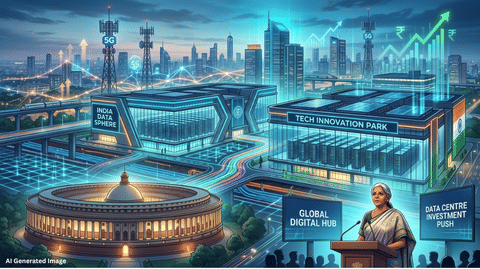

Lok Sabha has passed the Finance Bill 2026, with a strong policy push aimed at transforming India into a global digital infrastructure powerhouse. According to media reports, Union Finance Minister Nirmala Sitharaman outlined a sweeping vision anchored by nearly $70 billion in ongoing investments in data centres, backed by structured tax incentives and domestic value creation mandates.
Structured Tax Incentives Linked to Local Value Creation
Replying to an intense debate in the House, Sitharaman clarified that the government’s tax holiday policy for data centres is not an open-ended incentive but comes with “structural conditionalities” to ensure tangible economic benefits within India. As per media sources, she emphasized that these provisions are specifically designed to promote job creation, technology capability building, and localisation of operations.
The Finance Bill extends tax holidays until 2047 for foreign cloud service providers, but only under strict conditions. According to media reports, such companies must utilise physical data centre infrastructure located within India. This requirement ensures that core operations such as maintenance, network management, and infrastructure deployment remain anchored domestically, generating employment and strengthening India’s digital backbone.
Ecosystem Boost Through Mandatory Local Routing
Further, the minister highlighted that all services sold to Indian customers must be routed through Indian reseller entities. As per media reports, this move is expected to create a broad ecosystem involving domestic system integrators, managed service providers, and telecom partners, thereby ensuring that economic value is retained within the country.
Addressing concerns raised by Opposition members, including Congress MP Amar Singh, Sitharaman rejected allegations that tax exemptions disproportionately favour large global firms without accountability. According to media reports, she reiterated that the policy framework integrates skilling initiatives alongside fiscal incentives, ensuring that Indian talent plays a central role in the evolving data economy.
Safe Harbour Rule Ensures Genuine Domestic Operations
A key feature of the Finance Bill is the Safe Harbour Rule, which introduces a 15.5% margin on costs for Indian entities providing data centre services to related foreign companies. As per media sources, this provision ensures that domestic firms are fairly compensated and are not reduced to “hollow shells,” but instead build genuine technical expertise and profitability.
Massive Job Creation Backed by Cloud Expansion
The scale of the opportunity is substantial. According to media reports, India’s cloud capacity is projected to grow four to five times by 2030, driven by rising demand for digital services, artificial intelligence workloads, and data localisation requirements. Sitharaman noted that this expansion will trigger large-scale investments in construction, cooling systems, power infrastructure, cybersecurity, and network operations, collectively generating lakhs of direct and indirect jobs.
Reform Momentum Aligned with Viksit Bharat Vision
Positioning the Finance Bill within a broader national vision, the minister stated that each reform step contributes to the long-term goal of building a “Viksit Bharat” by 2047. As per media reports, she underscored that India’s reform trajectory is guided by conviction and clarity under the leadership of Narendra Modi.
The Finance Bill 2026 is structured around five core principles: trust-based tax administration, ease of living, empowerment of MSMEs and farmers, strengthening India’s position as a global business hub, and seamless trade facilitation through customs reforms. According to media reports, additional measures include reduced TCS rates for overseas education and travel, along with the removal of customs duties on select life-saving medicines.
With its passage, the Finance Bill signals a calibrated approach to economic growth, balancing global investment attraction with domestic capability building, and positioning India at the forefront of the global digital economy.
𝐒𝐭𝐚𝐲 𝐢𝐧𝐟𝐨𝐫𝐦𝐞𝐝 𝐰𝐢𝐭𝐡 𝐨𝐮𝐫 𝐥𝐚𝐭𝐞𝐬𝐭 𝐮𝐩𝐝𝐚𝐭𝐞𝐬 𝐛𝐲 𝐣𝐨𝐢𝐧𝐢𝐧𝐠 𝐭𝐡𝐞 WhatsApp Channel now! 👈📲
𝑭𝒐𝒍𝒍𝒐𝒘 𝑶𝒖𝒓 𝑺𝒐𝒄𝒊𝒂𝒍 𝑴𝒆𝒅𝒊𝒂 𝑷𝒂𝒈𝒆𝐬 👉 Facebook, LinkedIn, Twitter, Instagram

