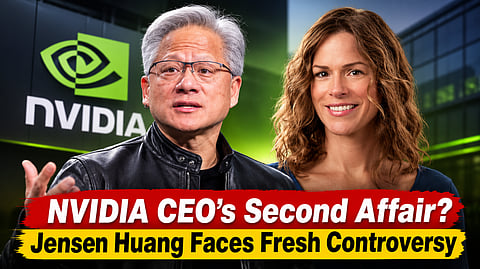

Nvidia CEO Jensen Huang is facing a fresh wave of scrutiny after reports alleged a second extramarital relationship, this time involving a senior executive within his own company. The latest allegation concerns Kimberly Powell, Nvidia’s vice president of healthcare, who reportedly reports directly to Huang.
The development follows an earlier controversy involving Alice Huang, a Singapore-based business executive suspected by US authorities of links to Chinese intelligence. Jensen Huang acknowledged being unfaithful to his wife in a message to employees, prompting Nvidia’s board to investigate whether he had been targeted by a foreign intelligence operation.
The latest report has widened the controversy beyond national security concerns, placing executive conduct, workplace relationships and board oversight under renewed scrutiny. Nvidia, Jensen Huang and Kimberly Powell had not publicly confirmed the reported relationship at the time of publication.
Who Is Kimberly Powell?
Powell is a long-serving Nvidia executive who has spent more than 18 years at the company. She joined the chipmaker in 2008 as a director and gradually advanced through its leadership ranks, eventually becoming vice president of healthcare.
Her career at Nvidia began with efforts to establish the company’s graphics processing units (GPUs) as accelerators for medical imaging equipment. The role has since expanded considerably as Nvidia has extended its computing technology into healthcare research and applications.

Before joining Nvidia, Powell worked as an engineer and later in product development at an electronics startup. She eventually approached Nvidia to discuss its computing chips. After recognising the potential applications of its technology in healthcare, the company contacted her about joining, she said in an August episode of the Lifers podcast. Powell described the opportunity as a “dream come true.”
According to her professional profile, Powell was promoted to senior director in 2016, leading a business development team focused on artificial intelligence. By late 2017, she had become Nvidia’s vice president of healthcare.
How the Second Allegation Emerged
According to The New York Times, Huang and Powell were reportedly seen behaving affectionately at a hotel in San Jose, California, during an Nvidia conference in March. The newspaper said a bystander recorded the interaction, although it had not viewed the video itself.
The report also alleged that Huang’s security team approached the person who filmed the encounter and offered a nondisclosure agreement. These details have not been independently verified.
The allegations raise questions about Nvidia’s rules governing relationships between senior leaders and employees who report to them. Such relationships can create potential conflicts of interest and concerns about impartiality, although the available reporting does not establish that Powell received preferential treatment or that the company’s policies were violated.
Separate Controversy Over Alice Huang
The Powell report follows a separate controversy involving Alice Huang, a Singapore-based businesswoman whose reported connections to Nvidia CEO Jensen Huang have drawn scrutiny over possible foreign intelligence activity.
US intelligence officials reportedly suspected Alice Huang of links to Chinese intelligence and of facilitating shipments of Nvidia chips to Chinese companies. The allegations have raised questions about whether Jensen Huang was targeted by a foreign intelligence operation and whether Nvidia’s technology or confidential information could have been exposed.
In a November 8 statement, Nvidia’s board announced an independent investigation overseen by independent directors and outside counsel. The board said it had no reason to believe that US national security or Nvidia’s secrets had been compromised. Jensen Huang expressed support for the review and committed to cooperating with it.
Nvidia Board Weighs Huang’s Future
The controversy has now developed into a broader leadership crisis. On November 11, The Wall Street Journal reported that Nvidia’s board was preparing to remove Huang as CEO. Reuters subsequently reported that the board was meeting to consider his future. No final decision on his position had been confirmed at the time of reporting.
The reports have also raised questions about succession planning at Nvidia, a company valued at roughly $4 trillion and central to the global AI infrastructure market. Bloomberg reported that the board was working with an outside firm to identify potential CEO candidates. Huang has led Nvidia since its founding, and his potential departure could create a significant leadership gap.
Investors reacted sharply to the reports, with Nvidia shares falling more than 8% in after-hours trading following the news of a possible leadership change. The company’s market value had come under substantial pressure amid the unfolding controversy.
US lawmakers have also sought answers over the separate allegations involving a suspected foreign intelligence connection, with reports indicating that Huang could face a congressional subpoena if he does not respond to a request for a closed-door briefing.
For Nvidia, the issue now extends beyond the personal allegations against its chief executive. The board’s response, the outcome of its investigation and the company’s ability to reassure investors about governance and succession could shape the next phase of the chipmaker’s leadership. With Nvidia playing a central role in the AI boom, uncertainty surrounding its founder has become a matter of wider significance for the technology industry.
𝐒𝐭𝐚𝐲 𝐢𝐧𝐟𝐨𝐫𝐦𝐞𝐝 𝐰𝐢𝐭𝐡 𝐨𝐮𝐫 𝐥𝐚𝐭𝐞𝐬𝐭 𝐮𝐩𝐝𝐚𝐭𝐞𝐬 𝐛𝐲 𝐣𝐨𝐢𝐧𝐢𝐧𝐠 𝐭𝐡𝐞 WhatsApp Channel now! 👈📲
𝑭𝒐𝒍𝒍𝒐𝒘 𝑶𝒖𝒓 𝑺𝒐𝒄𝒊𝒂𝒍 𝑴𝒆𝒅𝒊𝒂 𝑷𝒂𝒈𝒆𝐬 👉 Facebook, LinkedIn, Twitter, Instagram