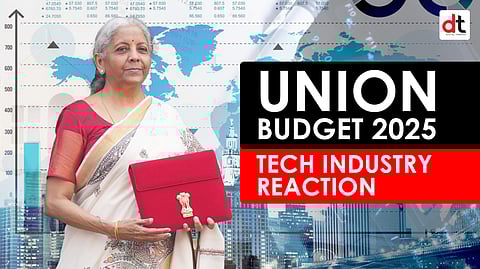

Finance Minister Nirmala Sitharaman has officially presented the Union Budget 2025 in Parliament, outlining key measures aimed at boosting the technology sector. The Union Budget 2025 has sparked diverse reactions from tech industry leaders. As India continues its journey towards becoming a global tech powerhouse, tech leaders are reacting to this year’s budget and what it means for the future of IT sector.
Budget 2025 Boosts Innovation and Economic Growth

Alok Dubey, Chief Finance Officer, Acer India, appreciates the Union Budget’s emphasis on tax relief, innovation, and infrastructure development to drive economic growth. He says, "The Union Budget 2025 takes a decisive step toward strengthening India’s economy with a strong focus on innovation, digital transformation, and manufacturing excellence. The significant tax cut, with exemptions up to ₹12 lakh under the new regime, will provide much-needed relief to the middle class, boosting disposable income and driving greater consumer spending, savings, and investments. Additionally, the government’s continued push for technology and infrastructure development will create new opportunities for businesses while reinforcing India’s position as a global manufacturing and technology leader. At Acer, we welcome these forward-looking initiatives and remain committed to supporting India’s vision for self-reliance and sustainable economic growth."
A Game-Changer for Cybersecurity
Sunil Sharma, Vice President - Sales, Sophos India and SAARC lauds the Union Budget 2025-26 for its focus on enhancing cybersecurity by promoting research fellowships and skilling initiatives. He comments, "We believe the emphasis placed by the Union Budget 2025-26 on research fellowships and skilling will be a game-changer for India's cybersecurity landscape. Through the 10,000 PM Research Fellowships in IITs and IIScs, the Government is fostering an ecosystem where cybersecurity skilling will be accessible to a wider talent pool.”
Sunil further adds, “The establishment of National Centres of Excellence for Skilling, combined with education in regional languages, will ensure that enterprises of all sizes—especially MSMEs—can build robust cyber defenses without being held back by a talent shortage. We are particularly hopeful seeing the commitment to ease of doing business through regulatory reforms allowing enterprises to scale faster, innovate freely, all the while bolstering their operations with cutting-edge security solutions. This year’s Union Budget lays the foundation for a cyber-resilient India where businesses can thrive securely in an increasingly digital world, powdered by workforce readiness and regulatory agility."
Strong Support for Startups, Lack of Focus on Electronics
Dr. Ajai Chowdhry, Founder of HCL and Chairman of EPIC Foundation shares a mixed reaction to the Union Budget 2025-26, highlighting key strengths and areas for improvement in strategic sectors. Dr. Ajai says, “The budget o+ers mixed outcomes for the industry. The addition of Rs 10,000 crore funds of funds and Rs 20,000 crore for deep tech is beneficial for startups seeking VC funding. However, there is no focus on making India a leader in electronic products and chips, crucial for strategic autonomy amid current geopolitics.”
He further states, “For startups, there has been no correction in ESOP taxation for startups—a significant oversight. On a positive note, allowing loans between Rs 10-20 crore under credit guarantee schemes will greatly aid startups with their working capital needs. Initiating research and development in the private sector, last year’s plan of Rs. 1 lakh crore has been advanced with a provision of Rs 20,000 crore in this year’s budget. This initiative is highly beneficial for establishing India as a leading nation in product innovation.”
“The opening of the nuclear sector to private companies and the move towards smaller Modular Micro Reactors (MMRs) marks an important step in moving away from fossil fuels and diversifying energy sources. In the future, with the expected increase in Data Centers, nuclear energy will become essential, especially as smaller reactors are being developed worldwide. The National Geospatial Mission is another noteworthy initiative aimed at improving e+iciency and promoting development. The establishment of a Manufacturing Mission and enhancing EODB will also play a pivotal role in attracting more investments,” Dr. Chowdhry concludes.
Positive Steps for ESDM Sector
Ashok Chandak, President of IESA acknowledges the Union Budget 2025-26’s support for the ESDM sector but calls for more clarity and bold initiatives to further boost growth. He says, The Union Budget 2025-26 presents several indirect benefits for the Electronics System Design & Manufacturing (ESDM) sector, aligning with key recommendations from IESA but has been muted on big announcements. Our focus on startups, R&D, skilling, export support, and continued semiconductor manufacturing incentives has been partially addressed through multiple schemes:
The budget’s provisions for MSME support , Start Up’s ( 5 yr incorporation and Fund of Fund) Centers of Excellence (CoEs) in skilling and AI, and reduced Basic Customs Duty (BCD) on display panels and lithium-ion batteries will enhance local value addition in EVs and mobile manufacturing, IT Hardware, Export promotion schemes, Tax certainty for electronics manufacturing, establishing national manufacturing mission, Presumptive taxation on electronics manufacturing support, etc will also help step towards India’s position as a global electronics manufacturing hub and atmanirbhar Bharat.
Further the ₹20,000 crore allocated for R&D, along with 10,000 technology fellowships at IITs, will foster innovations and IPR development.
revised IT slabs for the middle class will boost disposable income, thereby driving increased consumption and demand for consumer electronics.
Ashok further adds, “On the positive side, Overall 21945 Cr INR has been allocated for the ESDM sector ( under MeitY) which is a significant step compared to last FY. This includes 9000 cr for Electronics PLI, 7000 cr for Semiconductor and display manufacturing, 2000Cr AI Mission, 1259 Cr for R&D, 575 Cr for skilling , 712 Cr for MSIPS/EDF/ Mfg Clusters, etc.”
“However, the budget lacks clarity on ISM 2.0 (incentives beyond the $10 billion mark) and does not introduce a major PLI scheme for components or a dedicated product creation initiative as a growth driver. This could potentially slow the pace of value addition in India's electronics ecosystem. We remain Optimistic that these aspects will be addressed through specific policy measures beyond the Budget announcement,” he concludes.
Forward-Looking Blueprint
Ramesh Natarajan, CEO of Redington Limited, welcomed the Union Budget, describing it as a forward-looking blueprint for India's continued growth and innovation. He expressed his optimism about the government's strategic focus on key sectors, emphasizing that the budget lays a strong foundation for economic expansion and technological advancement. "The Union Budget 2025 presents a forward-looking vision that strengthens India’s digital and technology ecosystem. The continued focus on local manufacturing through reduced import duties on key components is a welcome move, further boosting the Make in India initiative and enhancing supply chain efficiencies. As a leading technology distributor, Redington is optimistic about the government’s emphasis on AI, semiconductor development, and skilling initiatives, which will drive innovation and create a future-ready workforce. The incentives for MSMEs and startups will also accelerate digital adoption across industries, fostering a more connected and resilient economy.”
He further adds, “The increased income tax exemption threshold and greater outlay of funds through welfare schemes is expected to boost both urban and rural consumption of technology products. This budget lays a strong foundation for India’s digital future, and we look forward to playing a pivotal role in enabling businesses to leverage these opportunities."
Strengthening AI Education
Sunil Gupta, Co-founder, CEO & MD, Yotta Data Services emphasizes the transformative role of AI education and research in shaping India’s future as a global technology leader. Sunil says, “The Union Budget 2024 reinforces India’s ambition to emerge as a global technology powerhouse by driving AI, deep tech, and cutting-edge research. The ₹500 crore investment outlay for three Centres of Excellence for AI in education is a big step towards making AI-led learning mainstream. This will not only help in upskilling the AI talent pool in India and preparing the youth for the jobs of the future but also democratize access to high-quality education by enabling AI-driven solutions such as real-time language translation and personalized learning pathways. This is especially critical in a country where millions of students receive their education in their native languages and aspire to careers in sectors that primarily operate in these languages.”
Sunil further states, “Additionally, measures like the Deeptech Fund of Funds and the 10,000 fellowships for tech research at IITs and IIScs under the PM Research Fellowship Scheme will help bridge the gap between education and employability while creating a robust pipeline for homegrown AI-led technological breakthroughs. By integrating AI into education at scale, India is not only addressing existing challenges in the education system but also equipping students with the digital and analytical skills necessary for the modern economy.”
“Just as the IT boom positioned India as a global tech hub, this budget lays the foundation for long-term AI leadership by prioritizing talent development. By fostering AI-driven learning, removing financial and linguistic barriers, and enabling large-scale skill-building, India is not just preparing for the future but actively shaping it—taking a decisive step toward global digital leadership,” concludes Sunil.
Strengthening Electronics Manufacturing
Kapal Pansari, Managing Director, Rashi Peripherals Limited (RP Tech) supports the Union Budget's steps to bolster India’s electronics manufacturing. Kapal states, ‘’The Union Budget 2025 strengthens India’s commitment to domestic electronics manufacturing and aligns with the vision of 'Make in India' and 'Digital India.' The increase in the tax-free income threshold to ₹12 lakh under the new tax regime is a welcome step that will raise disposable incomes, driving higher demand for consumer electronics, IT peripherals, and gaming products—key focus areas for RP Tech. Additionally, the government's support for the electronics industry and rationalization of customs duties on key components will enhance local manufacturing competitiveness, further strengthening India's position as a global electronics hub.”
“The push to promote Global Capability Centers (GCCs) in Tier-2 cities will accelerate digital adoption and create new opportunities in emerging markets, supporting the broader goals of the 'Digital India' initiative. Policy measures encouraging domestic production of critical electronic components will contribute to a more self-reliant and resilient electronics supply chain. These initiatives collectively will drive the growth of the ICT sector, empower businesses, and ensure that cutting-edge technology reaches every household across the country. Overall this is a progressive budget targeted at inclusive growth,” Kapal states.
Massive Boost for AI Innovation
Swapna Bapat, Vice President & Managing Director, India and SAARC, Palo Alto Networks highlights the government's efforts to balance AI innovation with strong cybersecurity measures. Swapna states, “We strongly believe that innovation is the driving force behind sustainable progress. The Government of India's ₹500-crore investment to establish a Centre of Excellence in Artificial Intelligence for education marks a decisive step toward realizing AI’s full potential. Equally critical is modernizing and securing both legacy and emerging systems, supported by a workforce skilled in meeting the demands of an increasingly digitally connected world.”
Swapna further adds, “We appreciate the government’s commitment to upskilling the young workforce for emerging technologies. The creation of national centers for skilling with global expertise under ‘Make for India’, alongside provisions for 10,000 fellowships for technological research in IITs and IISc, will play a pivotal role in bridging the talent gap and preparing professionals for the future of work.”
“The India AI Mission presents vast opportunities for AI adoption yet it also highlights inherent security risks associated with it, as AI remains a double-edged sword. Initiatives like the IndiaAI Innovation Centre, IndiaAI FutureSkills, and Safe & Trusted AI exemplify a forward-looking approach to responsible AI implementation, reinforced by robust security measures. Together, these steps foster a secure, innovation-centric ecosystem that benefits both businesses and society,” Swapna concludes.
National Manufacturing Mission Boosts Make in India
Rajesh Doshi, Co-founder & Director, Zebronics is optimistic about the Union Budget's emphasis on MSME growth and job creation across sectors. He says, "The Union Budget 2025's introduction of the National Manufacturing Mission will bolster the 'Make in India' initiative significantly along with the reforms for MSMEs and start-ups which will greatly encourage employment opportunities including women workforce, across all spectrums. Additionally, the revised New Income Tax regime, with no tax on income up to ₹12 lakh, underscores an increase in disposable income, stimulating consumer spending and economic growth.”
Equitable Customs Policies to Foster TV Manufacturing Growth
Avneet Singh Marwah, CEO, SPPL, a Kodak and Blaupunkt brand Licensee expresses, "We appreciate the Honourable Finance Minister’s efforts, such as the reduction of income tax up to Rs 12 lakh and the formation of a high-level committee for regulatory reforms, which help enhance governance. However, the recent reduction in customs duties to nil on open cells and components manufacturing applicable only to industries with bonded manufacturing plants, creates an uneven playing field for TV manufacturers without access to such facilities. This policy is not welcomed by the broader TV manufacturing industry, and for true growth, these benefits should be extended more equitably across the sector. Additionally, the government’s National Manufacturing Mission, which will support small, medium, and large industries with policy backing and a governance framework, is a positive step toward fostering a more inclusive and competitive manufacturing ecosystem."
Strengthening Manufacturing and Workforce Development
Warren Harris, CEO & MD, Tata Technologies, highlights the Union Budget’s focus on manufacturing excellence, skill development, and AI innovation to propel India’s global competitiveness. He says, “The budget's focus on establishing a National Manufacturing Mission aligns with our goal of engineering in India for 'Make in India' and enhancing the nation's self-reliance in manufacturing. This initiative is poised to attract investments and improve efficiency, positioning Indian companies as globally competitive players. The establishment of five National Centres of Excellence for Skilling is a pivotal move in building a future-ready workforce. This initiative resonates with our commitment to engineering a better future for India's youth through investment in in-demand training programs across Industry 4.0, IoT, and advanced manufacturing, and collaborating with state governments to upgrade ITIs into technology hubs. Additionally, the allocation of ₹500 crore for a Centre of Excellence in Artificial Intelligence for education underscores the importance of fostering innovation and research in AI, which will benefit both the education sector and the broader technology landscape.”
Empowering Women Entrepreneurs
Pallavi Singh, Country Representative, JVC TV India commends the government’s initiatives to empower women entrepreneurs but calls for broader benefits in TV manufacturing. She says "We applaud the Honourable Finance Minister for initiatives like the Ministry of Skill Development and Entrepreneurship's support for female micro-entrepreneurs through incubation and acceleration programs. These efforts are crucial for empowering women-led enterprises and fostering a more diverse, inclusive business landscape, ultimately contributing to India’s long-term manufacturing growth. However, we are concerned about the recent reduction in customs duties on open cells and components, which only benefits industries with bonded manufacturing plants, creating an uneven playing field and disadvantageous to other TV manufacturers.”
“We believe these benefits should be extended more broadly across the sector to ensure true and sustainable growth. Additionally, the reduction in income tax up to Rs 12 lakh and the formation of a high-level committee for regulatory reforms are vital steps towards improving spending power and helping the common man fight rising inflation," Pallavi concludes.
AI Focus and Data Infrastructure Growth
Puneet Gupta, Vice President & Managing Director, NetApp India/SAARC highlights how the Union Budget 2025 prioritizes AI and digital skill development to drive India’s future tech growth. He comments, “The Union Budget 2025 highlights India’s commitment to innovation, skill development, and entrepreneurship, especially in AI and deep tech. The establishment of a Centre of Excellence in AI for education and the expansion of premier institutes like IITs and IISc, showcase India’s forward-thinking approach in preparing our workforce for the future. The integration of AI and digital skills into mainstream education and related investments will ensure better accessibility to technology and infrastructure. With the government’s support to MSMEs aiding AI adoption and promising investments in building the Centres of Excellence and tinkering labs, India’s tech talent and prowess will be set on a high-growth trajectory.”
Puneet further adds, “Consequently, deep technologies like AI will see accelerated adoption making it critical for businesses to modernize data management for mission-critical AI workloads. Through our intelligent data infrastructure solutions, NetApp is committed to help businesses, startups, and professionals leverage AI, cloud, and data solutions. With our focus on data-driven innovation, we are well aligned with the Government’s vision to drive economic growth and global impact through technology.”
National Manufacturing Mission Boosts 'Make in India' and Sustainability
Rajeev Singh, Managing Director, BenQ India and South Asia expresses optimism about the Union Budget’s initiatives for manufacturing, education, and AI-driven innovation. He asserts, "We are encouraged by the government's announcement of the National Manufacturing Mission, which represents a significant step towards enhancing the 'Make in India' initiative. This mission's focus on supporting small, medium, and large industries, along with its emphasis on clean technology manufacturing, aligns perfectly with our commitment to sustainability and innovation.”
Rajeev adds, “Further, the decision to increase the basic customs duty on interactive flat panel displays is a crucial step in addressing the inverted duty structure. This move will foster local manufacturing and support the growing demand for advanced educational technologies, ultimately enhancing innovation in learning environments.”
He further states, “Moreover, the announcement of five National Centers of Excellence for Skilling as well as the setup of 50,000 adult tinkering labs in government schools presents a significant opportunity to integrate advanced technologies, such as interactive flat panel displays (IFP), into the educational framework. These centers will not only equip our youth with essential skills required for manufacturing under the 'Make in India' initiative but also leverage global expertise to design curricula that meet industry needs.”
“The establishment of a Centre of Excellence for AI in education with a ₹500 crore investment is another vital step towards preparing our youth for future challenges. By fostering skills in AI and related technologies, we can enhance employability and drive innovation across various sectors. Thus, we believe that with the right policy support and a robust ecosystem for electronic components, India can establish itself as a global hub for advanced technologies. We look forward to collaborating with the government and industry stakeholders to capitalize on these opportunities and contribute to India's digital transformation," he concludes.
Investment in AI Education
Pankaj Jha, Managing Director, MAXHUB India celebrates the government’s ₹500 crore allocation to set up Centres of Excellence for AI in education. He asserts, "The government’s decision to allocate ₹500 crore for setting up a Centre of Excellence on AI in the education sector marks a significant step towards leveraging technology to transform learning. At MAXHUB, we welcome this forward-looking move, as it resonates with our mission to enhance educational experiences through AI-powered interactive panels. This initiative underscores the potential of technology to create immersive and future-ready classrooms, and we remain committed to driving innovation in this space to support the evolving needs of educators and students."
Boost for Mobile Manufacturing
Arijeet Talapatra, CEO, itel and TECNO supports the Union Budget's strategic moves to strengthen mobile manufacturing and boost consumer spending. He notes, “The Union Budget 2025 signals a strategic move to position India as a global hub for mobile manufacturing. The proposed tariff reductions on essential assembly components—such as PCBAs, camera modules, USB cables, and display modules—are a welcome measure that will improve cost efficiencies, accelerate localization, and strengthen the Make in India initiative. This move strengthens India’s position in the global supply chain, especially amidst shifting trade dynamics amongst major economies.”
“The decision to raise the income tax exemption limit upto ₹12 lakh will substantially increase disposable income, providing a significant financial boost to taxpayers, leading to increased consumer spending on electronics. As purchasing power of consumers rises, the demand for smartphones and other digital devices is expected to rise, further fueling the growth of India’s electronics industry. The establishment of five National Centres of Excellence for Skills and global skilling cooperation would equip young people for global opportunities. The Make in India campaign and streamlined trade policies are consistent with the government's goals of driving growth, promoting investment, and encouraging women workforce participation,” Arijeet concludes.
Big Support to IT Sector Growth
Alok Gupta, CEO, Softmart Solutions sees the changes in income tax and AI investments as significant contributors to the growth of India’s IT sector in FY-25-26. He says, “The changes in Personal Income Tax comes as a relief to all Taxpayers. This will contribute to a feel good factor with all taxpayers. Initiatives in the budget with respect to investments in Infra and Nuclear Energy, investment limit changes for MSME's, Additional seats in IIT's and Medical Colleges, Exemption Extension to Startups and the Investment in COE for AI should help the Indian IT Sector to achieve increased growth for this coming year FY-25-26.”
Budget 2025 Catalyzes India’s Tech Leadership
Hitesh Garg, VP and India Managing Director, NXP Semiconductors, discusses the Union Budget's focus on self-reliant manufacturing and sustainable deep tech growth. Hitesh asserts, "The Union Budget 2025 continues to reinforce India’s ambition to be a global leader in technology, with initiatives focussed on driving self-reliant, advanced manufacturing as innovation. The launch of the National Manufacturing Mission is a key step accelerating the ‘Make for India, Make for the World’ vision. Its focus on clean technology and sustainability ensures long-term competitiveness in global markets.”
Hitesh further comments, “The government’s ₹20,000 crore investment in private sector-led R&D, alongside the Deep Tech Fund, is a strategic move to strengthen India’s leadership in AI, semiconductors, and next-gen manufacturing. The ₹10,000 crore Fund of Funds for startups and enhanced SME/MSME credit facilities will continue to encourage entrepreneurship across the board, and in technology- led innovation, in particular. This, combined with existing policy-driven support for clean energy, will have a far-reaching impact on industries like semiconductors and automotive, accelerating EV adoption, enhancing chip design capabilities, and fostering broader technology advancements. The initiatives around lithium-ion batteries and other components that go into Electric Vehicles will drive up local innovation and manufacture not just of the finished product but also spur the development of a much-needed manufacturing ecosystem.”
“The plan to establish a national framework for Global Capability Centers in tier 2 cities will help India reap the benefits of its current and continued investments in skills and higher education beyond the metros, thereby creating job local opportunities and curbing urban migration. There is focus on continuing to retain the skills advantage both in the medium and long term, with the establishment of the five National Centres of Excellence and the focus on increasing the student pool at five IITs, and the Atal Tinkering Labs initiative in Government schools across the country. At NXP Semiconductors, we see Budget 2025 catalysing deep tech innovation and sustainable growth, continuing to set the stage for India’s emergence as a global powerhouse. We are committed to collaborating with policymakers, startups, and industry leaders to drive India's technological transformation,” Hitesh concludes.
Foundation for India’s IT Leadership
Lakshmi Mittra, Senior Vice President and Head, Clover Academy, commends the Union Budget’s focus on AI education and skill development to solidify India’s IT leadership. According to Lakshmi, "The Union Budget 2025-26 lays a strong foundation for India’s future, with a decisive focus on skilling, AI, and technological innovation. The establishment of five National Centres of Excellence for skilling will enhance India’s global IT leadership, while the PM Research Fellowship’s 10,000 scholarships for IITs and IISc will drive cutting-edge advancements in AI and deep tech. The Centre of Excellence in AI for Education will democratize AI learning, embedding it into India’s academic fabric. Additionally, the government’s push for regulatory reform signals a more agile, innovation-friendly business landscape. This Budget paves the way for a dynamic, inclusive, and future-ready India."
Strengthening AI and Innovation Ecosystem
Sachin Panicker, Chief AI Officer, Fulcrum Digital, underscores the Union Budget’s pivotal role in driving AI adoption, industry collaboration, and a talent-driven future for India. He says, “The 2025 budget reaffirms India’s commitment to fostering an innovation-driven economy. By prioritizing ease of doing business, the government is ensuring agile policies that foster a thriving business ecosystem and scalable technology. This emphasis on modernization extends to India’s talent ecosystem, where initiatives like the Atal Innovation Mission and the PM Research Fellowship for technological research in IITs and IISc, are designed to foster meaningful industry tie-ups. This creates an ecosystem where companies and young researchers work together to develop relevant, future-ready technologies.”
“Additionally, the establishment of a Center of Excellence in AI for Education with an outlay of ₹500 crores will enable young minds to gain deeper insights into AI applications. By integrating AI learning at an early stage, India is equipping its workforce with the skills necessary to drive the next wave of digital transformation. At Fulcrum Digital, we believe these initiatives will unlock new possibilities for India’s tech landscape. With a robust regulatory framework, industry-driven research, and AI-led skilling, India is positioning itself as a global leader in innovation, and we are committed to being part of this journey,” Sachin notes.
𝐒𝐭𝐚𝐲 𝐢𝐧𝐟𝐨𝐫𝐦𝐞𝐝 𝐰𝐢𝐭𝐡 𝐨𝐮𝐫 𝐥𝐚𝐭𝐞𝐬𝐭 𝐮𝐩𝐝𝐚𝐭𝐞𝐬 𝐛𝐲 𝐣𝐨𝐢𝐧𝐢𝐧𝐠 𝐭𝐡𝐞 WhatsApp Channel now! 👈📲
𝑭𝒐𝒍𝒍𝒐𝒘 𝑶𝒖𝒓 𝑺𝒐𝒄𝒊𝒂𝒍 𝑴𝒆𝒅𝒊𝒂 𝑷𝒂𝒈𝒆𝐬 👉 Facebook, LinkedIn, Twitter, Instagram
