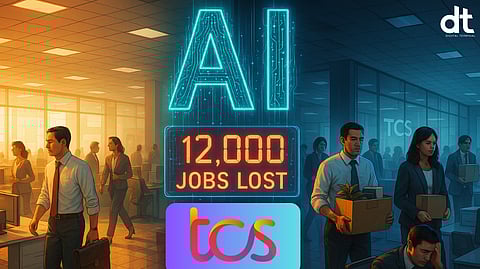

Tata Consultancy Services (TCS), India's largest IT services company, is preparing to reduce its global workforce by around 12,000 employees during the current financial year. This planned reduction equivalent to nearly 2% of its overall headcount is being positioned as part of a broader strategy to modernize the company’s delivery model and align its workforce with evolving client expectations in the AI and automation era.
AI Adoption Drives Workforce Realignment
While artificial intelligence (AI) is not cited as the sole reason for the layoffs, TCS has acknowledged that AI-driven efficiencies, coupled with the changing nature of technology services, have led to an increasing gap between existing employee skills and those in demand. The company is seeking to build a more agile, digitally focused workforce to support next-generation solutions for global clients.
Mid-Level Executives Face the Brunt
Most of the job reductions are expected to affect mid to senior-level employees. These roles are often harder to retrain or redeploy, and are more costly to retain if not immediately billable. In contrast, entry-level employees and fresh recruits will largely remain unaffected, as the company continues to invest in campus hiring and early-career development programs.
As of June 30, 2025, TCS reported a global workforce of over 613,000 employees. The company had added around 5,000 people during the first quarter, making the upcoming layoffs one of the most significant realignments in its history.
Focus on Redeployment and Support
TCS has emphasized that it is taking steps to manage the transition humanely. Affected employees will be provided with severance packages, extended benefits, and outplacement assistance. The company also reiterated its commitment to reskilling initiatives and internal redeployment efforts wherever feasible.
Industry-Wide Implications
TCS's announcement reflects a larger trend across the global tech industry, where companies are increasingly using AI to streamline operations and reduce dependency on manual processes. With client expectations evolving and pricing pressures intensifying, particularly from major international markets like the US and Europe, IT service providers are being forced to re-examine their cost structures and workforce models.
This development marks a significant moment for the Indian IT sector. TCS, long regarded as a benchmark for job stability in the industry, is now leading a shift that many peers are likely to follow. For thousands of professionals, the message is clear: the future of IT lies in adaptability, continuous learning, and alignment with digital transformation.
As TCS navigates its next phase of growth, the success of its AI strategy and its ability to reskill and retain talent will be closely watched across the industry.
𝐒𝐭𝐚𝐲 𝐢𝐧𝐟𝐨𝐫𝐦𝐞𝐝 𝐰𝐢𝐭𝐡 𝐨𝐮𝐫 𝐥𝐚𝐭𝐞𝐬𝐭 𝐮𝐩𝐝𝐚𝐭𝐞𝐬 𝐛𝐲 𝐣𝐨𝐢𝐧𝐢𝐧𝐠 𝐭𝐡𝐞 WhatsApp Channel now! 👈📲
𝑭𝒐𝒍𝒍𝒐𝒘 𝑶𝒖𝒓 𝑺𝒐𝒄𝒊𝒂𝒍 𝑴𝒆𝒅𝒊𝒂 𝑷𝒂𝒈𝒆𝐬 👉 Facebook, LinkedIn, Twitter, Instagram
