
The Government of India’s decision to invest ₹4,500 crore in modernising the Semiconductor Laboratory (SCL) in Mohali represents a significant milestone in the country’s journey toward self-reliance in semiconductor manufacturing.
This move is not only a boost to India’s domestic chip ecosystem but also a strategic step to position the nation as a global player in advanced technology and deep-tech innovation. The modernisation of SCL is expected to enhance India’s capacity for fabless semiconductor design, accelerate prototype and small-volume production, and enable homegrown solutions across critical sectors such as defence, aerospace, and space technology.
The initiative aligns with the broader India Semiconductor Mission, which seeks to create a robust supply chain, attract investment, and nurture a skilled workforce capable of supporting the next generation of semiconductor products.
By upgrading SCL’s capabilities, India is signalling its intent to build trusted, indigenous manufacturing facilities that can meet both commercial and strategic requirements, while also providing a platform for startups and innovators to turn ideas into market-ready solutions faster and more securely.
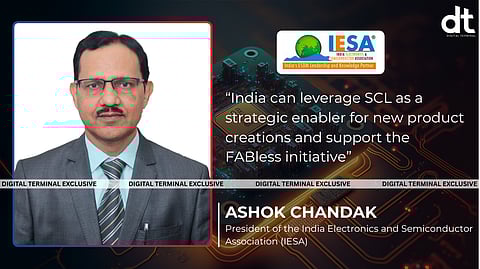
Expressing his perspective, Ashok Chandak, President of the India Electronics and Semiconductor Association (IESA), said, “The Government of India’s continued commitment of 4500 Cr INR to modernising SCL Mohali marks a crucial step in strengthening the nation’s semiconductor foundation. To ensure timely progress, it is imperative that the Centre and the Punjab Government work in close coordination to expedite land allotment and infrastructure clearances, avoiding delays and uncertainty. IESA applauds vision and commitment of Hon’ble Union Minister Sh Ashwini Vaishnaw, Mr. Amitesh Kumar Sinha, CEO ISM and Mr. Kamaljeet Singh, Director General SCL.”
Chandak highlighted the strategic potential of SCL, noting, “India can leverage SCL as a strategic enabler for new product creations and support the FABless initiative. To begin with, the SCL plant is expected to be modernised for 180 nm node that has many business opportunities with 100X capacity creation. The successful 180 nm setup can build confidence and next upgrades to lower technology nodes in future.”
He further emphasised the transformative impact for India’s startup ecosystem, “Importantly, a modern SCL can play a transformative role for India’s deep-tech and semiconductor startups by supporting pilot production, small-volume fabrication, and early-stage prototyping—turning ideas into market-ready products faster, locally, and securely.
This capability is also vital for India’s strategic needs, especially in defence, aerospace, space, and other sensitive sectors that require trusted, indigenous semiconductor manufacturing.”
Chandak also stressed the role of SCL as a training hub, “SCL could also evolve into a national training and capacity-building centre, providing EDA-tool access, hands-on workforce development, and strong collaboration with academia and industry to build India’s future semiconductor talent pool.”
Finally, he underlined the importance of stable policy and collaborative execution, “Stable policy and fiscal support under the India Semiconductor Mission will further enable SCL to scale, integrate with India’s broader supply chain, and contribute to the nation’s export and innovation goals.
The consortium approach with CDAC, DRDO, ISRO and State Govt support will make SCL facility highly successful and impactful. IESA and its member companies reiterate their full support for this initiative and remain committed to working with all stakeholders to ensure that SCL becomes a modern, high-impact, trusted facility that accelerates India’s semiconductor and strategic technology ambitions.”
With this investment, SCL Mohali is poised to become a cornerstone of India’s semiconductor strategy, fostering innovation, strengthening strategic autonomy, and building a robust ecosystem for the next generation of Indian technology leaders.
