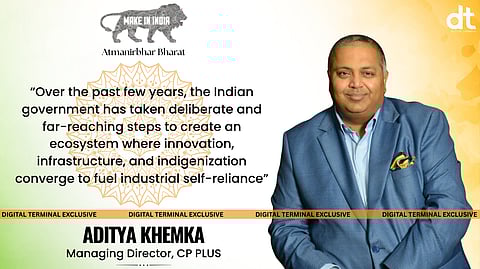

With one of the world’s largest surveillance manufacturing facilities and a strong focus on local innovation, CP PLUS is setting new benchmarks for tech production in India. Talking exclusively to DT< Aditya Khemka, Managing Director, CP PLUS explains how the company is accelerating capacity, investing in backward integration, and embracing “Made-in-Bharat” initiatives.
Scaling Manufacturing to Meet Growing Demand
Highlighting CP PLUS’s manufacturing prowess, Aditya Khemka stated, “CP PLUS currently operates the world’s 3rd largest surveillance manufacturing facility, located in Kadapa, Andhra Pradesh. Commissioned in mid‑2022, this plant delivers a monthly output of more than 1.5 million units, positioning CP PLUS as India’s Largest producer of CCTV and aligned products. Under its “Made‑in‑Bharat” initiative and aligned with national self‑reliance goals, CP PLUS has secured an additional 10 acres adjacent to its Kadapa location to facilitate backward integration of components - including housings, cables, adapters, and bare PCBs - which will further raise local content and cost control. By the end of 2025, CP PLUS aims to expand manufacturing capacity to 3-4 million units per month - effectively doubling its current output.”
Attractive Destination for Global Tech Manufacturing
Emphasizing the country’s strategic advantages, Aditya explained, “India today stands at the confluence of vision, opportunity, and geopolitical rebalancing - a fertile ground for global tech manufacturing to flourish. As the world looks to diversify beyond concentrated manufacturing hubs, India has emerged as a compelling destination, backed by its inherent advantages and proactive policy interventions.”
“First and foremost, India offers a unique demographic and talent dividend. With one of the youngest working populations globally and over a million engineering graduates entering the workforce annually, the country presents a deep, skilled talent pool for technology-led industries. Labor remains competitively priced compared to Western economies and even parts of East Asia, making India ideal for both low-cost, high-volume production and specialized, high-precision tech manufacturing.”
He further highlighted, “Furthermore, India’s government has rolled out transformative programs such as Make-in-India, Design-in-India, and Production-Linked Incentive (PLI) schemes that reward volume, local value addition, and innovation. These policies have made it not only possible but profitable for global OEMs and ODMs to set up shop and scale in India.”
The Role of Government and Policymakers
Stressing policy support, Aditya remarked, “The rise of India as a tech hardware manufacturing powerhouse owes much to the vision and stewardship of its policymakers. Over the past few years, the Indian government has taken deliberate and far-reaching steps to create an ecosystem where innovation, infrastructure, and indigenization converge to fuel industrial self-reliance.”
He added, “One of the most pivotal interventions has been the introduction of regulatory frameworks that prioritize national security and local capability. The mandatory STQC (Standardisation Testing and Quality Certification) requirements, which ask surveillance brands to submit their firmware, hardware, and source codes for certification, have not only pushed for transparency but also incentivized homegrown development. This is not merely a compliance measure, it is a strategic shift that empowers companies like CP PLUS to stand on the strength of their Indian-made credentials.”
Challenges Facing Manufacturers in India
Acknowledging hurdles, Aditya noted, “India’s manufacturing sector, while flourishing, continues to grapple with a spectrum of challenges that must be navigated skillfully for long-term growth. The journey from being an assembly-driven economy to a design-led manufacturing powerhouse is riddled with structural, operational, and technological hurdles.”
He explained, “One challenge is the delays and bottlenecks in certification and regulatory processes. While STQC and cybersecurity protocols are essential to national security, the approval timeline can stretch into months. For a fast-moving industry like surveillance technology, where innovation cycles are short and customer expectations evolve rapidly, such lags can stall go-to-market plans and disrupt revenues.”
He further adds, “The need for skilled labor and technology transfer also looms large. While India boasts a young demographic, there is a gap in mid-to-high-skill technical expertise needed to run complex manufacturing lines, conduct QA testing, and manage component-level production.”
Opportunities
Looking ahead, Aditya underscored, “The next three to five years promise to be transformative for OEMs and ODMs in India, with a confluence of technological, geopolitical, and policy shifts creating fertile ground for exponential growth. One of the most exciting opportunities lies in the expansion of smart infrastructure. From smart cities and intelligent traffic systems to connected railways, airports, and digital governance initiatives, India is investing heavily in building tech-enabled public assets.”
𝐒𝐭𝐚𝐲 𝐢𝐧𝐟𝐨𝐫𝐦𝐞𝐝 𝐰𝐢𝐭𝐡 𝐨𝐮𝐫 𝐥𝐚𝐭𝐞𝐬𝐭 𝐮𝐩𝐝𝐚𝐭𝐞𝐬 𝐛𝐲 𝐣𝐨𝐢𝐧𝐢𝐧𝐠 𝐭𝐡𝐞 WhatsApp Channel now! 👈📲
𝑭𝒐𝒍𝒍𝒐𝒘 𝑶𝒖𝒓 𝑺𝒐𝒄𝒊𝒂𝒍 𝑴𝒆𝒅𝒊𝒂 𝑷𝒂𝒈𝒆𝐬 👉 Facebook, LinkedIn, Twitter, Instagram
