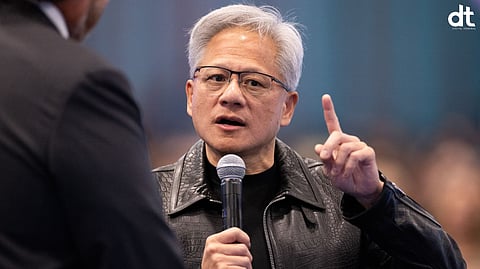

Nvidia CEO Jensen Huang has dismissed fears that artificial intelligence could bring about the end of humanity within the next few years, putting the probability of the world ending because of AI by 2030 at zero. Huang described such warnings as “doomsday narratives” as the debate over the risks of increasingly powerful AI systems continues to intensify.
Huang’s comments come at a time when AI development is moving at an unprecedented pace, with technology companies investing heavily in advanced models, data centres and computing infrastructure. While some experts have raised concerns about the long-term consequences of increasingly autonomous AI, the Nvidia chief does not share the view that the technology is heading towards human extinction.
Huang Rejects AI Doomsday Narrative
According to the report, Huang gave a 0% chance to the world ending by 2030 because of artificial intelligence. His comments represent a strong rejection of predictions that increasingly capable AI systems could become uncontrollable and ultimately pose an existential threat to humanity.
Rather than viewing AI development primarily through an extinction-risk lens, Huang has remained focused on the technology’s ability to transform computing and productivity across industries.
The Nvidia CEO's position is also significant because Nvidia sits at the heart of the current AI infrastructure expansion. Its graphics processors and AI accelerators are widely used by technology companies and data-centre operators to train and run advanced AI models.
AI Risk Debate Gets Sharper
The question of AI safety has become increasingly prominent as models gain the ability to handle more complex tasks, use external tools and operate with greater levels of autonomy.
Concerns raised by AI researchers and technology leaders extend beyond extinction scenarios. These include misuse of AI for cyberattacks, misinformation, autonomous decision-making, security vulnerabilities and the possibility that future systems could become difficult to control.
Huang’s comments do not eliminate those concerns but reflect a different assessment of the probability of an AI-driven catastrophe. His 0% estimate places him firmly on the side of those who believe the technology can continue advancing without resulting in an existential outcome within that timeframe.
Nvidia’s Role in the AI Boom
The timing of Huang’s comments is notable as Nvidia continues to play a central role in the global race to build AI infrastructure. Demand for high-performance computing has expanded rapidly as businesses and technology companies deploy generative AI and develop increasingly sophisticated applications.
The growth of AI is consequently driving major investments in processors, data centres, networking equipment and energy infrastructure. Nvidia has emerged as one of the most important technology suppliers in this ecosystem.
At the same time, the industry's rapid expansion has intensified discussions around responsible AI development. Governments, researchers and technology companies are examining how safety measures and human oversight should evolve alongside increasingly capable systems.
Huang’s latest remarks add a strong counterpoint to the more pessimistic forecasts surrounding AI. While he rejects the possibility of AI ending the world by 2030, the wider technology industry continues to debate how far AI capabilities will advance and what safeguards will be required as those systems become more powerful.
𝐒𝐭𝐚𝐲 𝐢𝐧𝐟𝐨𝐫𝐦𝐞𝐝 𝐰𝐢𝐭𝐡 𝐨𝐮𝐫 𝐥𝐚𝐭𝐞𝐬𝐭 𝐮𝐩𝐝𝐚𝐭𝐞𝐬 𝐛𝐲 𝐣𝐨𝐢𝐧𝐢𝐧𝐠 𝐭𝐡𝐞 WhatsApp Channel now! 👈📲
𝑭𝒐𝒍𝒍𝒐𝒘 𝑶𝒖𝒓 𝑺𝒐𝒄𝒊𝒂𝒍 𝑴𝒆𝒅𝒊𝒂 𝑷𝒂𝒈𝒆𝐬 👉 Facebook, LinkedIn, Twitter, Instagram
