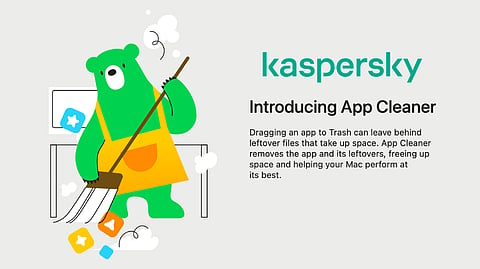

Kaspersky Premium for macOS now includes App Cleaner, a feature designed to address a common challenge for Mac users trying to free up space on their devices: leftover files from uninstalled apps. Caches, preferences, support files and other associated data may remain on a Mac after an app is uninstalled by dragging it to the Trash, gradually taking up valuable disk space and adding to digital clutter.
App Cleaner helps remove apps completely without leaving traces behind, as well as find and delete leftover files from previously removed apps to keep your Mac clutter-free.
A recent Kaspersky survey* showed that macOS users are quite proactive about managing their digital clutter. Nearly half of users clear browser history, cookies, cache and temporary files (56%), while a similar number share manage or delete unnecessary files like photos and videos (54%). However, less than half (44%) regularly delete unused or rarely used apps. Removing leftover files from uninstalled apps remains a challenging task that can be overlooked.
When users delete an app by dragging it to the Trash, they often assume it's completely gone. In reality, settings, caches, logs, support files and other files that are associated with the app may remain on the disk. These leftovers can be difficult to locate and, in some cases, may occupy more space than the original application.
For example, when they are associated with browsers. Some apps and their components may also be hidden from the standard macOS interface, making them difficult to detect.
Another problem is that leftover files may contain sensitive information, including account tokens, saved passwords, activity logs, IP addresses, usernames, document fragments, images, chats and personal folder paths. If an attacker gains access to the device, or if it is sold or given away without being fully wiped, these files could be used to recover passwords, steal personal data or access user accounts.
App Cleaner solves this problem. When a user deletes an app with App Cleaner it detects and deletes associated files. App Cleaner can also find and delete leftover app-specific files from applications that were uninstalled in the past. The exception is shared files. It won't delete files used by other apps, such as common components shared between Microsoft Office apps. These files can only be deleted along with the last application that uses them.
While macOS has long been considered more secure, today's threats are not limited to viruses – ransomware, trojans, spyware, online scam and phishing credential theft and other online threats pose risks to Mac users as well. What's more, Kaspersky specialists have identified cases where malware was disguised as legitimate cleaning software, impersonating tools like CleanMyMac, Mole or CCleaner Pro. Kaspersky experts warn that users should stay vigilant while downloading any cleaning software, especially from third‑party websites.
"We've seen growing demand for device management tools as users accumulate more digital content. Yet a patchwork of third‑party utilities is both inconvenient and risky. With App Cleaner, macOS users can clean up digital leftovers without installing additional software – keeping their devices secure and clutter‑free," comments Irina Ermilova, Vice President for Consumer Product Management at Kaspersky.
Beyond using App Cleaner, Kaspersky experts recommend the following essential practices to keep Mac devices secure:
Use a dedicated security solution. While macOS has built‑in protections, security software adds a crucial layer of real‑time defense against threats that the system alone cannot block. Kaspersky Premium for macOS protects against ransomware, trojans, spyware, phishing and hacking attacks.
Grant the necessary permissions. For any security software to function properly, it needs full disk access and the ability to install system extensions and network content filtering. Without these permissions, protection features may not work as intended.
Keep your apps and operating system updated. Regular updates include critical security patches and new features.
Be cautious with downloads and links. Phishing attacks rely on social engineering and can appear in emails, messages or websites. Avoid opening suspicious links or downloading unverified software, regardless of your device. To protect yourself, allow the security solution to check all incoming content for malicious links and files.
Remove sensitive data before handing over your Mac. If you lend or transfer your device for an extended period, remove sensitive files and sign out of personal accounts first. Before selling or permanently giving away your Mac, perform a complete factory reset to erase personal data, account information and leftover files.
𝐒𝐭𝐚𝐲 𝐢𝐧𝐟𝐨𝐫𝐦𝐞𝐝 𝐰𝐢𝐭𝐡 𝐨𝐮𝐫 𝐥𝐚𝐭𝐞𝐬𝐭 𝐮𝐩𝐝𝐚𝐭𝐞𝐬 𝐛𝐲 𝐣𝐨𝐢𝐧𝐢𝐧𝐠 𝐭𝐡𝐞 WhatsApp Channel now! 👈📲
𝑭𝒐𝒍𝒍𝒐𝒘 𝑶𝒖𝒓 𝑺𝒐𝒄𝒊𝒂𝒍 𝑴𝒆𝒅𝒊𝒂 𝑷𝒂𝒈𝒆𝐬 👉 Facebook, LinkedIn, Twitter, Instagram
