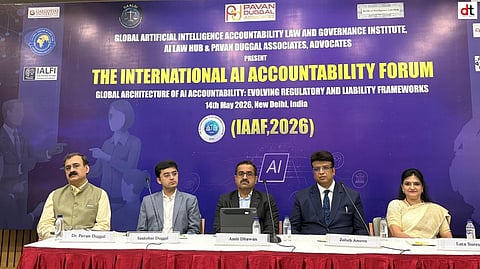

The International AI Accountability Forum (IAAF) was formally founded at the India International Centre, New Delhi, as the world’s first permanent multilateral institution dedicated exclusively to the regulatory, jurisprudential and liability architecture of artificial intelligence. In a single, coherent founding act, three constitutive instruments- the IAAF Charter, the New Delhi Compact on AI Accountability, and the Universal Declaration of AI Accountability Rights , were unveiled.
The permanent seat of the Forum is established at New Delhi. Dr. Pavan Duggal, Advocate, Supreme Court of India, and the globally recognised Architect of Global AI Accountability, has been designated by Charter as the Forum’s Founder, Founding Chairman, and Chief Architect.
The founding was attended by a distinguished international gathering of jurists, parliamentarians, regulators, scholars and industry leaders convened from the US, European Union, India, Ghana, Lebanon, the Netherlands and the wider Indo-Pacific, whose contributions across five substantive sessions are detailed below.

Delivering the Founding Keynote , “AI Accountability Jurisprudence: The Emerging Trends” , Dr. Duggal opened the proceedings by reframing the moment in civilisational terms.
“We stand at a moment of civilizational choice. The question is not whether we shall have artificial intelligence. The question is whether we shall have accountability for it.”
A Diagnosis of Three Global Failures
The Founding Keynote situated the establishment of the IAAF against three structural failures of the prevailing international order. First, Principle-Fatigue, a proliferation of well-intentioned but nonbinding declarations on AI ethics, none of which has prevented algorithmic harm at scale. Second, the Liability Vacuum , the transition from generative to agentic AI has outpaced every existing doctrine of tort, contract, product, and criminal law.
Third, Algorithmic Colonialism - AI systems designed in a handful of jurisdictions are deployed globally, imposing the values and biases of technology-producing nations upon all others. The IAAF is constituted as the institutional and doctrinal response to all three.
The Founding Trinity , Three Instruments, One Architecture
At the heart of the founding act lies a coherent three-instrument architecture- the Founding Trinity , launched simultaneously and designed to operate as one integrated whole:
I. The IAAF Charter , the Institution. The constitutive instrument establishing the International AI Accountability Forum as a permanent multilateral institution, with permanent seat at New Delhi, Republic of India. The Charter establishes nine organs - the Conference of Parties, Governing Council, Doctrinal Tribunal, Advisory Board, Secretariat, Certification Authority, Observatory and Indexing Office, Academic & Research Council, and subsidiary bodies.
Twelve of the twenty-one Governing Council seats are reserved for Global South Member States. Dissolution requires unanimous consent of all Members. The Founder’s Clause designates Dr. Pavan Duggal as Founder, Founding Chairman, and Chief Architect.
II. The New Delhi Compact on AI Accountability- the Principles. Forty-two operative paragraphs, organised across four Parts. Part I sets forth twelve Foundational Principles, beginning with the primacy of human dignity and ending with the prohibition of regulatory arbitrage. Part II articulates thirteen mandatory State Obligations, including the establishment of National AI Accountability Authorities, mandatory impact assessment, and the reverse burden of proof in AI harm.
Part III lays down the multilateral architecture, recognition of the IAAF, the Global AI Accountability Index, and the path toward a binding Convention. Part IV provides for differentiated, tier-based implementation timelines that protect the institutional capacity of the Global South.
III. The Universal Declaration of AI Accountability Rights , the Rights. Thirty articles proclaiming the inalienable rights of every person, community, and nation in the Age of Artificial Intelligence - drafted in the cadence of 1948 and addressed to the crisis of 2026. The Declaration is structured across six pillars: seven Foundational Rights (dignity, equality, explanation, contest, remedy); five Rights of Autonomy and Mind (mental privacy, cognitive integrity, neurodiversity);
five Collective and Community Rights; five Rights of Nations and Peoples (algorithmic sovereignty, fair data compensation, protection against algorithmic colonialism); three Protections for the Vulnerable (children, persons with disabilities, the marginalised); and five Rights of Enforcement and the Future (competent authority, the foreclosure of the ‘algorithm did it’ defence, and intergenerational justice).
Voices from the Forum - The Five Substantive Sessions
The founding act unfolded across five substantive sessions that, together, lent the IAAF its multilateral character and its intellectual depth. Each session, from a distinct vantage, converged on the architecture announced today.
The Inaugural Session. The Forum opened with an Inaugural Session bringing executive, parliamentary and judicial perspectives into a single frame. The dais featured Mr. Ryan Carrier, Executive Director of ForHumanity; Mr. Peter Knoope, Founder of the International Centre for Counter-Terrorism (ICCT); Dr. Manoj Kumar, Additional Secretary, Legislative Department, Ministry of Law and Justice, Government of India; and Hon’ble Justice Rajesh Bindal, Judge (Retd.), Supreme Court of India. Their interventions, taken together, signalled the convergence of state, parliamentary and judicial authority required to anchor a permanent multilateral institution of this kind at New Delhi.
The Opening Session , The Current State of AI Accountability. The first substantive session was led by Dr. Krishna Ravi Srinivas, Adjunct Professor of Law and Director of the Centre of Excellence in AI and Law at NALSAR University of Law, alongside Dr. Pavan Duggal. Dr. Srinivas mapped the present global state of AI accountability scholarship and practice; Dr. Duggal articulated the foundational principles undergirding the Duggal Global Agentic AI Liability Framework released in March 2026.
Current International Perspectives and Trends in AI Accountability. The Forum’s most geographically expansive session brought together Mr. Brando Benifei, Member of the European Parliament since 2014 and a leading European voice on the EU AI Act; Prof. Jaap van den Herik, Professor of Law and Computer Science at Leiden University, the Netherlands; Mr. Pradeep Gupta, Chairman of CyberMedia Group; Dr. Richa Chaudhary, Dean of the Faculty of Law at SGT University; and Mr. Manoj Chugh, a leading voice in the global technology industry. The session illuminated comparative regulatory trajectories across the European Union, the Indo-Pacific and the Global South , and identified the convergence points around which the IAAF architecture is being built.
Issues and Challenges Facing AI Accountability. The third substantive session surfaced the unresolved liability gaps, evidentiary asymmetries, and cross-border enforcement challenges that confront contemporary AI regulators. The panel comprised Mr. Alfredo Ronchi, General Secretary of the EC MEDICI Framework; Prof. Mona Al-Achkar Jabbour, Professor of Law at the Lebanese University; Mr. Amit Dhawan, CEO , India & APAC; and Mr. Zoheb Amin, an award-winning techno-legal leader. Their interventions underscored the urgency of an evidentiary architecture purpose-built for agentic AI litigation , an imperative that finds operative expression in the Duggal Agentic AI Black Box Recorder (DAABBR) and the proposed Global AI Harms Registry.
The Way Forward for the Evolution of AI Accountability. The Forum’s conceptual culmination charted the operational roadmap for institutionalising AI accountability across jurisdictions. The panel featured Dr. A. G. Hessami, Chair and Technical Editor of the IEEE 7000 Technology Ethics Standard; Mr. Saakshar Duggal AI Governance and Law Expert; Ms. Lata Suresh, Head of the Knowledge Resource Centre at the Indian Institute of Corporate Affairs (IICA); and Ms. Usha Mujoo Munshi, Chief Librarian, India International Centre. The panel converged on a multistakeholder, multi-jurisdictional accountability architecture grounded in the four operative pillars of Global South AI governance , authorship, co-design, consensus and flexibility.
The day’s proceedings closed with an Interactive Session and a Vote of Thanks , recording broad crossjurisdictional support for the Founding Trinity and for the establishment of the IAAF as a permanent multilateral institution of AI accountability.
The Doctrinal Substrate - The Duggal Doctrine
The Founding Trinity is anchored in a body of doctrinal scholarship assembled by Dr. Pavan Duggal over thirty-seven years of cyberlaw and AI law practice and across two hundred and three published books. The architecture rests on two operative frameworks released earlier in 2026 , the AI Accountability Framework 2026 (released January 2026) and the Duggal Global Agentic AI Liability Framework (released March 2026) , and is operationalised through eleven Foundational Principles, eleven Jurisprudential Doctrines, fifteen Duggal Doctrines of Agentic AI Liability, a five-tier liability stack, a five-level autonomy taxonomy, and the Duggal Agentic AI Black Box Recorder (DAABBR) , a mandatory immutable cryptographic logging regime for the complete Agentic Decision Chain of all Level-3-and-above autonomous AI executions, retained for between twenty-four and eighty-four months and admissible as primary legal evidence.
The Duggal Doctrine forecloses the most pervasive escape hatches of contemporary AI law. The “algorithm did it” defence is rejected as legally and ethically unacceptable. Opacity is rejected as a defence , and reclassified as an aggravating factor. The reasonable-person standard, product liability, contract privity, and mens rea-based criminal doctrines - each of which presupposes a human or statictool actor , are diagnosed as structurally inadequate to the agentic AI condition. The Duggal Doctrine of Autonomous Accountability supplies the operative norm: the greater the autonomy granted to an AI system, the greater , not lesser , the accountability borne by those who granted it.
“Autonomy without accountability is tyranny encoded. The law must not merely react to artificial agency; it must proactively bound it.”
The Global South as Co-Architect
A central commitment of the founding act is the formal recognition of the Global South not as a passive recipient of AI governance, but as its co-architect. Four operative pillars give the commitment effect: authorship, not adoption , Global South nations must author their own accountability frameworks rather than merely adopt those authored elsewhere; co-design, not compliance , equal voice in international standard-setting and treaty negotiation; consensus, not hegemony , multilateral harmonisation by genuine consensus rather than hegemonic imposition; and flexibility, not uniformity , differentiated implementation calibrated to institutional capacity and developmental stage. The Governing Council of the IAAF , twelve of twenty-one seats reserved to Global South Member States , gives this commitment institutional form.
Dr. Duggal placed the founding squarely within an expanding geography of AI governance:
“The geography of AI governance has been narrow. Today it widens. Bletchley. Seoul. Paris. San Francisco. New Delhi. The permanent seat of the International AI Accountability Forum. Not a passive recipient. A co-architect. The era of algorithmic colonialism ends here.”
The Founding Advisory Board
The Charter provides for a Founding Advisory Board comprising distinguished persons of global eminence who lend their personal authority to the institution at its founding. The categories of Founding Members include former Heads of State drawn from across four world regions; former Justices of the Supreme Courts and Constitutional Courts of leading jurisdictions;
Nobel Laureates from the disciplines of Peace, Economics, Literature and the sciences; leading scholars of artificial intelligence, law, ethics and constitutional theory; civil society leaders representing affected communities of the Global South; and senior multilateral figures formerly of the United Nations, the OECD, UNESCO and the Council of Europe. The full roster of names will be announced in a separate communication in the weeks following the founding.
The Calendar - Four Moments, One Year, One Permanent Rhythm
The Founding Chairman set out a definite institutional calendar across 2026 and 2027:
14 May 2026 , The Founding Trinity. The IAAF Charter, the New Delhi Compact on AI Accountability, and the Universal Declaration of AI Accountability Rights are launched. New Delhi is constituted as the permanent seat.
Throughout 2026 , The UN Process. The IAAF will formally contribute to the Artificial Intelligence Process of the Secretary-General of the United Nations, New York.
Through 2026 , Index Methodology Consultation. Release and public consultation on the methodology for the Global AI Accountability Index.
14 May 2027 , First Anniversary. The inaugural Conference of Parties convenes; the first Global AI Accountability Index , with country rankings , is published. From 2027 forward, every 14 May is the anniversary of AI accountability.
The Global AI Accountability Index will measure and rank the accountability performance of jurisdictions across five weighted pillars.
A Call to Action , to States, Industry, Civil Society and Academia
Closing the Founding Keynote, Dr. Duggal addressed four distinct constituencies. States were called upon to sign the Declaration and establish their National AI Accountability Authority within twenty four months. Industry was called upon to embrace accountability as foundational to sustainable innovation , to implement the Reasonable Agentic AI Governance Standard (RAAGS), to submit to certification, and to accept appropriate liability for AI-caused harm.
Civil society was called upon to stand as vigilant watchdog, to conduct independent research, to represent affected populations, and to hold every actor to account. Academia was called upon to build the jurisprudence , to publish in the IAAF Journal, to train the next generation of AI law scholars, and to make accountability a teachable discipline.
“On this day, the twenty-first century’s AI accountability architecture begins here. At New Delhi.”
𝐒𝐭𝐚𝐲 𝐢𝐧𝐟𝐨𝐫𝐦𝐞𝐝 𝐰𝐢𝐭𝐡 𝐨𝐮𝐫 𝐥𝐚𝐭𝐞𝐬𝐭 𝐮𝐩𝐝𝐚𝐭𝐞𝐬 𝐛𝐲 𝐣𝐨𝐢𝐧𝐢𝐧𝐠 𝐭𝐡𝐞 WhatsApp Channel now! 👈📲
𝑭𝒐𝒍𝒍𝒐𝒘 𝑶𝒖𝒓 𝑺𝒐𝒄𝒊𝒂𝒍 𝑴𝒆𝒅𝒊𝒂 𝑷𝒂𝒈𝒆𝐬 👉 Facebook, LinkedIn, Twitter, Instagram
