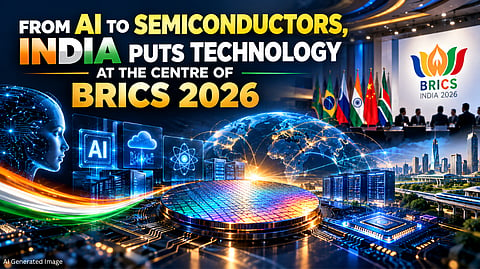

As India prepares to host the 18th BRICS Leaders’ Summit in New Delhi on September 12–13, technology is emerging as a key pillar of its presidency. New Delhi is seeking deeper cooperation among BRICS nations in artificial intelligence, advanced computing, quantum technologies, semiconductor materials, scientific research and digital infrastructure.
The ambition is to move technology cooperation beyond policy discussions and build practical partnerships that can strengthen innovation, supply-chain resilience and technological capabilities across the Global South.
Building Shared Technology Infrastructure
A major proposal is the Global Research Advanced Infrastructure Network (GRAIN), which could provide researchers across BRICS access to high-performance computing and advanced research facilities. This is increasingly important as AI development, drug discovery, climate modelling and advanced-materials research require enormous computing resources.
Instead of each country independently developing expensive infrastructure, a coordinated network could allow researchers to access specialised capabilities across member nations. India is also working on a common science and research repository to facilitate access to datasets, research infrastructure and scientific capabilities, particularly in advanced materials engineering and nanotechnology.
AI Becomes A Strategic Priority
Artificial intelligence is at the centre of India's technology ambitions. New Delhi wants BRICS countries to develop stronger domestic AI capabilities covering computing infrastructure, datasets, talent, research and applications.
India's own experience provides a potential model. Under the IndiaAI Mission, more than 38,000 GPUs have reportedly been onboarded into the country's common AI computing facility. AIKosh is also being developed as a central platform for non-personal datasets and AI models.
For BRICS, the opportunity extends beyond sharing AI models. Joint research, computing access and common approaches to responsible AI could help emerging economies develop technologies suited to their own languages, industries and public-sector requirements.
Chips And Quantum Technologies Gain Importance
Semiconductors are another strategic focus as global economies attempt to reduce dependence on concentrated chip supply chains. India is pushing cooperation around semiconductor materials, research and technology capabilities while simultaneously expanding its domestic semiconductor ecosystem.
The BRICS science and technology framework has also identified quantum computing, quantum sensing and secure information technologies as priority areas. Cooperation in these fields could allow member countries to pool research expertise and infrastructure in technologies that are still developing but could eventually transform cybersecurity, healthcare, materials science and computing.
Startups Could Turn Research Into Business
India is also pushing stronger connections between BRICS startups, incubators, investors and research institutions. Proposed initiatives such as a BRICS Startup Innovation Fund and Incubator Network could create new opportunities for deep-tech companies seeking capital, technical expertise and international markets.
This is particularly relevant for semiconductor, AI, quantum and advanced-material startups, where development cycles are long and conventional venture funding may not always be sufficient. A cross-border innovation network could help move promising technologies from laboratories into commercial applications.
India's Digital Infrastructure Advantage
India's experience with digital public infrastructure is another major component of its BRICS technology proposition. UPI has demonstrated how interoperable digital payment infrastructure can scale nationally and potentially support greater cross-border connectivity.
However, expanding digital systems across countries will require common standards and greater trust around cybersecurity, privacy, data governance and financial regulation. India's own cautious approach to international payment integration shows that digital connectivity must be balanced with strategic and data-security considerations.
From Declarations to Execution
The larger objective behind India's technology push is to create a more resilient and collaborative technology ecosystem for the Global South. By connecting research institutions, computing infrastructure, startups, investors and digital platforms, New Delhi wants BRICS to become more relevant to the technologies shaping the next decade.
The real test, however, will be implementation. If initiatives such as GRAIN, shared research platforms, startup networks and technology partnerships evolve into functioning programmes, India's 2026 BRICS presidency could mark a significant shift—from BRICS as primarily an economic and geopolitical grouping to a platform for shared technological innovation, strategic resilience and digital growth.
𝐒𝐭𝐚𝐲 𝐢𝐧𝐟𝐨𝐫𝐦𝐞𝐝 𝐰𝐢𝐭𝐡 𝐨𝐮𝐫 𝐥𝐚𝐭𝐞𝐬𝐭 𝐮𝐩𝐝𝐚𝐭𝐞𝐬 𝐛𝐲 𝐣𝐨𝐢𝐧𝐢𝐧𝐠 𝐭𝐡𝐞 WhatsApp Channel now! 👈📲
𝑭𝒐𝒍𝒍𝒐𝒘 𝑶𝒖𝒓 𝑺𝒐𝒄𝒊𝒂𝒍 𝑴𝒆𝒅𝒊𝒂 𝑷𝒂𝒈𝒆𝐬 👉 Facebook, LinkedIn, Twitter, Instagram
