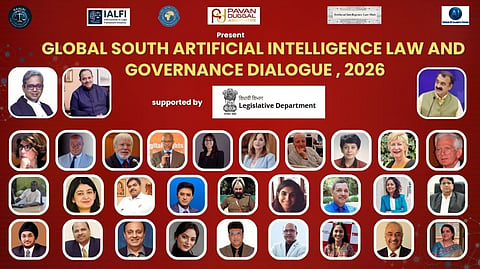

The Second Global South Artificial Intelligence Law and Governance Dialogue 2026, convened online today, concluded with the formal adoption of the Global South Legal Architecture for Artificial Intelligence Governance and Accountability, a structured, operational instrument designed to translate the Global South’s stated principles on AI into national statute, sectoral policy, and enforceable practice.

Convened by Dr. Pavan Duggal, Advocate, Supreme Court of India and a globally recognised authority on AI law and cyberlaw, the Second Global South Artificial Intelligence Law and Governance Dialogue 2026 brought together judges, senior government officials, regulators, scholars, technologists and civil-society leaders from across Asia, Africa, Latin America, the Middle East and Europe.
The Architecture is conceived not as another declaration of principle but as operational scaffolding. It builds upon - and does not seek to replace - the instruments already adopted by the Global South, including the New Delhi Accord on Artificial Intelligence Law and Governance (2025), the New Delhi Declaration on Artificial Intelligence (February 2026),
The New Delhi Compact on Artificial Intelligence Accountability (May 2026), the AI Accountability Framework 2026, the Global Agentic AI Liability Framework, and the Universal Declaration of AI Accountability Rights adopted at the International AI Accountability Forum 2026.
A Distinguished Opening
The proceedings featured a Keynote Address by Hon’ble Justice Suraj Govindraj, Judge, High Court of Karnataka, setting the judicial and constitutional context for AI law, governance and accountability, and a Special Address by Dr. Manoj Kumar, Additional Secretary, Legislative Department, Ministry of Law and Justice, Government of India. Professor Christoph Stueckelberger, Professor of Global Ethics in Asia and Africa, addressed the ethical challenges confronting the Global South in the age of AI.
Across the day's sessions, chaired by the Convenor, Dr. Pavan Duggal, the platform featured voices from every region of the Global South and beyond, including Lebanese cyberlaw scholar Mona Al Achkar Jabbour, Ambrose Ruyooka of Uganda's Ministry of ICT & National Guidance, Rosa Delgado from Peru, Latin America, Alfredo Ronchi, Secretary General EC Medici Framework, Prof Sarah Fox, eminent British academician,
Axel Lehmann of the World Federation of Scientists, Saakshar Duggal, eminent AI Law expert, Amandeep Singh of the Bureau of Police Research & Development, Manoj Chugh corporate governance guru, and Drishyaa Duggal AI Psychology evangelist alongside leading academics, regulators and industry leaders from across Asia, Africa, Latin America, the Middle East and Europe.
What the Architecture Establishes
A three-layer legal architecture. The instrument is built on three concentric, independently operative layers: a dedicated national statute on artificial intelligence and accountability in each Global South nation; sector-specific national policies spanning health, education, finance, agriculture, public administration, law enforcement, judicial processes, electoral integrity, defence and digital public infrastructure; and a continuously updated layer of living standards and best practices that allows governance to evolve without statutory amendment at every turn.
Seven non-negotiable pillars - the common minimum denominators that must inform every national instrument and sectoral policy:
1. Algorithmic Sovereignty - the sovereign right of every Global South nation to govern, regulate, audit and, where necessary, restrict the AI systems operating within its jurisdiction.
2. Prevention of Cognitive Colonialism - guarding against the silent transfer of epistemic, narrative, linguistic and value-laden authority to AI systems trained and governed beyond Global South frontiers.
3. Prohibition of Unconsented Data Distillation and Extraction - barring the unconsented scraping, ingestion and commercial extraction of personal, cultural, indigenous and behavioural data.
4. Mandatory Compliance of Big Tech AI with National Law - affirming that extraterritorial corporate practice cannot displace constitutional duty.
5. Protection of Linguistic, Cultural, Tribal and Indigenous Data Heritage - requiring free, prior and informed consent before community knowledge is ingested or commercialised.
6. Agentic AI Liability Anchoring - ensuring autonomous AI systems do not operate in a state of “legal weightlessness,” with liability anchored on those who derive the principal benefit and exercise principal control.
7. Protection of Indigenous Communities and Cultural Practices from Algorithmic Harm - preventing AI from functioning as an engine of cultural erasure or epistemic subordination.
Novel building blocks. The Architecture introduces a set of original instruments, including a Global South Algorithmic Sovereignty Index, an Inter-Global South AI Mutual Legal Assistance (MLA) Compact, a Civilizational AI Audit standard, a Doctrine of Algorithmic Non-Alignment, a Right to Algorithmic Refusal for indigenous and tribal communities, a Reverse Burden of Proof for Foreign AI Providers, a Sovereign Data Repository Principle, and a Global South AI Harm Notification Protocol.
Institutional Engine and Early Deliverables
The Architecture establishes two complementary Working Groups: a Working Group on Global South Algorithmic Sovereignty, drawn initially from the Dialogue’s speakers, scholars and practitioners, to serve as the doctrinal and technical engine; and a State-anchored Working Group on Global South AI Governance, to which ministries and designated nodal officers across the Global South will be invited, charged with translating doctrinal output into harmonised national positions and multilateral submissions, including to United Nations preparatory processes.
Two early deliverables were identified:
The Inter-Global South AI MLA Compact, to be developed and opened for signature within twelve months, establishing reciprocal recognition of regulatory and audit determinations, cross-border information-sharing, harmonised audit methodology, and coordinated enforcement against extraterritorial AI providers.
A Global South Model Law on Artificial Intelligence Accountability, to be drafted on a preferable nine-month timeline, offering ready, adaptable statutory text that any Global South legislature may customise and enact. A Drafting Committee of 15 to 21 members, with balanced regional and subject-matter representation, is to be constituted within thirty days of adoption.
Convenor’s Remarks
“This Architecture belongs, from the moment of its adoption, to the nations and institutions of the Global South that will take it forward,” said Dr. Pavan Duggal, Convenor of the Dialogue. “It is offered without proprietary claim and with a single conviction: that the algorithms which shape a citizen’s life must be subject to the laws of their land, the values of their civilization, and the consent of their community. Algorithmic sovereignty, the prevention of cognitive colonialism, and the anchoring of agentic-AI liability are no longer aspirations for the Global South - under this Architecture, they are commitments.”
Pathway Forward
The outputs of the Architecture - the work of both Working Groups and the text of the MLA Compact - are to be channelled into the United Nations preparatory process for the global AI scientific model and related multilateral instruments. The Architecture is designed to remain operative for the Global South Group of Nations, whether or not it is absorbed by other multilateral processes, and remains open for endorsement, signature, accession and national adoption by all States of the Global South.
𝐒𝐭𝐚𝐲 𝐢𝐧𝐟𝐨𝐫𝐦𝐞𝐝 𝐰𝐢𝐭𝐡 𝐨𝐮𝐫 𝐥𝐚𝐭𝐞𝐬𝐭 𝐮𝐩𝐝𝐚𝐭𝐞𝐬 𝐛𝐲 𝐣𝐨𝐢𝐧𝐢𝐧𝐠 𝐭𝐡𝐞 WhatsApp Channel now! 👈📲
𝑭𝒐𝒍𝒍𝒐𝒘 𝑶𝒖𝒓 𝑺𝒐𝒄𝒊𝒂𝒍 𝑴𝒆𝒅𝒊𝒂 𝑷𝒂𝒈𝒆𝐬 👉 Facebook, LinkedIn, Twitter, Instagram
