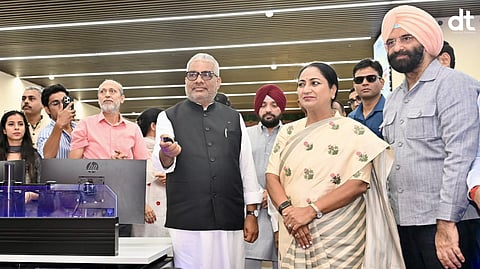

Delhi government has introduced an AI-powered Integrated Command and Control Centre (ICCC) to bring pollution monitoring, environmental data and enforcement activities onto a single platform. Launched by the Delhi Pollution Control Committee (DPCC) on October 1, the centre is designed to help authorities identify pollution hotspots, track violations and improve coordination between agencies responsible for environmental compliance.
Union Environment Minister Bhupender Yadav and Delhi Chief Minister Rekha Gupta reviewed the centre’s operations on Tuesday, highlighting the administration’s focus on using technology to strengthen pollution monitoring and enforcement across the capital.
AI Brings Multiple Pollution Data Sources Together

The ICCC integrates information on ambient air quality, industrial emissions, construction dust, noise pollution, stubble-burning incidents and citizen complaints. By consolidating these data streams, the platform aims to provide officials with a more comprehensive picture of environmental conditions across Delhi.
Its air quality module displays readings from monitoring stations, highlights PM10 exceedances and generates AQI-related alerts. The system also uses AI-based recommendations to help officials interpret pollution patterns and identify areas that may require attention.
The analytics module enables authorities to compare data across different periods, assess dominant pollutants and examine pollution trends across districts. These capabilities are intended to support more targeted interventions by helping officials identify where monitoring or enforcement resources may be needed.
Construction dust and other dust-generating activities are monitored through a separate module. It tracks relevant sites, generates alerts and incorporates CCTV feeds where available, giving officials additional information to assess potential sources of pollution.
The platform also maps enforcement vehicles and records the locations of officers and their assigned zones. Mechanical road-sweeping machines are tracked as part of the system, adding visibility into activities intended to control road dust.
A dedicated noise monitoring module helps authorities track decibel levels against applicable limits, including separate daytime and nighttime readings. The centre also tracks environmental consent applications handled by the DPCC.
Complaint Tracking and Field Enforcement
Beyond monitoring pollution levels, the ICCC is designed to connect alerts and public complaints with administrative action. Its complaint management workflow assigns cases to officers, tracks deadlines and records activity as cases move through the system.
Officials can use a mobile application to submit evidence, including geo-tagged and time-stamped records. This is intended to make field inspections easier to document and provide a clearer record of actions taken in response to reported violations.
The platform is also being developed to integrate data from 15 external systems. Nine have been integrated so far, while work on the remaining six is still underway.
Technology Must Translate Into Action
The effectiveness of the ICCC will ultimately depend on whether its monitoring capabilities lead to timely inspections, corrective measures and stronger compliance. The platform can help authorities identify violations and prioritize responses, but it cannot independently reduce emissions or eliminate pollution sources.
Key indicators of its performance will include the number of inspections conducted, violations detected, improvements in air quality, compliance levels and the time taken to respond to and close complaints.
The centre gives Delhi’s pollution-control agencies a centralized mechanism to analyse environmental data and coordinate enforcement. Its broader impact, however, will depend on how consistently the concerned departments act on the information and ensure that identified violations result in meaningful corrective action.
𝐒𝐭𝐚𝐲 𝐢𝐧𝐟𝐨𝐫𝐦𝐞𝐝 𝐰𝐢𝐭𝐡 𝐨𝐮𝐫 𝐥𝐚𝐭𝐞𝐬𝐭 𝐮𝐩𝐝𝐚𝐭𝐞𝐬 𝐛𝐲 𝐣𝐨𝐢𝐧𝐢𝐧𝐠 𝐭𝐡𝐞 WhatsApp Channel now! 👈📲
𝑭𝒐𝒍𝒍𝒐𝒘 𝑶𝒖𝒓 𝑺𝒐𝒄𝒊𝒂𝒍 𝑴𝒆𝒅𝒊𝒂 𝑷𝒂𝒈𝒆𝐬 👉 Facebook, LinkedIn, Twitter, Instagram
