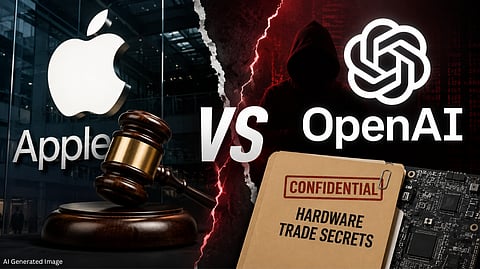

Apple has initiated a high-profile legal battle against OpenAI, accusing the artificial intelligence company and two former Apple employees of illegally acquiring confidential hardware information to strengthen OpenAI's consumer hardware business. The lawsuit, filed in the U.S. District Court for the Northern District of California, raises serious allegations involving trade secrets, engineering data, and proprietary manufacturing knowledge.
Apple Alleges Misuse of Sensitive Hardware Information
According to the lawsuit, Apple claims that confidential engineering documents, manufacturing processes, technical specifications, and details of unreleased products were improperly accessed and retained by former employees before and after they left the company. The tech giant alleges that this information was later used to support OpenAI's expanding hardware ambitions.
Apple argues that the alleged actions go beyond isolated incidents and reflect a broader pattern involving former employees who later joined OpenAI or its affiliated companies.
Former Apple Executives Named in the Case
Among those named in the lawsuit are Tang Tan, a former Apple Vice President who played a key role in the company's hardware design, and Chang Liu, a former senior systems electrical engineer. Following his departure from Apple, Tan joined io Products, the AI hardware startup founded by former Apple design chief Jony Ive. OpenAI acquired io Products in a multi-billion-dollar deal last year, bringing several experienced hardware engineers into the company.
Apple alleges that Chang Liu continued accessing Apple's internal systems even after leaving the organization and downloaded confidential engineering presentations, manufacturing documents, technical specifications, and proprietary project files. The company also claims Liu advised another employee on methods to copy sensitive information while avoiding internal detection mechanisms.
Recruitment Practices Under Scrutiny
The complaint also questions OpenAI's recruitment process for hardware engineers. Apple alleges that individuals involved in hiring encouraged candidates to bring confidential design files, hardware prototypes, CAD models, supplier information, and other proprietary materials during interviews.
According to Apple, interview discussions allegedly included references to internal Apple project codenames and requests for physical hardware components to better understand unreleased technologies. If proven, these claims could significantly strengthen Apple's case regarding the alleged misuse of trade secrets.
Concerns Over Manufacturing and Supplier Information
Beyond engineering documents, Apple claims that confidential supplier relationships and manufacturing expertise were also targeted. The lawsuit alleges that OpenAI used proprietary supplier information to approach manufacturing partners that have long collaborated with Apple and sought assistance involving production methods developed specifically for Apple products.
The company argues that such information represents years of research, investment, and collaboration, making its protection critical to maintaining its competitive advantage.
Apple Says Earlier Concerns Were Ignored
Apple states that it raised concerns with OpenAI earlier this year and requested an internal investigation into the alleged misconduct. However, according to the complaint, the company did not receive a satisfactory response, prompting it to pursue legal action.
The lawsuit seeks financial damages, the immediate return or destruction of any confidential Apple information allegedly obtained, and court orders preventing further use or disclosure of the company's proprietary trade secrets.
A Significant Legal Battle for the AI Industry
The case is expected to become one of the most closely watched legal disputes involving artificial intelligence and intellectual property. As leading technology companies invest heavily in AI-powered devices and next-generation hardware, the outcome could shape how courts address trade secret protection, employee mobility, and competitive practices in the rapidly evolving AI industry.
OpenAI has not yet issued a detailed public response to the allegations, and the matter will now proceed through the U.S. legal system.
𝐒𝐭𝐚𝐲 𝐢𝐧𝐟𝐨𝐫𝐦𝐞𝐝 𝐰𝐢𝐭𝐡 𝐨𝐮𝐫 𝐥𝐚𝐭𝐞𝐬𝐭 𝐮𝐩𝐝𝐚𝐭𝐞𝐬 𝐛𝐲 𝐣𝐨𝐢𝐧𝐢𝐧𝐠 𝐭𝐡𝐞 WhatsApp Channel now! 👈📲
𝑭𝒐𝒍𝒍𝒐𝒘 𝑶𝒖𝒓 𝑺𝒐𝒄𝒊𝒂𝒍 𝑴𝒆𝒅𝒊𝒂 𝑷𝒂𝒈𝒆𝐬 👉 Facebook, LinkedIn, Twitter, Instagram
