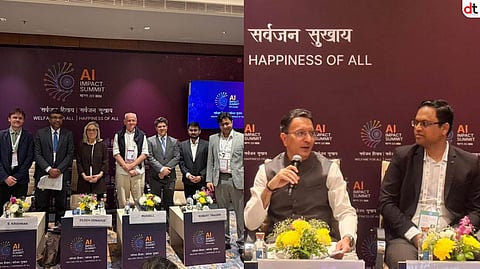

The inaugural day of the India AI Impact Summit 2026 witnessed a convergence of global policymakers, multilateral institutions, technology leaders, innovators, and industry representatives.
Bringing together influential voices from across the world, the Day 1 sessions reinforced India’s pivotal role in the global AI ecosystem. Discussions focused on creating a robust roadmap for India’s AI strategy, emphasizing the transition from theoretical frameworks to concrete institutional design and infrastructure planning.
Key themes from the first day included Responsible Governance & Sovereignty, AI-Led Economic Transformation, From Theory to Implementation, and Skilling and Ecosystem Building.
Speaking at the Summit, Shri Jitin Prasada, Hon’ble Union Minister of State for Electronics and Information Technology and Commerce & Industry, reinforced India’s leadership in AI development. He stated, “It’s AI not only for India, but for the whole world. India will be that service provider for the whole world. We have to contribute to the developing world as well as the Global South in development.
Further underscoring the need for sovereign and inclusive AI hardware systems, Shri S. Krishna, Secretary, MeitY, speaking in a session titled Hardware-Rooted Sovereignty: Verifiable Safe and Trusted AI Infrastructure for the Global South, stated, “What we have attempted to do here is encourage the private sector to invest heavily in establishing data centres and AI-based compute infrastructure. Instead of directly subsidising the establishment of AI compute, we have said that we will subsidise access.
We have underwritten the market and ensured that researchers, innovators, small and medium enterprises, and students all have access to AI compute at reasonable prices. Today in India, you can get access to AI compute at about a third of what you would pay elsewhere in the world.”
A defining highlight of the Summit’s opening day was the culmination of the India AI Impact Buildathon, a nationwide initiative designed to democratize AI. Spanning 48 pre-summit workshops across 21 cities, the campaign engaged over 10,000 students before expanding into a pan-India hackathon that mobilized 40,000 learners and professionals from 100 cities.
To democratize access to technology, participants, including those from non-technical backgrounds, completed four foundational AI courses to ensure baseline readiness. From this talent pool, 850 finalists formed 200 teams to compete in the final rounds. On Day 1, the top six teams (three student teams and three professional teams) presented live AI-driven solutions to combat financial and digital fraud. Their innovations were evaluated by a distinguished jury representing industry, government, and academia.
Shri Abhishek Singh, Additional Secretary, MeitY; CEO, IndiaAI Mission; and DG, NIC, said, “The real power and the real strength of India is in all of you who are here to build something impactful, something that can create a difference and touch lives at scale.” He further added, “The world already recognizes India’s strength in technology, from IT services to our Digital Public Infrastructure. Platforms like Aadhaar and UPI have transformed governance and payments. In fact, for this Summit, we received RBI approval to enable UPI access for foreign delegates, allowing them to experience seamless digital payments through the One World Wallet.”
The session reinforced how structured public-private collaboration can unlock scalable AI solutions to national challenges while strengthening India’s global AI positioning.
During the session on Trustworthy AI: Balancing Innovation and Regulation, experts examined how regulatory frameworks and technological progress can co-evolve. Discussions centred on transparency, explainability, governance mechanisms, accountability structures, and the importance of human oversight
In the session titled Operationalising Open Source AI: Pathways to Sovereignty, experts and policymakers explored the evolving definition of sovereignty in the AI era. The dialogue established that digital sovereignty extends beyond model ownership to encompass autonomy across the entire AI stack, including compute infrastructure, governance frameworks, and auditability mechanisms.
Addressing the global concentration of digital power, the panel underscored the need for resilience across critical ecosystem layers, from semiconductor hardware to interoperable governance standards. The consensus reinforced that, for nations to secure their digital future, sovereignty must be operationalised through robust infrastructure strategies, regulatory clarity, and the nurturing of indigenous development ecosystems.
A high-level panel on Workforce Transformation and Economic Mobility examined the structural shifts necessitated by the AI revolution. The discussion focused on leveraging AI-driven changes to unlock economic mobility, particularly in emerging economies. Key areas of focus included the formalisation of labour markets, portability of skills, and gender inclusion in the future workforce.
In the session titled Operationalising Open Source AI: Pathways to Sovereignty, experts and policymakers explored the evolving definition of sovereignty in the AI era. The dialogue established that digital sovereignty extends beyond model ownership to encompass autonomy across the entire AI stack, including compute infrastructure, governance frameworks, and auditability mechanisms.
Addressing the global concentration of digital power, the panel underscored the need for resilience across critical ecosystem layers, from semiconductor hardware to interoperable governance standards. The consensus reinforced that, for nations to secure their digital future, sovereignty must be operationalised through robust infrastructure strategies, regulatory clarity, and the nurturing of indigenous development ecosystems.
A high-level panel on Workforce Transformation and Economic Mobility examined the structural shifts necessitated by the AI revolution. The discussion focused on leveraging AI-driven changes to unlock economic mobility, particularly in emerging economies. Key areas of focus included the formalisation of labour markets, portability of skills, and gender inclusion in the future workforce.
𝐒𝐭𝐚𝐲 𝐢𝐧𝐟𝐨𝐫𝐦𝐞𝐝 𝐰𝐢𝐭𝐡 𝐨𝐮𝐫 𝐥𝐚𝐭𝐞𝐬𝐭 𝐮𝐩𝐝𝐚𝐭𝐞𝐬 𝐛𝐲 𝐣𝐨𝐢𝐧𝐢𝐧𝐠 𝐭𝐡𝐞 WhatsApp Channel now! 👈📲
𝑭𝒐𝒍𝒍𝒐𝒘 𝑶𝒖𝒓 𝑺𝒐𝒄𝒊𝒂𝒍 𝑴𝒆𝒅𝒊𝒂 𝑷𝒂𝒈𝒆𝐬 👉 Facebook, LinkedIn, Twitter, Instagram

