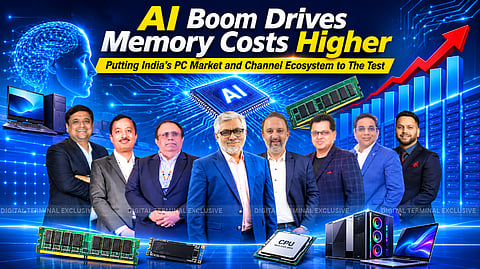

Artificial intelligence is transforming the technology industry, but the rapid expansion of AI infrastructure is also driving up memory and storage costs, creating fresh challenges for the conventional PC market. As data centres consume more high-bandwidth memory, server-grade DRAM and enterprise storage, component availability and pricing are coming under pressure. The impact is particularly significant for India, where dependence on imported hardware and components exposes the market to global supply shifts, currency fluctuations and rising costs.
Higher prices are influencing PC configurations, upgrade decisions and customer spending, putting manufacturers, distributors and channel partners under pressure to balance performance with affordability. While demand for gaming, professional computing and AI-enabled devices continues to offer growth opportunities, the industry faces difficult choices around pricing, inventory and demand generation. DT spoke to industry leaders to understand what rising memory costs mean for India’s PC market, how the channel ecosystem is responding, and what strategies could help sustain growth amid continuing uncertainty.
Rising Memory Costs Put Pressure on the PC Market

Rising memory costs are creating pressure across the IT hardware ecosystem, influencing everything from manufacturing economics to consumer purchasing decisions. Although the Indian PC market continues to benefit from device refresh cycles and growing demand for higher-performance systems, higher prices could affect volumes and the frequency of repeat purchases.
Sanjeev Mehtani, Chief Sales Officer, Acer India, believes the market remains resilient but acknowledges that rising component costs are changing purchasing behaviour. He says, “Rising memory costs are creating pressure across the IT hardware ecosystem, given the significant role memory plays in the overall cost structure of PCs and other devices. The impact is being felt across the value chain, particularly among manufacturers and channel partners, while also influencing pricing and value considerations for consumers.”
He adds that the market continues to have underlying demand drivers despite the cost pressures. “That said, we believe the Indian PC market remains resilient, supported by ongoing device refresh cycles, increasing digitisation and growing demand for higher-performance and AI-enabled devices. At Acer, we are closely monitoring cost movements and working with our supply chain and channel partners to navigate these dynamics while maintaining product availability and delivering the right value proposition across segments.”
Explaining the likely effect on market demand, Sanjeev Mehtani adds, “The increased cost might influence the consumer buying more sensibly as per the requirement rather than buying Configuration because it is good to have. Back to back business is impacted to due to budget constraints. Overall market may remain flat or slightly sluggish but due to ASP increase the revenue will not get impacted.”
The pressure is also visible in memory modules, SSDs and other computing components. Ravi Dhyani, Country Manager, ADATA India, says, “Rising memory costs are putting pressure on the Indian IT market, particularly in price-sensitive segments. Higher RAM and NAND flash prices are affecting SSDs, memory modules, and computing devices, making affordability a key concern for consumers and channel partners.”
Vikash Hisariya, Managing Director, Vishal Peripherals, also attributes the increase to global supply-demand dynamics and changing semiconductor capacity allocation. He says, “The rise is being driven by global supply-demand dynamics, semiconductor capacity allocation and growing demand from data centres, AI infrastructure and other high-performance computing applications. Memory is particularly impacted, with shifting capacity towards these segments putting pressure on availability and pricing.”
He explains the direct effect on Indian buyers, “For India, global price movements directly affect landed costs and PC builds and upgrades. Customers are therefore becoming more value-conscious and evaluating performance against price more carefully.”
For manufacturers and channel partners, the challenge is to manage these cost increases without weakening demand. While some customers may postpone purchases, others are likely to look for configurations that meet their immediate requirements at a more manageable price.
AI Infrastructure Changes the Economics of Memory
The growing demand for AI computing is emerging as a central factor behind the current component-price pressure. Semiconductor manufacturers are increasingly directing capacity towards high-bandwidth memory, server-grade DRAM and enterprise storage, leaving conventional computing applications to navigate tighter availability and higher costs.
Rajesh Khurana, Country Head – Consumer BU, South Asia, BIWIN Technology, links the changing memory market directly to the expansion of AI infrastructure. He explains, “AI is changing the tech industry landscape. Memory, digital fast storage like DDR5 / gen 4 / gen 5 SSDs are critically required to enable the AI infrastructure ecosystem. Incidentally, the industry was not prepared for high demands for memory emerging out of the evolving AI models. As such, this trend may continue for the coming future.”
Highlighting the supply-side challenges emerging from this demand surge, Rajesh Khurana further added, “Most of the manufacturers for flash and Drams are overbooked for coming months. Hence, channel partners need to work with their respective vendors to plan for inventories at least for six months in advance. Volatility in prices may continue as a result.”
Neeraj Garg, Managing Director, VNS International, also identifies AI and data-centre expansion as the central force behind the pressure on memory supplies. He says, “Memory is really at the heart of it. AI and data-centre buildouts are soaking up a huge share of DRAM and high-performance memory capacity, and manufacturers naturally want to put their capacity where the margins are better. That leaves less to go around for the PC segment, and prices have moved up as a result.”
Neeraj Garg points to other factors affecting the final cost of hardware in India. “On top of that, there are the usual pressures: semiconductor supply swings, higher manufacturing costs, rising logistics expenses and currency movements. India feels this a little more sharply because so much of what we sell is imported, so every exchange-rate move shows up in the final price.”
Himanshu Jain, Director, Acro Engineering Company, believes the increase in component costs reflects a combination of global supply challenges and expanding demand from AI data centres. He says, “The journey of building a new PC is facing a global headwind. Over the last year, the cost of core IT components, particularly memory and storage, has spiked sharply. This price pressure isn’t random; it’s fueled by a complicated mix of worldwide supply challenges and the immense, rapidly growing demand from artificial intelligence (AI) data centers.”
Explaining how these global cost pressures affect the Indian market, Himanshu Jain says, “Since these components are the true backbone of modern computing, global price hikes ripple out across the entire industry. For India, these worldwide economic pressures—coupled with fluctuating currencies and high import dependencies make the struggle even more visible at the consumer level.”
PC Configurations Become More Deliberate
As hardware prices rise, consumers are becoming more selective about specifications. The shift is prompting manufacturers and retailers to place greater emphasis on configuration flexibility, ensuring customers can choose systems that match their actual workloads and budgets.
Sanjeev Mehtani of Acer India links these shifts to rising component costs and changing customer priorities, saying, “Rising component costs are making configuration and portfolio decisions increasingly important across the PC industry. Customers are becoming more deliberate about the specifications they need, with performance, memory, storage and overall value being evaluated more closely across price segments. At the same time, requirements vary significantly across consumer, gaming, professional and business users.”
He further highlights how these changing preferences are reflected in memory configurations across PC segments, saying, “The entry level (R3/i3) more on 8 GB the 16 GB requirement is not seen as much. Mid-range processors (i5/R5) the demand was more on 16 Gb but now we see some moment of 8 GB for price sensitive customers. However, on the Premium side the demand for 32 GB has gone down. Gaming looks to be unchanged. At Acer, we are focused on maintaining a broad portfolio across price points and configurations, giving customers the flexibility to choose devices based on their specific needs and use cases.”
Sanjeev Mehtani says Acer is responding by offering choices across different customer requirements. “At Acer, we are focused on maintaining a broad portfolio across price points and configurations, giving customers the flexibility to choose devices based on their specific needs and use cases. While value remains an important consideration, we continue to see strong interest in performance-led products, gaming PCs and AI-enabled devices. Our focus is on optimising configurations and supply while working closely with our channel partners to ensure the right products are available across markets.”
Ravi Dhyani of ADATA India also sees customers becoming more conscious of value for money. He says, “Customers are becoming more conscious of pricing and value for money. While budget-conscious buyers may opt for lower capacities, gamers and professionals continue to prioritize performance. This increases the demand for products that balance capacity, speed, reliability, and affordability.”
Higher hardware costs could also prompt some price-sensitive customers to consider refurbished or pre-owned computers. Sanjeev Mehtani says, “Higher hardware costs could lead to greater consideration of refurbished and pre-owned devices among price-sensitive customers, particularly where affordability and lifecycle value are key priorities. As consumers and businesses become more conscious of total ownership costs, this segment could see increased interest, especially for use cases where the latest specifications are not essential.”
He adds that Acer will continue to focus on its established portfolio while monitoring how the market develops. “At Acer, our focus remains on strengthening our core portfolio across price segments and delivering the right balance of performance, reliability and value. We will continue to monitor how customer preferences and the broader PC ecosystem evolve, while assessing opportunities that can complement our portfolio and work effectively with our channel partners.”
Neeraj Garg believes this change could encourage healthier purchasing decisions. He says, “One positive shift I'm seeing is in how customers buy. They're no longer chasing the cheapest configuration on paper. They're asking about performance, reliability, warranty and how long the machine will actually serve them. That's a healthier conversation for the industry.”
Storage Market Looks Beyond Traditional Computing
Despite current cost pressures, the long-term outlook for India's memory and storage market remains linked to expanding digital adoption and the growing needs of performance-intensive applications.
Ravi Dhyani of ADATA India identifies gaming, content creation, digital adoption and increasing data-storage requirements as important drivers of growth. He says, “India’s storage market will continue to grow through gaming, content creation, digital adoption, and increasing data storage needs. At ADATA and XPG, we are strengthening our product portfolio across mainstream and high-performance segments while working with channel partners to improve product availability, visibility, and consumer awareness.”
The expansion of AI is also creating specialised requirements for memory and storage. Rajesh Khurana says, “Customers who are focused towards AI centric, high end fast and reliable computing applications require high end memory (DRAM) with capacities of 192Gb with CL 28. The ROI outputs far exceed the high costs as compared to standard products. Hence, we are witnessing new segments evolving, ranging from upgradation of existing PC to building of AI enabled applications.”
Rajesh Khurana says this expansion is reaching beyond traditional computing. “As AI continues to reshape computing, the demand for memory and storage is expanding across enterprise, automotive, industrial, PC and edge applications, and increasingly compact intelligent devices. System performance, efficiency and scalability are critical.”
Looking further ahead, Rajesh Khurana says, “Biwin will continue investing in memory, storage and advance packaging technologies while strengthening our capabilities across the full technology and manufacturing chain worldwide. Specifically in India, we would be exploring more local partners in these new evolving verticals.”
Channel Partners Demand Greater Pricing Visibility
For distributors, system integrators and resellers, rising component prices create challenges beyond the initial increase in procurement costs. Stock purchased at one price may become more expensive to replace, while customer quotations can become difficult to honour if prices change before an order is completed.
Vishal Hegde, Director – Sales, Ingram Micro India, attributes the increase to the changing structure of global semiconductor demand. He explains, “This hike in the personal computer and IT-component prices stems from a change in structure in global semiconductor demand, primarily the rapidly expanding AI infrastructure and data centres. As requests for HBM, server-grade DRAM and enterprise SSDs increase, semiconductor manufacturers have been focusing their production capacity on higher-margin AI and data centre applications over conventional DRAM and NAND flash memory to be used in PCs, laptops and other consumer devices.”
Highlighting the wider impact on the IT ecosystem, Vishal Hegde says, “The supply side and the manufacturers changing semiconductor priorities, alongside rising procurement costs, all have contributed to the overall increase in component prices. Such pressures have been felt across value chains fundamentally affecting product configurations, inventory planning and pricing decisions of PC manufacturers, distributors and channel partners.”
Rajveer Shah, Global Chief Strategy Officer, MITSUMI Distribution, attributes the price pressure to tightening memory supplies and rising procurement costs, explaining, “The pressure starts with memory. DRAM and NAND supply has tightened as manufacturers redirect capacity and investment toward high-bandwidth memory and server-grade products serving AI infrastructure, leaving less for mainstream PCs, smartphones and consumer devices. Because memory sits inside virtually every device, the increase passes into end pricing quickly. Currency movements compound the effect in India, where components are largely imported and priced in dollars. Logistics costs and longer lead times add further strain, and contract price resets mean the impact reaches the channel in stages rather than all at once. The cost base reset by these shifts is unlikely to reverse quickly.”
Rajveer Shah says the impact is already changing purchasing behaviour. “Buying behaviour is already adjusting. Many customers are delaying refresh cycles, extending the life of existing devices, while others are moving toward lower-spec configurations to hold budgets steady. For distributors and resellers, planning is now as critical as demand, because pricing moves faster than purchase cycles, particularly in deals quoted weeks in advance.”
Turning to the support needed by channel partners, Rajveer Shah adds, “If elevated memory prices persist, the channel will need support that goes beyond revised price lists. Partners need pricing stability, including price protection on stock already in the channel and early visibility into upcoming changes, so they can quote with confidence.
Brands and Retailers Look for Ways to Sustain Demand
With higher prices affecting both purchasing decisions and working capital, industry leaders are calling for stronger coordination between brands and the channel. Predictable pricing, supply commitments, flexible financing and product choices across price points could help partners serve customers without taking on unsustainable risks.
Himanshu Jain believes brands need to focus on stability and variety rather than simply passing on higher costs. “Brands have an opportunity to lead by partnering with their distribution channel. Stability is the key currency today. Partners need predictable pricing, clear visibility on upcoming revisions, and flexible support for their working capital.”
He adds, “The solution is about variety, not just cost-cutting. By creating a deeper range of products—offering meaningful alternatives across multiple price points—brands can empower retailers to meet diverse customer budgets. Coupled with joint marketing programmes and channel incentives, this collaborative effort can keep demand strong.”
Vishal Hegde also emphasises closer coordination. He says, “Better pricing visibility, reliable supply allocation, and advance notice of product availability will enable partners to plan purchases and manage stocks more efficiently. We might also anticipate that PC manufacturers will be looking into different initiatives addressed to channel players, including pricing schemes, credit facilities, and promotional campaigns.”
He says sustained cooperation across the ecosystem will be important to long-term business performance. “If rising memory prices continue for the foreseeable future, it will be necessary for PC makers, distributors and channel partners to work more closely together to ensure continued business success.”
Vishal Hegde adds, “At Ingram Micro we believe that a collaborative ecosystem approach, combined with effective supply chain management, demand forecasting and a wide assortment of products, will become a winning strategy. In our opinion, this approach will help channel partners cope with cost pressure, maintain customer trust and find new sources of sustainable growth.”
Vikash Hisariya highlights the role of channel support and retail initiatives in managing rising component costs, saying, “Brands can support the channel through competitive pricing, better inventory visibility, timely replenishment, channel schemes, bundles and consumer-focused promotions. Predictable pricing and supply will be particularly important for managing high-value inventory.”
Vikash Hisariya also outlines the initiatives his company uses to help customers find products and manage purchases. “At Vishal Peripherals, we focus on genuine products at the best prices, supported by our PC Build Finder and Build Your Sim feature. We also maintain strong inventory across categories, helping customers find the products they need without facing availability issues.”
He further explains how Vishal Peripherals is supporting customers through its retail initiatives, adding, “At Vishal Peripherals, we complement this with our best-price proposition, VP Coins and app benefits. Customers earn 1 VP Coin for every ₹200 spent, while eligible new customers receive ₹200 off their first app order above ₹999. We also offer 3 months No Cost EMI on eligible products.”
“With elevated memory costs, a combination of strong brand support, adequate inventory and customer-focused retail initiatives will be important to sustain demand and keep the PC market growing,” he concludes.
Rajveer Shah further emphasises the need for stronger channel support, saying, “Supply assurance matters too, through allocation commitments and predictable lead times, especially for project-based business. Higher unit values stretch partner balance sheets, so extended credit terms and working capital support will be important. Incentive and margin structures should reflect larger ticket sizes, so partners are not left to absorb cost increases alone.”
He also argues that brands must help partners maintain demand as customers delay upgrades or choose lower specifications. “With customers delaying refreshes and trading down on specifications, brands should also help partners keep demand moving through configuration guidance, refresh programmes and financing options that make upgrades viable. Resilient growth will come from vendors, distributors and resellers planning together, with transparency at every stage. That will decide who stays competitive.”
Neeraj Garg emphasises the importance of predictable pricing and stronger channel support, saying, “Stability and clear communication matter most. If prices stay high, partners need price protection, good visibility on inventory, and advance notice of price changes. Without that, it's very hard to plan purchases or commit to customers with confidence.”
He also points to the need for financial and commercial support, adding, “Beyond that, things like channel incentives, special project pricing, flexible financing and marketing support would go a long way in helping partners stay competitive without giving up their margins.”
“The other piece is configuration flexibility,” Neeraj Garg adds. “The answer shouldn't be to simply push up specs and prices. Brands and partners should sit with the customer and find the right balance between performance and cost. If OEMs and the channel work closely on this, I'm confident we can get through this phase and keep growing.”
Collaboration Will Shape the Market’s Next Phase
The rise in memory costs is testing the Indian PC market at several levels, from component availability and product pricing to inventory planning and consumer affordability. While AI infrastructure is creating new opportunities for memory and storage providers, it is also changing the economics of conventional computing.
For manufacturers, distributors and retailers, the immediate priority is to align supply, configurations and pricing with changing customer needs. Maintaining a range of products across price points, communicating price changes clearly and supporting channel partners with predictable supply and workable financing will be important to sustaining demand.
As Himanshu Jain puts it, “Ultimately, the path forward for the Indian PC market demands transparency, reliability, and teamwork. By focusing on stable supply and healthy margins for everyone involved, the industry can successfully navigate these high-cost years and ensure continued growth.”
The market’s next phase will depend on how effectively the industry manages the tension between rising component costs and the need to keep computing accessible. Collaboration across the technology ecosystem could help ensure that AI-driven change creates new business opportunities without putting conventional PC demand under undue pressure.
𝐒𝐭𝐚𝐲 𝐢𝐧𝐟𝐨𝐫𝐦𝐞𝐝 𝐰𝐢𝐭𝐡 𝐨𝐮𝐫 𝐥𝐚𝐭𝐞𝐬𝐭 𝐮𝐩𝐝𝐚𝐭𝐞𝐬 𝐛𝐲 𝐣𝐨𝐢𝐧𝐢𝐧𝐠 𝐭𝐡𝐞 WhatsApp Channel now! 👈📲
𝑭𝒐𝒍𝒍𝒐𝒘 𝑶𝒖𝒓 𝑺𝒐𝒄𝒊𝒂𝒍 𝑴𝒆𝒅𝒊𝒂 𝑷𝒂𝒈𝒆𝐬 👉 Facebook, LinkedIn, Twitter, Instagram