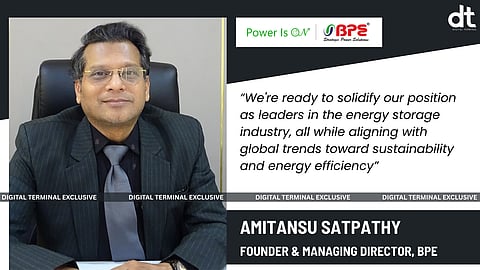

As India accelerates its trajectory as a global tech and manufacturing powerhouse, companies like BPE are scaling operations to align with the country’s Make in India and Atmanirbhar Bharat vision. In an exclusive conversation with DT, Amitansu Satpathy, Founder & Managing Director of BPE, shares insights on the company’s manufacturing capabilities, India’s growing attractiveness for global tech manufacturing
Scaling Manufacturing for the Future
With over 25 years of experience in power solutions, BPE has established itself as a leading global manufacturer. Amitansu Satpathy explains, “Having worked in power solutions for over 25 years, we have become one of the premiere manufacturers of power supply products around the globe. We continue to improve our operation and product offerings to meet the current and upcoming needs of the market.
"Our advanced facilities in India which have capacity, specialize in manufacturing a flurry of different products, including static and modular Uninterruptible Power Supply (UPS) systems, rack solutions, static switches, distribution power units (PDUs) and rackmount solutions - all with the capacity to support megawatts of power for mission-critical applications. We are not limited to UPS systems, and with the added product line the advanced power quality solutions, PDUs, which are designed to support the seamless running of existing data centers all around the world.”
He added, “In light of the increasing demand for sustainable energy solutions, we're excited to broaden our focus to include Battery Energy Storage Systems (BESS). By the end of 2025, our goal is to significantly boost our manufacturing capabilities to create and deliver innovative BESS products that meet the needs of power producers, businesses, and everyday customers.
"This expansion will involve investing in cutting-edge production technologies, training our workforce, and ramping up research and development to keep our solutions at the leading edge of innovation. With our extensive expertise, strong infrastructure, and keen market insights, we're ready to solidify our position as leaders in the energy storage industry, all while aligning with global trends toward sustainability and energy efficiency.”
India’s Growing Appeal for Global Tech Manufacturing
On India’s rising significance, Amitansu noted, “India is really stepping up as a global player in tech manufacturing, thanks to a mix of strong government initiatives, a huge domestic market, and its smart geopolitical location. The ‘Make in India’ campaign, along with the Production Linked Incentive (PLI) scheme, has played a key role in cutting down on import reliance and boosting self-sufficiency in vital areas like electronics, semiconductors, and mobile production. These policies not only offer financial perks but also help create a welcoming environment for both local and international manufacturers.”
He added, “The PLI and design-linked incentives have especially benefited the semiconductor and mobile manufacturing sectors that need extensive capital and advanced technology. Therefore, we have seen multibillion-dollar investments in India’s manufacturing landscape with companies such as Micron Technology, Foxconn, and Renesas.
"These investments not only result in capital investment taken by the companies, but in job creation, technology transfer, and local capacity development, allowing India to be an important part of the supply chain at a global level. Furthermore, with India’s improved trade measures, an educated workforce, and a growing digital economy, India is a more attractive option for advanced tech manufacturing with unlimited potential growth and innovation.”
Government Support as a Catalyst
Amitansu emphasized, “The Indian government and its policymakers have been instrumental in making India a competitive location for tech hardware manufacturing. The Production Linked Incentive (PLI) scheme is a key development, providing financial incentives to companies based on additional production and value creation. The PLI scheme has increased investor confidence and encouraged many of the global leaders in electronics, semiconductors, servers and medical technology to set up operations in India.”
He added, “The government’s other initiatives, including Make in India, Digital India, supporting Electronics Manufacturing Clusters (EMCs), and improvements in infrastructure, regulations, and ease of doing business have supplemented the ecosystem. The emphasis of the government on research and development (R&D), skill development, and supply chain localisation provides long-term sustainability and competitiveness.
"By promoting collaboration between academia and industry, policymakers are also developing a capable workforce that can address the needs of next-generation manufacturing. Collectively, these complementary features create a framework for manufacturers to succeed in India’s changing marketplace.”
Key Challenges for Manufacturers
Acknowledging industry hurdles, Amitansu noted, “Indian manufacturers are confronted with a complicated variety of issues that differ by industry but in aggregate affect efficiency of operations and competitiveness. In the auto industry, for example, supply chain outages—specifically for the rare earth elements used in electric vehicle (EV) and high-performance component manufacture—are major challenges. Large industries like mega steel plants also struggle to obtain reliable, high-quality power, impacting productivity and elevating operational expenses.”
He highlighted workforce and financial challenges, “Another key challenge is the paucity of trained and skilled manpower, especially in Tier 2 and Tier 3 cities, where lower costs and availability of land make expansion in manufacturing feasible. The unpreparedness of the workforce in these areas constrains the capacity to entirely leverage cost-advantaged locations. Also, high cost of financing is a recurring inhibitor, with affordable credit access being key for manufacturers to compete in the global market, particularly in relation to nations with better financing environments.”
“Geopolitical uncertainties complicate the scenario even more and the effects on export-oriented manufacturers can be complicated as they navigate supply chain implications and altering trends in international trade. Solving these issues is going to take a collective effort from industry and policymakers, as well as academia, to raise the level of infrastructure, skills, & access to finance work,” he stated.
Opportunities for OEMs and ODMs
Looking ahead, Amitansu sees transformative potential, “The next 3-5 years create a transformational opportunity for Original Equipment Manufacturers (OEMs) and Original Design Manufacturers (ODMs) in India driven by the velocity of change in important sectors. The explosion of data centers as a result of the digital economy, cloud computing and e-commerce creates unprecedented demand for reliable power infrastructure including UPS systems, PDUs and energy storage. At the same time, the global program to achieve self-reliance in semiconductors provides opportunities for both domestic manufacturing and export, aided by India's trade policies and Free Trade Agreements (FTAs).”
“The health care industry is also gearing up for substantial growth, with government schemes and increasing public investment creating new demand for modern medical devices and supporting infrastructure. Furthermore, India's manufacturing industry is gaining traction in many global markets supported by FTAs and as a quality and innovative footprint.
"These developments present enormous opportunities for OEMs/ODMs to develop and produce power quality products and energy solutions of paramount importance to these sectors. Our organization is well-positioned to take advantage of these trends, providing innovative, high-quality solutions to enable India to become a global manufacturing hub,” he concluded.
𝐒𝐭𝐚𝐲 𝐢𝐧𝐟𝐨𝐫𝐦𝐞𝐝 𝐰𝐢𝐭𝐡 𝐨𝐮𝐫 𝐥𝐚𝐭𝐞𝐬𝐭 𝐮𝐩𝐝𝐚𝐭𝐞𝐬 𝐛𝐲 𝐣𝐨𝐢𝐧𝐢𝐧𝐠 𝐭𝐡𝐞 WhatsApp Channel now! 👈📲
𝑭𝒐𝒍𝒍𝒐𝒘 𝑶𝒖𝒓 𝑺𝒐𝒄𝒊𝒂𝒍 𝑴𝒆𝒅𝒊𝒂 𝑷𝒂𝒈𝒆𝐬 👉 Facebook, LinkedIn, Twitter, Instagram
