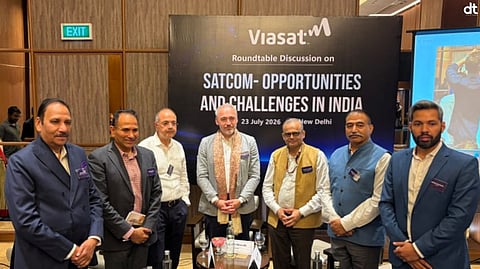

Viasat convened senior policymakers, regulators and industry leaders for a high-level roundtable discussion on "SATCOM: Opportunities and Challenges in India," highlighting the importance of continued public-private collaboration in unlocking the full potential of India's satellite communications ecosystem and supporting the country's digital and space ambitions.
The roundtable brought together Prabhat Dikshit, Deputy Director General (Satellite), DoT; Dr. Vinod Kumar, Director, Directorate of Promotion, IN-SPACe (virtual); Ashwin Mahavadi, Senior Vice President, Skyroot; AK Bhatt (retd.), Director General, Indian Space Association (ISpA); Anil Prakash, Director General, SIA-India; along with Michael Howells, Global Head of Strategic Relationships & Market Development, Viasat and Gautam Sharma, Managing Director, Viasat India. The discussion was moderated by renowned journalist Pankaj Doval.
The discussion focused on India's evolving policy and regulatory landscape for satellite communications, emerging opportunities, as well as the need to address challenges relating to spectrum management, infrastructure, affordability, investment and market adoption. Participants also discussed the importance of strengthening collaboration between government and industry to build a resilient, globally competitive and investment-friendly SATCOM ecosystem.
Michael Howells, Global Head of Strategic Relationships & Market Development, Viasat, highlighted India's emergence as one of the world's most promising satellite communications markets and emphasized the role of public-private partnerships in supporting the sector's long-term growth. "I'd rather have a supply-side problem than a demand-side problem. You've got really high demand for skills because the sector is doing so well and growing so well. That's a good problem to have. I'm sure the education system and the private sector will solve it. Smart people will want to work in this sector, and people from around the world will want to come and work here.
It is very clear that there is incredible growth potential here, and India is doing an amazing job of tapping into that by leveraging its tremendous human capital strengths. That has been the result of strong public-private partnership, a supportive regulatory environment and sustained investment into the sector by ISRO and others. It is an exciting story, and in many ways, India will be the envy of other countries that have achieved such success” he said.
“You can see not just our company, but many companies like ours wanting to come here because we see the opportunity to partner and grow together. I have a great sense of optimism and excitement about what we can achieve together. It is a golden age for the sector, and we should seize this opportunity." Howells further added.
Speaking on the evolving regulatory landscape, Howells noted that the challenges associated with emerging satellite technologies can be addressed through thoughtful regulation and close collaboration between government and industry. "Most of these risks and challenges are engineering problems that can be solved. With the right regulation, the right guidelines and the right guardrails from governments, companies can address them. The trade-off between risk and opportunity is one that every regulator faces, and the best outcomes come when governments and industry work together.
Regulatory sandbox approaches, where innovation can be tested in a time-bound and risk-managed environment under close regulatory oversight, offer one way to explore new technologies while protecting consumers, national security and the wider economy. Satellite communications have the opportunity to extend the benefits of the digital economy to geographies and communities that have previously remained beyond its reach,” Howells said.
Gautam Sharma, Managing Director, Viasat India, reflected on the significant progress made by India's space and satellite communications sector over the past few years and stressed the importance of sustaining the momentum through collaborative action. "After IN-SPACe was formed in 2022, followed by the SATCOM policy initiatives and the Telecom Act, I think the results are visible. The successful launch of Vikram-1 is a time of celebration for the industry. A lot has been achieved in the last five years, but I believe the next five years will decide the destiny of the space sector in India. It is crucial to discuss how we can find solutions to the existing challenges that are hindering the growth of the space sector," he said.
During the discussion, Sharma noted that policy reforms over the past few years have significantly improved the regulatory environment for the satellite communications industry. “While important progress has been made, continued collaboration between industry and government will be critical to addressing the remaining challenges and enabling next-generation satellite services in India” Sharma added.
The roundtable concluded with a shared recognition that India's satellite communications sector is entering a pivotal phase of growth. Participants agreed that sustained collaboration between government, industry and the broader space ecosystem will be essential to accelerate innovation, expand connectivity and unlock the full potential of satellite communications in support of India's digital transformation and space economy ambitions.
𝐒𝐭𝐚𝐲 𝐢𝐧𝐟𝐨𝐫𝐦𝐞𝐝 𝐰𝐢𝐭𝐡 𝐨𝐮𝐫 𝐥𝐚𝐭𝐞𝐬𝐭 𝐮𝐩𝐝𝐚𝐭𝐞𝐬 𝐛𝐲 𝐣𝐨𝐢𝐧𝐢𝐧𝐠 𝐭𝐡𝐞 WhatsApp Channel now! 👈📲
𝑭𝒐𝒍𝒍𝒐𝒘 𝑶𝒖𝒓 𝑺𝒐𝒄𝒊𝒂𝒍 𝑴𝒆𝒅𝒊𝒂 𝑷𝒂𝒈𝒆𝐬 👉 Facebook, LinkedIn, Twitter, Instagram
