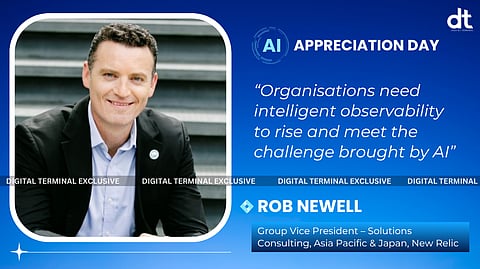

As artificial intelligence continues to redefine the enterprise landscape, leaders are grappling with a pivotal challenge—how to innovate responsibly while managing rising complexity and cost. On the occasion of AI Appreciation Day 2025, Rob Newell, Group Vice President – Solutions Consulting, Asia Pacific & Japan at New Relic, shares a sharp, forward-looking perspective on the region’s growing AI momentum and the critical role of intelligent observability in shaping a sustainable AI-driven future.
"On AI Appreciation Day, it is important to celebrate the significant progress made in recent years but also recognise that the AI race is far from over. APAC’s emerging leadership in AI adoption and investment means that AI is weaving its way into our everyday lives and systems. Organisations are using large language models (LLMs) and generative AI (genAI) to optimise operations, and AI agents promise to reshape our most common digital experiences. The value that organisations receive by augmenting human capabilities with AI are clear: there’s significant cost and productivity efficiencies that help businesses unlock new frontiers of innovation.
For organisations to integrate these AI tools and realise their potential, they will have to fundamentally rethink their technology architectures. Regardless of the size, all companies are facing the same harsh reality: AI tools are expensive to use, and the costs of building new AI-backed technologies are unpredictable. Organisations that win in our inevitable AI-enabled future won’t necessarily be the ones with the best ideas; instead, the winners will be those that have figured out how to effectively balance cost, value, and performance.
Despite the rapid evolution of generative AI technology, the fundamental questions underpinning the cost of AI are simple: How often do companies query an LLM and how much do those queries cost? By controlling these queries effectively and getting the most out of every call by adopting AI-supportive techniques such as retrieval augmented generation (RAG) and agent frameworks, companies can more reliably predict and lower their AI expenses.
Historically, observability has offered organisations the ability to detect and respond to anomalies in their systems and optimise performance. But with AI driving a revolution in processes and architectures, observability needs to evolve to keep pace and continue providing users with a window into their own systems and processes. New Relic research found that 39% of IT leaders in India regarded AI as a key driver for observability adoption.
Organisations need intelligent observability to rise and meet the challenge brought by AI. This next phase of observability will be preventive, self-healing, and autonomous, so that it can surface the right insights to the right person at the right time. AI monitoring tools give companies end-to-end visibility into their AI-integrated workflows, but more importantly real-time insight to troubleshoot, compare, and optimise approaches to using LLMs to improve their features or offer brand new experiences. This allows companies to adjust when necessary to manage costs, improve performance, and reduce common issues that can cause costly hiccups.
In the long term, AI will truly become ubiquitous when we can reliably achieve the right balance between cost, performance, quality, value, and reliability. Companies developing AI features need to identify the right use cases to get the most out of those LLMs while still delivering value and innovation to their customers.
Observability helps companies maintain reliability, quality, and efficiency throughout all components of the AI technology stack, alongside services and infrastructure, so that they have the data they need to make decisions that limit expenses, maximise ROI, and accelerate business outcomes.
𝐒𝐭𝐚𝐲 𝐢𝐧𝐟𝐨𝐫𝐦𝐞𝐝 𝐰𝐢𝐭𝐡 𝐨𝐮𝐫 𝐥𝐚𝐭𝐞𝐬𝐭 𝐮𝐩𝐝𝐚𝐭𝐞𝐬 𝐛𝐲 𝐣𝐨𝐢𝐧𝐢𝐧𝐠 𝐭𝐡𝐞 WhatsApp Channel now! 👈📲
𝑭𝒐𝒍𝒍𝒐𝒘 𝑶𝒖𝒓 𝑺𝒐𝒄𝒊𝒂𝒍 𝑴𝒆𝒅𝒊𝒂 𝑷𝒂𝒈𝒆𝐬 👉 Facebook, LinkedIn, Twitter, Instagram
