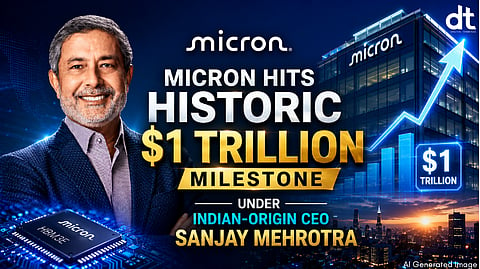

Micron Technology briefly crossed the historic $1 trillion market capitalization milestone on Tuesday, becoming one of the biggest beneficiaries of the global artificial intelligence infrastructure boom and reinforcing the growing strategic importance of memory chips in the AI era.
The milestone marks a dramatic transformation for Micron, long considered one of the semiconductor industry’s most cyclical companies. Over the past 12 months, the company’s stock has surged more than eightfold, fueled by explosive demand for AI-driven memory technologies, tightening supply conditions, and rising investments in hyperscale AI infrastructure.
Micron shares jumped more than 17% during trading and touched gains of nearly 19% after brokerage UBS sharply raised its price target on the stock to $1,625 from $535 — currently the highest target among major brokerages tracking the company.
AI Infrastructure Boom Drives Memory Chip Demand
The company’s rise reflects a broader shift taking place across the global semiconductor industry as investors increasingly recognize memory chips as a foundational component of AI infrastructure.
While NVIDIA continues to dominate the AI accelerator market with its GPUs, Micron’s memory technologies have become equally critical for storing, transferring, and processing the massive volumes of data required by AI systems, generative AI models, and hyperscale data centers.
Industry experts believe AI infrastructure growth is fundamentally changing the economics of the memory chip business.
AI workloads require significantly larger memory capacity, higher bandwidth, lower latency, and faster data movement compared to traditional computing environments. This has sharply increased demand for advanced memory technologies such as High-Bandwidth Memory (HBM), which has now become one of the most critical components powering AI servers and large language model infrastructure.
From Rejected US Visa to Leading a Trillion-Dollar Semiconductor Giant
Behind Micron’s extraordinary rise stands one of Silicon Valley’s most inspiring immigrant success stories.
Micron CEO Sanjay Mehrotra was born in Kanpur, India, and moved to the United States as a student after facing repeated visa rejections during the 1970s. According to media reports, Mehrotra was denied a US student visa multiple times before finally securing approval and pursuing higher education in America.
Coming from a modest middle-class Indian family, Mehrotra later co-founded SanDisk and eventually became one of the semiconductor industry’s most respected technology leaders before taking over as Micron CEO in 2017.
At the time of his appointment, Micron was valued at roughly $20 billion. Under his leadership, the company has transformed into one of the world’s most strategically important AI infrastructure companies amid the explosive rise of generative AI and hyperscale computing.
His journey from an Indian engineering student struggling to enter the United States to leading a trillion-dollar American semiconductor giant has become symbolic of the broader role Indian-origin executives now play in shaping the global technology industry.
HBM Demand Creates Industry-Wide Supply Crunch
Micron’s latest rally also reflects tightening supply conditions across the global semiconductor ecosystem.
According to media reports, the company recently confirmed that its entire 2026 supply of HBM chips has already been sold out, underlining the massive demand surge currently taking place within the AI infrastructure market. Micron has also begun production of its next-generation HBM4 products as technology companies aggressively scale AI data center deployments.
The rapid expansion of AI infrastructure spending by major technology firms has triggered shortages across memory categories and created pricing power for semiconductor manufacturers.
US Gains Strong Position in Global Memory Chip Race
Micron’s rise also strengthens the United States’ position within the highly competitive global memory semiconductor industry, which has traditionally been dominated by Asian manufacturers.
Samsung Electronics remains the world’s largest memory chipmaker and has already crossed the $1 trillion valuation milestone, while SK Hynix continues expanding aggressively within the HBM segment.
However, Micron’s rapid growth gives the US a significantly stronger foothold in the strategic memory chip market as AI-driven geopolitical competition intensifies globally.
The semiconductor industry is increasingly viewed as a critical pillar of national security, technological leadership, and economic competitiveness, particularly amid growing tensions between the United States and China over advanced chip technologies and AI dominance.
AI Investment Cycle Reshapes Semiconductor Valuations
Micron’s trillion-dollar valuation also highlights changing investor sentiment across the semiconductor sector. During the post-pandemic slowdown, memory manufacturers struggled with oversupply and weakening demand for PCs and smartphones due to inflationary pressures and reduced consumer spending. The AI revolution has dramatically reversed those conditions.
Technology companies are now committing to long-term AI infrastructure investments as they race toward advanced AI systems and future artificial general intelligence (AGI) capabilities. This shift is driving sustained demand for advanced memory, storage, and data center technologies.
Institutional investors have responded aggressively. Regulatory filings indicate that more than 2,400 institutions disclosed new positions in Micron during the first quarter, including major investment firms such as Rockefeller Capital Management and Schroders.
Despite its historic rally, Micron still trades at valuation multiples significantly lower than broader technology benchmarks, indicating investors may continue to see further upside potential as AI infrastructure spending accelerates globally.
Semiconductor Industry Enters New AI-Driven Era
Micron’s emergence as a trillion-dollar semiconductor company signals a major transformation underway within the global technology industry.
The AI era is no longer being driven solely by processors and computing power. Instead, the broader AI ecosystem now depends on an interconnected infrastructure stack that includes advanced memory, storage, networking, packaging, and high-performance computing architectures.
As enterprises, hyperscalers, governments, and AI developers continue investing billions into next-generation AI ecosystems, companies supplying critical infrastructure components are becoming central to the future of the global digital economy.
Micron’s rise reflects how memory technology has evolved from a background component into one of the defining pillars of the global AI revolution.
𝐒𝐭𝐚𝐲 𝐢𝐧𝐟𝐨𝐫𝐦𝐞𝐝 𝐰𝐢𝐭𝐡 𝐨𝐮𝐫 𝐥𝐚𝐭𝐞𝐬𝐭 𝐮𝐩𝐝𝐚𝐭𝐞𝐬 𝐛𝐲 𝐣𝐨𝐢𝐧𝐢𝐧𝐠 𝐭𝐡𝐞 WhatsApp Channel now! 👈📲
𝑭𝒐𝒍𝒍𝒐𝒘 𝑶𝒖𝒓 𝑺𝒐𝒄𝒊𝒂𝒍 𝑴𝒆𝒅𝒊𝒂 𝑷𝒂𝒈𝒆𝐬 👉 Facebook, LinkedIn, Twitter, Instagram
