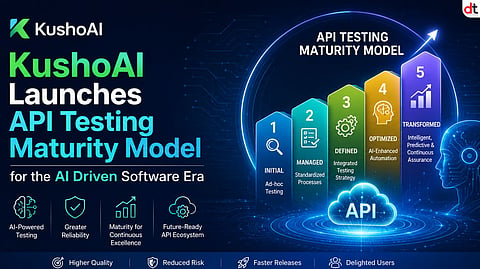

As AI transforms the way software is built, engineering teams are releasing code at unprecedented speed. But while software development has evolved rapidly, testing practices have largely remained unchanged, creating a growing gap between software velocity and software reliability.
Addressing this challenge, KushoAI today unveiled its API Testing Maturity Model. This comprehensive framework helps organizations assess their API testing journey and identify the capabilities needed to build resilient, AI-ready software systems.
According to KushoAI, organizations today are not struggling because they lack testing tools; they're struggling because they lack a structured roadmap for evolving their testing capabilities.
The model draws a distinction most testing programs miss: the difference between how testing is run and what it actually covers. Teams routinely build fast, automated pipelines on top of shallow coverage, passing every check while the cross-field and business-logic bugs that cause real outages go untested.
"The conversation around AI has largely focused on generating software faster. The next challenge is ensuring that software continues to work reliably as systems become more dynamic and interconnected," said Abhishek Saikia, Co-founder and CEO of KushoAI. "Testing can no longer be viewed as a final checkpoint before release. It has to become an intelligent, continuous process that evolves alongside the software itself."
The API Testing Maturity Model introduces a five-stage framework that enables engineering leaders to benchmark their current testing practices and progressively build toward intelligent, AI-assisted software reliability. The framework maps the evolution of API testing from foundational capabilities such as contract validation and functional automation to advanced practices including risk-based coverage, continuous validation, and self-healing test suites.
The framework also reflects the shift toward API-first architectures, AI-generated code, and the limits of static testing in fast-changing systems.
Over the past year, the company has introduced APIEval-20, the first open benchmark for evaluating AI agents on real-world API bug detection; published comparative research on how leading AI coding tools perform against complex API bugs; and launched the industry's first Test Readiness Score for OpenAPI specifications. Together, these initiatives aim to establish practical benchmarks for the next generation of software quality engineering.
The company's research suggests that as AI raises the ceiling on how fast software gets built, it simultaneously raises the cost of not knowing what that software actually does under pressure.
The API Testing Maturity Model is available as a free resource for engineering leaders, architects, platform teams, and developers looking to benchmark and modernize their API testing strategies.
𝐒𝐭𝐚𝐲 𝐢𝐧𝐟𝐨𝐫𝐦𝐞𝐝 𝐰𝐢𝐭𝐡 𝐨𝐮𝐫 𝐥𝐚𝐭𝐞𝐬𝐭 𝐮𝐩𝐝𝐚𝐭𝐞𝐬 𝐛𝐲 𝐣𝐨𝐢𝐧𝐢𝐧𝐠 𝐭𝐡𝐞 WhatsApp Channel now! 👈📲
𝑭𝒐𝒍𝒍𝒐𝒘 𝑶𝒖𝒓 𝑺𝒐𝒄𝒊𝒂𝒍 𝑴𝒆𝒅𝒊𝒂 𝑷𝒂𝒈𝒆𝐬 👉 Facebook, LinkedIn, Twitter, Instagram
